
18 September 2012
Hits, Misses and Meltdowns
“You must be so disappointed, what happened?”, what was the question asked by Giaan Rooney to Australia’s 4x100m men’s relay that flopped big time. If only this was the exact sort of question asked to the swimmers for almost 20 years, then maybe the predicament they were in now, and the disappointment and shock that the country felt, would not have occurred. As is typical of these modern times, this seemingly harsh critique of performances was suddenly the target of lame, non-sporting commentators and celebrities exclaiming that the athletes were brats and should be satisfied with silver, or fourth as was the case for the relay team. Shockingly one such “voice of reason” was Shane Gould on ABC’s Q&A program. Of course, she’s easy to talk, having won her 3 gold medals in Munich before suddenly quitting the sport because competition was suddenly of no interest to her.
This mentality to be content with second best and that the Olympics is not just about winning is the very reason the swimmers returned this horrific result. The word “result” is the key word. While the objective of sport should not be about statistical side of winning, it is about results, the most basic of which is meeting or improving your standard – ie: “doing your best”. These swimmers did not fail because they did their best and found an opponent better on the day. No, as they’ve done in many Olympics before, they failed to get even near their best. That is where the indictment lies, especially when the sport is heavily funded by the Australian tax-payer.
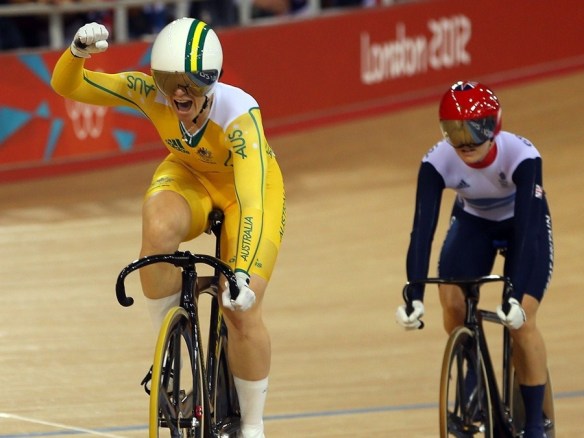
Anna Meares wins the women’s sprint at the London 2012 Olympics for Australia
Readers of Socceroo Realm reviews of previous Olympics will no doubt be aware of the harsh criticism placed on the swimmers. In truth, the team for London actually performed no worse than the team for Beijing. In London, they were favoured only for two gold, and won one. In Beijing, they were favoured for 12 gold, and won six. The failure rate is identical. It’s just that six is a nicer number and the hyperbolic chest-beating that this coerces clouds the shambolic performances far more readily than one gold medal can.
With Australia reeling on the medal table with just one gold for the first 10 days, the air of mediocrity began to descend on the team to accept their lot, and to reinforce to the public that even winning just any medal was not easier. The aforementioned Giaan Rooney would, nearing the end of the swimming meet, tweet that “times don’t win races, people do”. Rubbish! Who produce times? People! If the swimmers could simply produce their times, then would come the basic benchmark of success of “doing your best”.
Mitchell Watt, after flopping in the long jump, had the most galling and insulting argument saying to Australia “you need to wake up” and that only an infinitesimal amount of people in Australia have won an Olympic medal, insinuating that those without medals have no right to criticise or have no idea of the difficulty of winning one. Watt’s jump of 8.16 was 38cm off his personal best, with the competition won with just 8.24 – the shortest leap to win gold since Munich. Watt went on to say, “I can’t believe I am a silver medallist with 8.16. On the one hand I’ve lost count of the times I’ve jumped over 8.30 – it’s probably over a dozen competitions”. Bingo! He then continued to say, “an Olympic gold medal is bloody hard to get… If people can’t realise a silver medal is a great achievement then there is something wrong with them”. No, there’s something clearly wrong with Watt and others of his ilk. He’s exposed his own contradiction and folly without even realising it. For someone that can regularly jump 8.30, he could win a silver medal running backwards, with gold simply meeting his standard. Yes, an Olympic medal is hard for anyone off the street to win. It’s not for an athlete clearly ranked number one in his event and afforded all the funding and pampering to get there. All he really had to do was execute his day job to a close approximation of his everyday standard. He didn’t. He failed. Just as his comrades in the pool did.
Quotes from others…
James Magnussen: “I can hold my head high and I’m proud of my achievements this week”. After the debacle of the 4×100 relay, Magnussen went on to lose the 100free by 1/100th of second despite seemingly have a clear lead on the last stroke. He didn’t dive for the wall strongly enough. Also, he was over half a second off his PB. He’s joking if he can really be proud. In fact, he is joking. Upon returning to Australia, he occasionally slipped out among all the contrived gibberish and that there is a fire to atone at Rio 2016.
Cate Campbell said it was “a little bit hurtful” of the criticism: “Its not that we haven’t been performing, its just that the world has stepped up”. No, the Australians failed. When you can’t manage personal bests, questions must be asked.
Melanie Schlanger said the attitude of the Australian public would “be a lot better” if Magnussen and Seebohm won: “The difference between being slammed and being praised is quite harsh”. So it should be. The disappointment against those two is that they failed to produce their best. It’s not even about medals. Jessica Fox’s silver in the kayak slalom was the toast of the nation because she exceeded all expectations. Whereas when Magnussen hyped himself so much, only to under-perform, the criticism must be harsh, and the disappointment must be enduring.
Nick Green, chef de mission, said all Australian silver medallists were delighted with their results. “In no way has it been a negative for them or our team”.
Thankfully, not all athletes were in this mode of making excuses. In fact, the biggest story that provoked the mentality of accepting mediocre performances was Emily Seebohm. She was heart-broken and distraught at missing the gold. It was so good to see her cry, unlike the relay men making excuses in denial. Seebohm at least has some defence. While she was way slower than her heat and semi that saw her set an Olympic record, in the final the American was only 1/10th off this record. While Seebohm would have won gold had she matched her OR, the fraction is so small that she can be forgiven.
We should want to see our athletes cry. Most have dedicated huge portions of their lives to their sport and there simply must be an opposite emotion to the joy of winning. As Australia rejoiced in the women’s 4×100 relay victory, there was an opposing story for the Dutch – the hot favourites – losing. They collectively cried after the medal ceremony and one of the Dutch papers headlined with “Golden Girls Fail”. Let’s never be too precious or gloating of victory in these circumstances, because that’s just one minor chapter of an entire event’s story. When it’s our turn to read one of the bad chapters, we must do so with humility and acceptance.
Seebohm’s result highlighted the main intrigue of these Olympic flops. How can swimmers swim slower in the final or not even do a personal best? This pattern of slow times in finals has been omnipresent. At Beijing, while the entire world was breaking world records and setting PBs in the “super suits”, the Australians mysteriously were not. If they did break a world record, they’d do it in the semi and then swim slower in the final, as Eamon Sullivan did. Even in Seebohm’s race in London, the Australian in seventh did so with a PB. Why couldn’t Seebohm? It seemed – like most of these flops – they go out too fast. Seebohm admitted this herself, that she was really hurting by the end of the race.
WHY THE FLOPS?
Clearly it’s psychological and/or work ethic and/or attitude. Too often there’s been a wimp factor associated with our elite runners and swimmers. Ian Thorpe quit the sport primarily because the work to keep pace with the world was too tough and he preferred the easier life associated with his monetary riches that also saw him courted as one of the glitterati for pompous parties and speaking engagements. He sensationally switched coaches just before Athens to Tracey Menzies, primarily for motivation – ie: she told him stuff exactly that he wanted to hear. Cathy Freeman is an even a greater blight on the country in terms of quitting, when she retired just one year before Athens and forsaked almost the certainty of becoming a dual gold medallists given the slow winning time of her particular event. Again, talked out of it by some soft-belly psychologist saying something like “you’ve done so much for your country, go out and have fun for yourself”, rather someone ram the fire up her butt and telling her that destiny awaits.
Then there’s the easy life. In athletics, once you’re on the team, there’s an endless circuit of World Championships, World Cups, World Indoor Events, Commonwealth Games and Olympics. This began in the early 80s and with that Australia has remained stagnant. With the low profile of the sport in Australia, these athletes are simply now content to the travel the world and enjoy the pampering and pandering. Come the early 90s, swimming began to expand its calendar, almost now as full as athletics. With this perpetual state of an Australian team, there’s now such little incentive to drive harder for the Olympics. Ron Clarke once famously said that he never saw a pair of sunglasses win a race, and now Rob de Castella pinpointed this low work ethic as well. It’s true. The source of this laziness is the easy endorsements and cosy international life. No more is this typified in an athlete like Tamsyn Lewis. She’s been on the scene for over a decade and never got near her PB in years. No doubt her angst at missing the Olympics was for the social aspect and to advertise for her sponsors, not for a chance to perform. The only solution is much tougher qualification times.
Just as this blog is being written, news comes about that men’s 4x100m relay team causing havoc with a rambunctious bonding session just days before Olympic Games. Drinking and disturbing female swimmers asleep in the hotel. Along with the fiasco of swimmers plugged into social networks on the eve of their events, such incidents typified the arrogance and frivolous attitude that many had competing for Australia. Liesel Jones, no doubt the biggest choker and under-performing swimmer in Australia’s history, could not stop telling interviewers that she’s in London to have fun. When asked of her advice to team-mates, it was to have fun and not worry about race results. Compare her and Seebohm’s entry to the pool deck and they are giggling and waving, then look at the swimmers of most other nations, and it’s all seriousness. Heck, look at Sally Pearson’s steely approach and unwavering concentration through her rounds of 100m hurdles. The impression is stark. Just as stark as the final results.
In defeat, compare the likes of Watt and Jones that publicly state their pride in the silver, or bronze, or fifth. Because an Olympic medal is hard and most important is to have fun! Then look at Australia’s coxless four in rowing, or team pursuit in cycling, absolutely gutted to finish second. These were events where Australia almost only had to show up for a silver and that the fight was for gold was much like the situation for Watt in the long-jump. Except Watt still has his international circuit, endorsements and lifestyle. While many of the cyclists are fortunate enough to return to professional teams, the rowers must slug it out juggling everyday life for their sport. No wonder the huge disparity in reactions. That’s not to suggest that athletics needs to cut all their major competitions. That means it’s up to the sporting authorities to implement tougher standards for continued financial support. Ideally, level of funding should be based on Olympic results.
WHY SHOULD AUSTRALIA BE SO AGGRIEVED AT THIS OLYMPIC FAILURE?
These athletes are heavily funded by the Australian taxpayer. That money is for us to stoke our national pride every four years, not for them to have fun, acquire as many follower on twitter as possible and get inked with a new tattoo. $310 million went to this Olympic campaign, with just under $40m to the swimmers alone. Questions must be asked at all levels, with each individual sport made accountable to the AOC and the government. That includes the AOC itself.
One problem immediately noted was the lack of psychologists. Instead, the likes of Steve Waugh, Layne Beachley, John Eales and Kieren Perkins were there as “liaison officers”. What the hell would they know? The sporting careers of Waugh, Beachley and Eales consisted of a pampered lifestyle against minimal or dubious world opposition. Much of their success was dished up on a plate thanks to fat contracts and massive funding. None were accountable in defeat. Cricket is notorious for excuses and sticking by their mates, while rugby could always call on the excuse that only two states played the sport. As an athlete, I’d want to be hearing from someone that really did it tough. No doubt these clowns imparted such flaccid wisdom of “just do your best… results will come… oh, and have fun”. That might work in the tame world of cricket and women’s surfing, it doesn’t work in an Olympics whether there’s dozens of hungry athletes out to execute their one shot of glory every four years. Even Perkins, he could only relay his famous victory in Atlanta. That was off the back of success already in the same low-key event in Barcelona, so hardly motivation for those new to the game.
The good news is that despite the outburst against the failure and that athletes should be far be more appreciative and less petulant about their results, there’s a virtual unanimous acceptance by athletes, commentators, media and – most importantly – the AOC, the Australian government and various sporting bodies, that this Olympics was a failure. The issues that saw this failure have been embedded for nearly 20 years, and it took until a Games like this and that one lonely gold medal for reality to bite.
THE HITS
Sailing – 3 Gold, 1 Silver
It’s actually been a long time coming. The sailors have been strong in several events with World Champions since Atlanta. Minor medals there, two gold in Sydney, a disastrous total wipe-out in Beijing, and now 3 gold in London. Most of all, the three winning classes were all hot favourites for their event and flung the pressure off their trapeze and hiking straps with ease, and duly won. Tom Slingsby in the Laser had the most pressure, after being hot favourite in Beijing and finishing 22nd, he just couldn’t fail in London. The women’s match-racing team showed how a young and emerging force should compete: with fearless respect, concentration and determination. They lost the final 3-2 to Spain, being behind twice in the series, and unlucky in two races, first with losing a crew member after a freak wave, and then a penalty in the decider.
Sally Pearson – Athletics, 100m Hurdles, Gold
It’s not just because her result was one of most exciting, this woman is a true inspiration. She has the right attitude and the right work ethic. No mention of “having fun” in these quotes leading into her event…
I’m really hard on my self as well.. Nothing is good enough for me in training. I always want more. I always want to give 100%. I use my training like a competition. I imagine these girls [Dawn Harper and Kellie Wells] next to me every single time I’m going over those hurdles in training.
I’ve been given a gift from somewhere. I’m not sure where. For me I don’t want to waste it. You want to use it every single time you’re out there.
I am number 1 and everyone else is second and let’s hope that’s how it turns out on the night.
Anna Meares – Cycling, Sprint, Gold
While Pearson was favoured to win her event, Meares has often come up short. She was humbled in the World Championships in Melbourne earlier in the year, and just seems to have that brittle edge to her that many top Australian sports people do. It proved that it was her rival, Victoria Pendleton, that cracked, entering the back straight too slow after Meares had forced her to lead, Meares pounced. She herself couldn’t believe it. After rightfully edging past Pendleton in the first heat after a relegation, surely the second one should not be this easy? Most of all, Meares deserved it. It meant so much to her. Her reactions after receiving the medal should be bottled and shown forever to our swimmers to show medals can’t be taken for granted and are just so damn precious.
Kakak Slalom – Jessica Fox, Silver; Kayak Sprint – Men’s K4 1000, Gold
Proof that you don’t need gold for success. Just do your best. Or, in Fox’s case, exceed your best. As a winner of the 2010 youth Olympics, she had potential. Few expected her to finish second. If you listen to Fox, despite revelling in the silver, she’s still a little annoyed that gold was only half a second a way. She lost considerable time in one of the up-water gates. Don’t worry. That will keep her fired up for Rio.
The men’s K4 went into London on the back of silver at the last world championships and has clear fasted qualifier for the final. They kept their concentration and won accordingly.
MISSES
Cycling – 1 Gold, 2 Silver, 3 Bronze
Much was made of the rivalry with Great Britain on the track at these Games. It proved non-existent with Britain winning 7 of the 10 gold medals on offer on the track. Australia won the women’s sprint, Germany the women’s team sprint, while Denmark won the men’s omnium. The latter event, Australia was dead unlucky. Glenn O’Shea – the world champion – led the event into the scratch race, only to be marked out of it by his competitors. He missed the key breakaway and finished a lowly 14th. He took third in the final event of the 1km time trial to no avail. Of the six events he finished third 4 times, 8th and 14th. Even a top 8 in the scratch race would have been enough for gold.
The women’s omnium had a similar story, with one bad result costing Annette Edmondson. She still finished third. The marquee men’s pursuit race ended with a British victory in world record time. They’d broken the world record in qualifying and the first match-race. Women’s pursuit were .082 off the gold/silver ride – again, as is the trend for Australian failures, out too hard. They ended with nothing. Women’s kierin was the big miss. More on that later.
Australia were unlucky in two sports in London, targeting them that in any other year would have paid rich dividends. This year the host nation also had them targeted. The other sport of target was…
Rowing – 3 Silver, 2 Bronze
While one or two crews flopped, others had the formidable British in their way, most particularly the event of the men’s coxless four. Both crews streeted the field. Britain were just too strong. Like cycling, Australia unfortunate to have their sporting strengths the same as the British.
Athletics* – 1 Gold, 2 Silver
Kudos to Sally Pearson and Jared Tallant for holding their end of the bargain – and the pressure – to get the medals they deserved. What about the rest of this mob that was funded to the tune of $31mil? Other than the emerging Steven Soloman, did any other athlete make a final? Even our relay teams flopped, or didn’t even qualify for the Games, with only the men’s 4×100 squeaking into the final. A total embarrassment.
Cycling BMX – 1 Silver
Australia had the female world record holder and the male world champion. Both easily qualified for the final. Caroline Buchanan was slow off at the start, race over. Sam Willoughby was out-punched by defending champion, Maris Strombergs of Latvia. Strombergs looked in trouble during the 3-heat semi-finals, only just squeaking through to the final in the last heat with a high place. Was he conserving energy? It seemed so, because Willoughby had no answers. In fairness to both of Australia’s athletes, BMX is a one-off cut-throat final after going through qualifying, and then multiple quarter and semi rounds. It seems absurd. While in regular BMX racing, all rounds are sudden death, in the Olympics in probably should be fairer with a 3-heat final as well.
MELTDOWNS
Swimming – 1 Gold, 6 Silver, 3 Bronze, 1 lousy fourth place by the men’s 4×100 relay
As already mentioned, swimming returned results of farcical proportions. The number of minor medals tells the story. The gold won was actually unexpected. Of the two “certain” golds, one was the 4×100 men’s relay that swam 3 seconds below their best; the other James Magnussen in the 100 freestyle, touched out by 1/100th of a second despite seemingly leading on the last stroke, not to mention he was over half a second off his personal best. Stephanie Rice’s shoulder injury just hadn’t recovered enough to allow her to perform at her best. Expected better of either Sullivan or Magnussen in the 50m free. The latter couldn’t even make the final.
Of the “chances” as described in the preview, most of these took the minor medals.
Of the “hopes”, the women’s 4×100 relay team came through. In the women’s 200im, Alicia Coutts was dead unlucky to meet the super Ye Shiwen – the Chinese swimmer grossly unfairly the topic of drug smears. Coutts was one to consistently swim at or above her personal bests.
Tennis – Fail
Samantha Stosur should do better on grass. While winning was unlikely, the two women’s doubles and the mixed doubles were all bundled out in the early rounds. In men’s singles, ironically, the fading Lleyton Hewitt went the furthest in the tournament. Men’s doubles couldn’t even qualify a team. An absolutely appalling return given Australia’s rich history in tennis.
All Team Sports – 3 Bronze
As we know, neither football team could even qualify. That left the banner for hockey, basketball and water-polo. Men’s hockey – the perennial massive chokers of Australian Olympic team sports – did it again, leading Germany in the semis and losing. Both water polo teams led their semis before falling apart. The women recovered to take bronze. Women’s basketball lost to France in the round robin, forcing a showdown with the USA in the semi. They led at half time before wilting. They then won the bronze medal match over Russia and celebrated like winners. Never has a third place podium seen such a party. That’s because it felt like a “win”, compared to silver being awarded for losing the gold medal game.
Cycling – Anna Meares, Kierin, Fail
This woman should have been a double gold-medallist and real star of the Games. Instead, this failure will be forgotten as “swimmers syndrome” of winning gold in one or two events and forgetting the failures everywhere else. This event should not be forgotten. Ironically, Meares was a similar victim to Pendleton in their sprint decider. Meares entered the back straight too slow (read: too cocky) and got swamped. Race over.
Shooting – Michael Diamond, Single Trap, Fail
How could someone set an Olympic record and equal the world record with a score of 125 out of 125 in the preliminary rounds, only to miss 5 shots in the 25-shot final, including 3 of the last 5 shots to lose gold? Michael Diamond did. That’s right, he only needed to hit 23 of those 25 shots in the final round to win gold. He ended fifth of six finalists, missing a medal altogether – a total meltdown. He blamed “getting ahead” of the target – ie: trying to predict it rather than spot and shoot. That sounds more like poor concentration or maybe even the traditional Australian bullish arrogance. Then once there’s a miss, pressure is piled on.
Athletics – Steven Hooker, Pole Vault, Farcical
If there’s one “athlete” that sums up the weak Australian mentality and seemingly the focus to prance around in a dodgy hairdo and delusional strut, it’s this ultra sook, Steven Hooker. This was the athlete with the “yips”, then when presented with a chance to get more practice in the Olympic arena, he led a revolt during qualifying to force the remaining 14 men through to the final – as distinct to the usual 12 – because the last 4 were tied and that would have elongated the qualifying competition too long to split them. Naturally in the final he “no-heighted”, running through twice and crashed the bar down on the only leap that cleared the ground. At least with this humbling loss (if it’s not, it should be), the pressure’s gone, so as a has-been, he might be able to summon the will to become a been-again.
THE PREDICTED 8 TO 30 GOLD MEDALS?
That was the prediction, with 8 being the absolute lowest while 18 being optimum. Let’s look at the optimum gauge with the final result in brackets…
Athletics 1 (1)*
Cycling 4 (1)
Equestrian 1 (0)
Gymnastics 1 (0)
Hockey 1 (0)
Rowing 2 (0)
Sailing 2 (3)
Shooting 1 (0)
Swimming 3 (1)
Misc 2 (1)
Total 18 (7)*
Lauren Mitchell was apparently still recovering from injury that caused her stumble on the beam. Her best result was 5th on the floor. Equestrian had a disaster in the cross country for 3-day eventing, losing a rider and incurring too many penalties. Show-jumping was the other miss. The miscellaneous gold is courtesy of the kayak sprint, men’s K4 1000. Cycling should have delivered at least one more, either women’s kierin or either of the BMX; swimming at least the men’s 100m freestyle; and, shooting the men’s trap. That would have seen 10 – the actual AOC prediction.
An interesting comparison is between Australia and Great Britain and their respective home Olympics. GB won just six more medals at their home Games than did Australia in Sydney. Out of those medals, they won 29 gold compared to 16 (with 25 silver). Of course, neither of these compare to Spain’s result in Barcelona: 13 gold, 7 silver, 2 bronze. Now that’s a conversion rate. The official IOC predictions were practically spot on for total medals in London. GB did finish with 64, while Australia was 4 shy of the 39. The big error was the nature of those medals: GB won 29 gold, not 19, while Australia won 7, not 10.
AUSTRALIA’S FINAL MEDAL TALLY
Sailing 3 1 0 – 4
Swimming 1 6 3 – 10
Cycling 1 2 3 – 6
Athletics* 1 2 0 – 3
Kayak/Canoe 1 1 0 – 2
Rowing 0 3 2 – 5
Diving 0 1 0 – 1
Triathlon 0 0 1 – 1
Water polo 0 0 1 – 1
Field hockey 0 0 1 – 1
Basketball 0 0 1 – 1
Total* 7 16 12 – 35
THE FUTURE
Already most sports are conducting major reviews, especially swimming, while the Australian Sports commission will conduct a review. The broad issue is of directing money. Australia spent $310mil for 7 gold out of 35 medals (16 silver, 12 bronze); Britain spent $390mil for 29 gold out of 56 medals (17 silver, 19 bronze). Something clearly went wrong. You see a nation like Kazakhstan win 7 gold (1 silver, 5 bronze), with 4 from weight-lifting, including 3 by women. Korea exploited archery, fencing and shooting to help build their 13 gold. Britain took 8 gold from cycling, 5 from rowing, 4 from athletics and 3 from boxing and equestrian. Note that their swimmers failed, cycling and rowing still missed a few, sailing was unlucky with 4 silver, and their hot favourite in women’s triathlon came fifth. New Zealand targeted, and exploited, rowing for 3 of their six gold.
It’s not even about total gold medals, it’s about efficiency. Comments from the AOC that Australia should aim for top 5 on the medal tally is nonsense. The more medals won actually diminishes their value. Ironically, most Australians could name every gold medal at these Games. Could the British do so with their 29 gold? Had Australia won 15 or 20 gold, would our superb sailors get the adulation and credit they deserved? No. Winning between 5 and 10 is probably the right balance. More importantly it is that the athletes must perform and that ratio of medals is roughly equal. Because, as much as commentators and media and some athletes praised the silver medals as great results, the tune quickly changed once Slingsby, Meares and Pearson won gold.
Australia also makes the mistake of spreading funding around too broadly. Team sports should rely more on their own and funding based more on public participation. Depending on the sport, twenty athletes in a final Olympics squad, plus the massive program to support them, all for a chance to win 1 gold medal per event. In swimming, one athlete can win 6 individual gold, as we’ve seen with Michael Phelps. The public just see the gold, and individuals are far easier to laud as heroes. Only aficionados of the sport could care if basketball or water polo won a gold. Look to football, who even cared that Australia didn’t make it?
Within a sport, there are ways to be smarter. Holland and swimming, they only pour money into shorter freestyle events. With that you might get a butterflyer and a decent medley relay. Otherwise, you get 50, 100, 200 and 4×100 relay events. In Sydney they won 5 gold from 2 athletes (and 3 more gold from 1 cyclist). In London they won 2 gold and were the shock losers to Australia in the women’s 4×100 relay. Spending money on longer distance swimming and there’s really only the 1500, maybe the 400 for a special athlete. Note that of the apparent legend status of Kieren Perkins, he never won Olympic 400m. No point in lamenting that Australia is now a dud at distance events. Much more worthwhile to lament the dud results in the shorter and far more numerous shorter events with a far greater depth of talent.
Athletics is the other big sport for scrutiny. Before Pearson’s gold was Cathy Freeman’s in 2000 then Debbie Flintoff in 1988. That’s a twelve year cycle, and note that the men have won none on the track, and only Steve Hooker’s 2008 pole vault is the only success of anyone in the field. That is absolutely appalling for a sport that gets $31mil and returned just two medals at these Games at $15.5mil a pop and barely got anyone else into a final. Before 1988, Glynis Nunn won heptathlon in the boycott-hit 1984 Games, and then you need to revisit 1968 for the last success. In fact, one of the two gold there was Ralph Doubell in the 800m, and he still holds the Australian record. Reprehensible. Like swimming, athletics will still be funded because it’s so high profile. It just needs better accountability.
– All figures on Olympic funding courtesy of The Age newspaper, 11/08/2012
* Jared Tallent’s silver medal in the 50km Walk was upgraded to Gold in early 2016 after the Russian winner was disqualified for drug use. Australia’s final tally is 8 Gold, 15 Silver and 12 Bronze, with Athletics returning 2 Gold and 1 Silver.
THE HAPPY AND GLORIOUS GAMES
It not just about Australia, and this Olympic Games was the first one that you actually really experience. Thanks to the eight channels on Foxtel, Australia’s woes were made trivial next to the overwhelmingly glorious sporting spectacle on offer. While channel 9 only offered the gold medal race in the sailing events, those on pay-tv could keep track of the entire regatta, where the real drama lay. While Australia were largely untouchable by the time of their 3 Gold Medal races, other classes went down to the wire. China won the women’s laser in a virtual four-boat match race, Sweden stole gold from Britain in the Star class thanks to a late windshift, New Zealand kept the Brits aside in the women’s 470, and Britain’s Ben Ainslie won his fourth straight Olympic gold after a monumental battle against Denmark. Look to cycling, rowing and even swimming, where Lithuania’s Ruta Meilutyte, at just 15 years old, won the 100m breast-stroke, holding off American world champion Rebecca Soni. Amazing. Thanks to twitter, you get a direct feeling of her emotions too. These additions just made the experience so fabulous.
For me, mornings were used to watch the overnight recording of channel 9’s telecast and certain sporting sessions on Foxtel, with early afternoon reserved to watch repeated sporting sessions on Foxtel or a recording. By 4 or 5 PM it was a few hours catching up on the internet, reading newspapers both here and the UK, twitter feeds and viewing videos and photos from AOC and London2012 websites. At around 7pm was “off-peak” where only the odd rowing or kayak final or some basketball could drag major attention, before sailing was on at around 10pm. Around midnight was another small off-peak period where I could explore and catch up with other parts of life (like showering!), before bed time around 2 to 3am. It was full on.
The best Olympics ever? Before London I had Barcelona and Sydney as joint equal. Barcelona was the Games where Australia began to come of age, the boycott era was an extra 4 years behind, and who could forget some of the iconic images like the Olympic Flame lit via the archer’s arrow and the outdoor swimming pool? Sydney regaled most in national pride and setting a benchmark for following Games. London exceeded that, and put on a far superior sporting spectacular. While that’s no doubt aided by far greater exposure of the sporting contest, the host nation themselves performed so well, they produced iconic moments, plus the city itself was majestic in its deliverance. Easily the best Olympic Games ever.



 Socceroo Realm