Two great wins to open the final phase of qualifying

08 September 2016

Australia could not have hoped for a better start to the final phase of World Cup
qualifying for Russia 2018 with two great wins. The first a 2-0 win over Iraq in Perth last week and then a 1-0 win in the United Arab Emirates on Tuesday night.

The win over the UAE was particularly satisfying, with the UAE in good form after a 2-1 win in Japan in its first match and temperatures in Abu Dhabi in the mid 30s. It was a showcase of the future of Asian football when teams like the UAE won’t sit back and pounce on Australian mistakes. They will know that with points on the line at home, they must try to assert some authority, and this is where Australia excelled. Despite the tenacity and proficiency of the UAE, Australia had the game in complete control, forcing the UAE to chase for long periods, and then breaking forward whenever possible.

From the UAE’s perspective, they never relented either, and held Australia at 0-0 until the 75th minute when a sublime cross from Brad Smith was met on the volley by Tim Cahill. It was one of those magical moments in football when high pressure situation was released with an act of individual brilliance. That it was Cahill on the end of it, who’d just arrive on the field, was poetic for it further enhanced his mercurial qualities of scoring when Australia really needs it. As the Socceroo Realm has stated previously, if he belonged to any other country, he’d be the most annoying player ever. That Japan in Melbourne is Australia’s next home match is also poetic in that they are an opposition to which Cahill has done the most damage. Five days prior, Australia is away to Saudi Arabia, who have also won their first two games.

Tim Cahill scores the winner against UAE in Asian World Cup qualifier 2016-09-06

It’s all good signs after two difficult preparation games against Greece in June. A 1-0 win was followed by a 2-1 loss as Australia’s style to constantly pressure Asian teams was fully exploited by Greece, especially in that second game, where Greece really dominated the key moments. It’s a tactic Asian teams traditionally use except, this time, Greece had the strike power to finish us off. They pounced on Australian forays forward to the point Australia looked clueless, particularly barely able to penetrate when going forward. Much credit therefore to coach Ange Postecoglou that a more mature and balance approached was brought, particularly against the UAE.

Elsewhere in the group, Japan rebounded to win in Thailand, while UAE won their first match and Iraq and Thailand remain winless. With six teams in the group this time, up from 5 for 2014, statistically it will be much harder to qualify. While we hope for at least a draw in Saudi Arabia, that match against Japan be pivotal, both in terms of gaining points and to further knock them down the table. A loss will suddenly neutralise that promising start. That may not be too bad anyway, as the point of being in Asia is for a tough and fair challenge. For the good of Asia, it needs to be that way too. Mark Bosnich on Fox Sports was suddenly talking about wrapping it up with 2-3 games to go. First, that’s disrespectful to our opponents and, second, that would be boring. Without the journey, you can’t savour the success.

Results

01/09 Australia 2 (Luongo 58′, Juric 64′) – Iraq 0
06/09 UAE 0 – Australia 1 (Cahill 75′)

Match report, highlights and interviews

England-Who too classy for Socceroos

28 May 2016

It’s a sign of the times when the England XI contains only one recognisable name in Danny Drinkwater. That was only because I’d tuned into two of Leicester City’s late season games as they won that memorable English Premier League title. On the bench was Wayne Rooney, the only surviving member when the two teams last met – a 3-1 loss in London in 2003. That was about it. With the A-League growing and becoming more and more relevant to Australians, the English Premier League has taken a backseat in this small realm of the universe. Perhaps it’s even beyond the backseat and now dragging along the road from the back of a trailer.

Wayne Rooney scores England's second goal vs Australia, Sunderland, 2016-05-27

Wayne Rooney scores England’s second goal vs Australia, Sunderland, 2016-05-27 (image: theguardian.com)

More than 2003, this match was experimental: England in preparation for Euro 2016; Australia for World Cup qualifiers in September. While Australia were at full strength in 2003, in 2016 they were without 6 players from Asian leagues. This match was not on an official FIFA international window. England were also experimental, making 8 changes from their 2-1 win last week against Turkey. It wasn’t as bad as 2003 when the entire team were changed at half time. Even then, come the 60th minute, the game fell apart, as is often the case with these types of matches, when both teams made an endless stream of substitutions.

It was a disastrous and unlucky start for Australia, conceding just after two minutes when Marcus Rashford (who?) scored from close range from a deflected cross. Raheem Sterling (who?) also nearly got on the end of a good ball after 35 minutes. Otherwise, Australia dominated possession for much of the rest of the half, without creating many serious chances. They started just as well in the second half, only to be hit on the counter attack on 55 minutes with Wayne Rooney blasting home from just outside the box. Australia snuck one back on 75 minutes after substitute Eric Dier (who?) scored a poor own goal.

For all of Australia’s pressing, Fraser Forster (who?) only had one serious save for the match – that, late, off Robbie Kruse – as Australia remained poor with their final passes and shooting. Kruse was decidedly off for the night, while Tom Rogic returned to old habits of fluffing too many good shooting chances. Massimo Luongo seemed lost at times. Easily the best player was Aaron Mooy, who’s passing, vision and thought processes often seemed miles ahead of his team-mates’.

Overall, a decent effort and 2-1 a fair result. Australia need to do more with possession to really take the next step as a serious international team. England constantly looked dangerous on the break, as we’ve already seen with Asian teams exploiting Australia’s gameplan. Possession is useless if you do nothing with it, and by the game’s end England led that statistic anyway, 51-49.

It’s now two matches at home against Greece for Australia, the first next Saturday, and hopefully it’s solid performances from a solid test with solid results.

Summary

2016-05-27
Stadium of Light, Sunderland
England 2 – M. Rashford (3′), W. Rooney (55′)
Australia 1 –  E. Dier (75′, OG)

Full Report and Highlights

Kruse to the next phase; Japan await yet again

17 April 2016

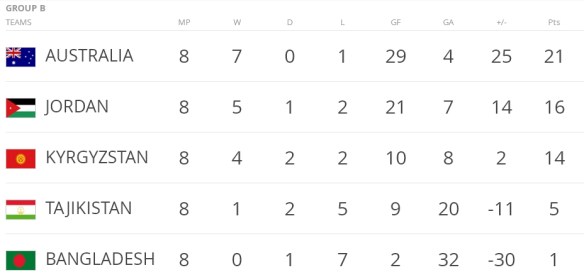
With comfortable wins over Kyrgyzstan and Bangladesh following the loss in Jordan, Australia’s final two matches at home were mostly academic. Two draws most likely would have been sufficient to qualify for the third round and final group phase of World Cup qualifying, while a win would guarantee it. Tajikistan proved to offer minimal resistance, losing 7-0 in Adelaide, while Jordan weren’t much better in their 5-1 loss in Sydney. Tajikistan conceded within 3 minutes and then another on 13 minutes before a 5-goal onslaught in the second half. Jordan lasted until the 24th minute before conceding, then conceded another two just before half time. Game over. For Jordan, after losing in Kyrgyzstan two games earlier and now requiring a win to guarantee a spot in the next round, it was heartbreaking. Remember, this was the team that made the intercontinental play-off in the last cycle.

Russia 2018 Asian World Cup Qualifying - Group B - Final Table

Most interesting to observe from these final two games was the team’s progression. They have had trouble putting teams away, and been dumb strategically. They were also too reliant on the aging Tim Cahill. Other players needed to step up, while the team needed to be smarter in their approach. Preferring more often to take the game to opponents, particularly away in the Middle East, it played into the hands of opponents, who’d sit back and pounce on the counter attack. Australia needs to remember that their opponents also are in it to win it, so away from home, let them be more adventurous and hit them on the break. Against Jordan, that philosophy was illustrated perfectly, and the results were comprehensive. They turned around a 2-0 loss away to a 5-1 win by simply allowing their opponents force some of the pressure.

Even more exciting was the improvement in many players. Robbie Kruse, who was finally back after a long injury spell, toyed with Jordan. It was one of his best games for Australia ever, and only dampened by a nasty tackle from behind by Jordan’s Yousef al Rawashde. How it wasn’t a red was mystifying. Even worse would have been another injury. Jordan were so rattled that they even threw a second ball on the field at one stage to stop a quick throw in. It failed miserably as Australia scored their fifth goal. Tom Rogic, now established in Scotland, has added a lethal shot and far superior decision making to his game. The three goals he scored in those two games were superb. Melbourne City’s Aaron Mooy has taken command in midfield, setting up and scoring goals. His passing is sublime, at a level not really seen in the Socceroos since Ned Zelic, or Milan Ivanovic with some of the long passing. Coach Ange Postecoglou even unearthed a bright new talent in Apostolos Giannou. He got his debut against Tajikistan, impressed with his pace and power, and only letdown by missing a sitter. He deserved a goal. Another letdown, becoming persistent too, is Matthew Leckie. He seems to have lost the plot, particularly with final balls into the box and shooting.

Onwards to the draw for the final group phase of qualifying. It’s no secret that the Socceroo Realm, as would many Australians, would love to see Australia play Iran again. It’s been nearly 20 years since the infamous Iran Game. Much of the chatter before the Jordan game was for Australia to win it to ensure a seeding as one of the top two teams. Supposedly that would avoid a tougher draw – based on FIFA rankings. No it wouldn’t, because FIFA rankings are a joke in their creation, and meaningless in a competitive field. Australia, Iran, Japan and Korea are arguably the top four teams in Asia and there’s little between them whatever some silly FIFA number sitting next to them wants to make us believe. In drawing the final two groups, two of these top four would play each other regardless. The only exception being that the top seed in each pot would not play each other. So for Australia to have a random chance at either Iran, Japan or Korea, they needed not to be seeded. As it turns out, they were one of the top two seeds. Guess which was the other? Iran. Depressing, and rigged. The top four should have been in one pot and randomly paired that way. In fact, the other 8 teams should be in one pot too, and randomly drawn. There should not be such a strict interpretation of these dopey FIFA rankings.

Immediately we knew Australia could not play Iran, so let’s hope we at least draw some new teams. We haven’t played Korea at all in World Cup qualifying since our entry into Asia, and drawing them would add to the rivalry generated from the epic Asian Cup 2015 final. Except for an early group phase two cycles ago, we’ve missed China too. Alas, nothing went our way. We got Japan for the third straight cycle, Thailand and three Middle Eastern teams. The only salvation is that Saudi Arabia is back on the ascend, so they should be interesting. UAE are on the rise too, finishing third in the Asian Cup. Iraq is the other team, who finished fourth in the Asian Cup, and can be dangerous. It’s a challenging draw.

Schedule

01 Sep 2016: Australia vs Iraq
06 Sep 2016: UAE vs Australia
06 Oct 2016: Saudi Arabia vs Australia
11 Oct 2016: Australia vs Japan
15 Nov 2016: Thailand vs Australia
23 Mar 2017: Iraq vs Australia
28 Mar 2017: Australia vs UAE
13 Jun 2017: Australia vs Saudi Arabia
13 Aug 2017: Japan vs Australia
05 Sep 2017: Australia vs Thailand

Note that there are six teams in each group, up from five from previous years. Obviously this is to allow more teams to be involved. It also means no more byes. The away trip to Japan is the second last match day, which could affect its prestige if both teams are safely qualified. The top two teams from each group automatically qualify for Russia 2018, with the two third teams playing off for a spot against CONCACAF’s fourth best team. That third-placed playoff is actually the only way Australia and Iran can meet in this World Cup qualifying cycle. Could it happen?

Round 2 Group Winners

Group A: Saudi Arabia
Group B: Australia
Group C: Qatar
Group D: Iran
Group E: Japan
Group F: Thailand
Group G: Korea Republic
Group H: Uzbekistan

Round 2 Best Second-Placed Teams

1. Iraq
2. Syria
3. United Arab Emirates
4. China

Round 3 Group Draw

Group A: Iran, Korea Republic, Uzbekistan, China, Qatar, Syria

Group B: Australia, Japan, Saudi Arabia, United Arab Emirates, Iraq, Thailand

More: http://www.fifa.com/worldcup/preliminaries/asia/

Socceroo Realm – Top 5 Moments of 2015

01 January 2016

Since the completion of the Asian Cup in January, it’s been a very quiet year for the Socceroo Realm. While the Women’s World Cup provided a tournament highlight mid-year, the U20 and U17 Men’s World Cups practically went unnoticed. The U20 for a reason: Australia didn’t even qualify. The U17s had an evolving problem.

During the dark days, during Australia’s time in Oceania, youth tournaments were a much needed solace for fans starved of international action. Otherwise, it was two serious World Cup qualifying games every four years. Nowadays, in Asia, the Socceroos are in action far, far more, to the point I barely watched 10 minutes of the U17 World Cup in Chile. I’d feel embarrassed if I was alone, that the tournament was well hyped and I simply ignored. I wasn’t alone. Even SBS couldn’t be bothered showing an evening’s highlight package. I had to check right now that Nigeria beat Mali in the final, while Serbia beat Brazil to win the U20 World Cup that was held in New Zealand.

Socceroo Realm - Australian Soccer / Football

1) Australia wins the Asian Cup

Easily the top moment of this year. It was a brilliant tournament, with a thrilling final and, obviously, a great result. More than that, it raised the profile of coach Ange Postecoglou into almost a messiah. We await for him to qualify the Socceroos for Russia 2018 and do much better than the three losses suffered at Brazil 2014.

2) The Women’s World Cup

Expanded to 24 teams and held in Canada, it proved a thrilling tournament. Not least that the Matildas did so well, with a memorable win over Brazil in the 1/8 final, thanks to a late goal by Kyah Simon. Even though they failed to inspire when losing the quarter final to Japan, the tournament itself became more exciting with pulsating knockout games and a rampant USA demolishing Japan in the final after Carli Lloyd scored a hat-trick in the first 16 minutes.

3) Jordan beating Australia in World Cup qualifying… again

Australia went into Asia for competition. We should hope it is tough, and demand it so, and not throw a tantrum and say “we should be beating these teams”. No, we should not be beating these teams. It’s football. The beauty of the game is that anything can happen. Ironically, Jordan’s win wasn’t really a case of “anything can happen”, since they won the last time when the two countries played in Amman. The fascinating aspect of this match and watching our fears materialised right before our eyes. Here’s another nugget to chew on: if we don’t miss qualifying for the occasional World Cup, then our role in Asia is failing. We are there to be mutually beneficial, which means to help improve the standard in Asia, which in turns forces Australia to improve.

4) Australia losing to Korea at the Asian Cup

A gripping match, even for a group game, that made the rematch in the final all the more exciting. Excuses did pour that Australia could have, should have, would have won. Nag, nag, nag. We Australians really must lose this arrogance of superiority, at least when it comes to football. Ultimately, losing probably helped by removing any complacency.

5) Australia beating China at the Asian Cup

With one billion Chinese watching, this quarter final was highly anticipated. Sadly for the Chinese, Australia put on a clinical display, which included a spectacular overhead goal by Tim Cahill.

Honourable Mention…

Even though the Socceroo Realm doesn’t rate “friendly” international matches, coach Ange Postecoglou rated the 2-2 draw in Germany in March as his highlight of the year: “Being champions of your region is one thing but we wanted to gain respect beyond that. It wasn’t that we got a draw, it was the manner that we got it. We played the world champions on their home soil and took the game to them. We scored two goals, could have had a couple more and didn’t take a backwards step. It gave the players a real belief that the way we play our football and our philosophy would serve us well as we build as a team, and I got a lot of satisfaction from seeing the belief flow into the players and the staff.”

It was a good result. Feelings of dread set in once Australia conceded after only 17 minutes. Big credit to the team that they didn’t fold, instead taking the lead after goals on 40 and 50 minutes, and only conceding the equaliser in the last 10 minutes.

2016

The final round robin of World Cup qualifying awaits, with Australia almost certainly through to that. It’s expanded to six teams per group, so potentially will be tougher than ever. Mid-year we have my other passion outside of the Socceroos: the Olympics! Let’s hope Australia qualify for that. Already there are problems with the qualifying tournament being held outside FIFA international dates, so the Olyroos is without many of its better players. As fans, we ask that it’s taken seriously, not like the disaster of four years ago when the team couldn’t even score a goal in the six matches of its final group phase.

Happy New Year!

Full site: socceroorealm.com

Asia wins as Australia win the Asian Cup of 2015

01 February 2015

Match Report, Asia’s Reaction, FIFA’s Reaction and Asia’s Future

31/01 Sydney: Korea Republic 1 – Australia 2 (1-1 FT)

The Asian Cup of 2015 needed the gripping final that it got to cement itself as the greatest moment in Australian football. It’s been a marvellous tournament, with thrilling football, big crowds and seamless organisation. The fact that the entire football community could so readily engage in the competition, especially to see games live, the tournament was so friendly, and that all the teams were our fellow Asian friends, made it more enjoyable, as a whole, than recent World Cups. Winning the championship surpasses Australia’s previous best triumph on home soil of qualifying for the 2006 World Cup. That was just a one-off game, whereas the Asian Cup was a proper tournament that required sustained high achievement over six games.

The final itself, just like the group game against Korea, could have gone either way. The Koreans had the three best chances of the first half, including an open header from a free kick, while Australia could only muster one decent shot on goal, that from Tim Cahill on a tight angle. Distinct from all previous opponents, Korea did not allow Australia to play its dominant possession game, pressuring high up the pitch, almost to the point Australia’s style collapsed. Australia’s opening goal, just before half time, ironically came from a deep pass direct from Trent Sainsbury to Massimo Luongo through one of very few channels the Koreans allowed. Even then, the pass needed Luongo’s deft skill to quickly turn past his marker, and then shoot quickly from 20 metres out. The “Luongoal” came out of nowhere, surprising everyone. It was fitting that Luongo, the man of the tournament, broke open the game with a stunning strike.

Korea dominated the second half, as you’d expect for a team chasing the game. They kept Australia’s defence busy as the match’s pattern became a sense of could Australia hold on. These were the critical moments of the match that ultimately caught Australia out. Even though the defence, in their defence (!), were superb, managing to repel almost everything, facts are that over an entire half, Korea would always create a few chances regardless of Australia’s defensive integrity. It ultimately became a matter of when Korea did, or whether Australia could exploit the open space available. Weaknesses in such situations were already observed in Australia’s previous two games and such profligacy would be punished against Korea. That Korea took until 91 minutes to slip a ball through for an equaliser, only made it heartbreaking for Australia, not undeserved for Korea

Reputedly, coach Ange Postecoglou told his players that extra time would be about making the Asian Cup story even better. Australia came out stronger and scored just before the end of the first period of extra time. It was a tenacious effort by Tomi Juric, who scrambled after a ball, was then doubled teamed on the goal-line, managed to flick the ball through the legs of a defender and then cross it low for James Troisi to slam home the spillage from goalie’s interception. The second period was part 2 of Korea on the press and Australia continually fluffing chances going forward. For some reason, players, when double teamed or even triple teamed, want to flick the ball through somehow. Fine if there’s no choice; terrible when you have a teammate on both wings in the clear, as was the most galling example by Juric really late in the game. 3-1 and you kill the game. Even when cramped in space, there still seems the obsession to pass it to other players tightly marked, rather than look for the obvious route out of a free play that there must be if the opposition is crowding you. This caused constant turnovers and must be the next step of Postecoglou’s development with the team. The two goals Australia scored were closer to a freak nature than of any great breakdown of the Korean defence.

The only disappointment with the final was the television coverage of the winning moment. With a camera still focused on Mathew Spiranovic after he repelled Korea’s final attack, those at home missed the moment of the referee’s whistle ending the game and missed seeing the jubilation of all the players on the field at once. Spiranovic seemed to have an eternity of coverage, then Postecoglou, then various players. Even the commentators missed the moment.

Asia’s Reaction

The Asian Football Confederation are ecstatic with this edition, with one official labelling it the best ever, and AFC president Shaikh Salman bin Ebrahim Al Khalifa glowing in his endorsement: “The tournament itself has been tremendous. Filled with quality and excitement, it was a fantastic festival of football that the whole of Asia can be proud of. As such, allow me to congratulate Australia for hosting such a memorable AFC Asian Cup. The whole world was presented with a competition that has been remarkable in spirit and in passion, and we have Australia to thank for that.” The biggest endorsement and validation and has come from Australia itself. Not just with words, it came with action.

All the garbage you read about Australia being “racist”, especially when the subject of dealing with illegal immigration is raised, this tournament showed the entire world the inclusive and welcoming nature that is modern day Australia. It’s doubtful any other Asian nation could showcase such a vibrant and passionate feel that this nation did for almost every single game. Crowds at just over 650k are the third highest ever, only behind China 2004 (1.02m) and South East Asia 2007 (690k). Cricket’s World Cup starts shortly, and if you want an idea of a true “lemon” on the global sporting scene in terms of general worldwide interest, local interest and crowds, look to that.

FIFA’s Reaction

FIFA President Sepp Blatter was in town for the final and also remarked on the amazing staging of this Asian Cup. He surprised no one when he lamented that no World Cup had yet been held in Australia, saying it’s “an unfortunate omission in sporting history because very few countries boast such a rich sporting culture and long list of champions” and that “we can say with confidence that it would be more than deserved if Australia were to stage the World Cup at some point.” Empty words by a sly and sleazy politician leading an even more sly and sleazy organisation. The World Cup bid was a debacle and if Australia has learnt one big lesson, it’s that any future bid must be foremost about football. Because of the over-reliance on oval grounds, the proposal for 2022 benefitted Australian Rules the most. Also the time of year, with Qatar 2022 certain to be staged in the northern winter, FIFA must formalise a flexible schedule so that a bidding nation can showcase the sport at its best.

With both the Asian and African Cups on in January, European clubs can clearly cope with this time of year, especially when most have winter breaks. The World Cup is only an extra week over those two continental ones. Even then, once the knockout stage started, Australia revived its A-League schedule during the Asian Cup. Therefore it’s only 3 weeks, maybe four, that the few European leagues not on a winter break (name England’s) might need to shut down. One or two leagues might need to re-schedule a few matches depending on the teams in the late stage of a World Cup. Note that this would happen only once every 16 years (at worst) and if it can’t be managed, then the entire notion of “world” in the World Cup needs to be re-examined.

Asia’s Future

Some unsavoury, older, comments emerged during the week about West Asia’s discomfort with Australia in the Asian confederation. It’s quite understandable considering many of them see it as Australia taking a World Cup spot without the region gaining much else in return. West Asia probably couldn’t care that much that the Asian Cup was such a success because, again, there’s no direct benefit to them. The reality is that strong teams make other teams stronger and that wallowing within your own little construct will only keep you down. We see that manifest with most Arab nations left behind at international level because their leagues have stagnated. Of the 10 Middle Eastern teams in Australia, seven went home after the group stage, with two of the 3 survivors coming out of a group of four Middle Eastern teams.

The World Cup situation has a simple answer. Rather than reduce competition (ejecting Australia has almost zero chance anyway), or contemplate the farcical notion of splitting West Asia entirely from the rest, Asia should embrace more competition. When Australia joined Asia, the expectation was that Asia’s final spot would be a playoff with Oceania. That occurred in 2010 when Bahrain lost to New Zealand, only to be dropped for 2014 when FIFA decided the two inter-continental playoffs should be randomly drawn. Asia copped South America where Jordan lost to Uruguay. Now is the time Asia seize their destiny and guarantee a full fifth spot by bringing Oceania into the fold. It’s a joke of a region, containing only New Zealand and 10 tiny Pacific island nations. There’s a reason Australia were desperate for decades to leave. With the Asian Cup expanding to 24 teams for the 2019 edition, and an expanded qualifying path for the 2018 World Cup, it makes even more sense to add Oceania to the mix to make a broader confederation representing all of Asia and the Pacific.

Full site: socceroorealm.com

On the precipice of mission accomplished

28 January 2015

26/01 Sydney: Korea Republic 2 – Iraq 0
27/01 Newcastle: Australia 2 – United Arab Emirates 0

Another polished performance saw Australia bound into the final of the Asian Cup after defeating the UAE 2-0. An impressive Korea Republic awaits them. Both teams won their semi-finals comfortably and both look to be the two teams entering the latter stages of the tournament in the best form and in the freshest condition. The final will be a rematch of the group A encounter in which the Koreans inflicted the Socceroos only loss. Korea enters the final not only undefeated, they haven’t conceded a goal during the entire tournament. While Australia has scored far more, they have conceded two. One was the very first goal of the tournament by Kuwait, and the second the solitary goal against the Koreans.

Like the quarter final against China, the semi final against UAE was broken open by two quick goals. This time they came within the first 15 minutes of the game, rather than around half time. One was a headed corner by Trent Sainsbury and the other a mid-range shot by Jason Davidson after it pinged out from a goal mouth scramble. The goals effectively killed the match, both in the UAE’s capacity to recover, and also killed the atmosphere. At 2-0 up, Australia was only in a position to lose, and without further goals coming, there seemed little to keep the crowd interested. The UAE’s best chance came immediately after Australia’s first goal, with a shot that skimmed the post. Other than that, any encroachment into the penalty box was easily snuffed out, leaving them restricted to mostly longer range efforts.

The only blemish with Australia’s performance was, for a second successive match, the inability to consolidate a result from the many chances created. Even ignoring the referees denying several goal chances with wrong offside calls (the one against Tim Cahill when he was 2 metres in his own half was particularly ridiculous), the conversion rate must improve against the miserly Koreans.

Curiously, Sainsbury made news during the week by saying UAE’s star player Omar Abdulrahman’s laziness could be exploited: “Very tidy on the ball, not the hardest worker and I think we can exploit that”. That they did, because Abdulrahman let Davidson waft forward to ultimately score that second goal. Abdulrahman made a late rush and challenge, to no avail. Australia also kept him under control, with that early opportunity that skimmed the post the only really dangerous chance he created.

Saturday night is shaping up to be a pivotal night in Australian football. It will be the first major trophy for the men’s team (the Matildas won the 2010 Asian Cup) and even the wretched rainy weather experienced in NSW for much of the tournament has disappeared for mostly fine days leading into the big night and on the night proper. When Ange Postecoglou was appointed as coach barely more than a year ago, the clear mission was to produce a plan to maximise the chances of winning the Asian Cup. Right now, he’s on the precipice of mission accomplished.

Full site: socceroorealm.com

Australia through to the semis, Iran and Japan out

24 January 2015

Quarter Finals
21/01 Melbourne: Korea 2 – Uzbekistan 0 (AET)
21/01 Brisbane: Australia 2 – China
22/01 Canberra: Iran 3 – Iraq 3 (1-1 FT, 6-7 PK)
22/01 Sydney: Japan 1 – UAE 1 (4-5 PK)

So much for the “mother of all football games” of Australia facing Iran in the Asian Cup final, with a match against Japan in the semis before that. While both Australia and Iran did their jobs in the group phase (Australia lost their last match, Iran won theirs), neither Japan or Iran could survive the first knockout game. Iran was terribly unlucky, losing a man early through a dubious red card when leading and then responding twice in extra time to draw the game level, while Japan failed to convert their rare chances eked out against the resolute UAE defence. Both matches went to penalty shootouts that proved notable for none of the four goalies able to make a save. The shootouts were decided on the kickers missing the goal totally. So much for the nonsense that shootouts are about luck. They are 100% skill and the ultimate test of nerve. Shoot straight and you convert, always.

After a tough first half, the Socceroos breezed through 2-0 over China in their quarter final. It’s amazing that a couple of goals can transform a game so much. Despite ridiculous statistics like 288 passes to 70 and 72% possession during the first half, China had Australia well contained, and looked dangerous on the break. While coach Ange Postecoglou said the strategy was to maintain possession and tire the Chinese, it looked more like he was trying to bore them to death. The vast bulk of that possession was messing about in the back line. Too often, forward approaches often resulted in the ball passed back. When Tim Cahill broke the stalemate early in the second half, it didn’t come from open play, it came from the second phase of a corner, with a delightful bicycle kick. Whether by design or accident, the ball came off the outside of his shin for the perfect angled shot across the face of goal. Fifteen minutes later, Cahill made it 2-0, this time from a trademark header from open play. From there, with China really opening up, Australia looked dangerous, creating many chances, unfortunately converting none, which is a concern.

Superficially the quarter final results seemed a great outcome for Australia. UAE in the semi finals is supposedly easier than Japan, while it will be Iraq or Korea (who knocked out Uzbekistan) in the final. The quarter final results show that the perceived difficulty factor doesn’t always correlate with reality on the day. Japan would not sit back against Australia like UAE most likely will do, so they could allow more chances to be created. Then there’s always the notorious frail Australian sporting psyche that can see them beat top teams one match then succumb to weaker teams in the next. The bravado entering these games often sees respect for the opponent lost, bullying becomes the game plan, the match doesn’t progress as expected, pressure builds, and it’s calamity. With Postecoglou at the helm, let’s hope he keeps that reigned in.

The quarter finals of the Asian Cup have been an some turnaround for Middle Eastern teams. Of the 10 that qualified for Australia, 7 went home after the knockout stage, with two that did progress coming from a group of four Middle Eastern teams. The only east Asian team that failed in the group phase was DPR Korea. Even then, DPR Korea’s supreme leader has no doubt told his people that their current world champions have demolished their group and quarter final opponents, and are on the way to winning the Asian Cup to match their World Cup winning romp in Brazil last year. That western Asia now has half the semi finalists is some redemption for their poor results over the past two World Cup cycles that’s only seen one team (Iran for Brazil 2014) qualify. Even accounting for Australia’s presence in Asia taking a spot, Bahrain failed in a playoff against New Zealand for 2010 and former powerhouse Saudi Arabia failed to even reach the final Asian qualifying phase last time. Ideally it would be good to see one of the Middle Eastern teams in the Asian Cup final, as long as it’s not the UAE.

Iran’s Red Card

Any major tournament sees issues emerge. While the group phase progressed smoothly, even to the point of producing no draws and every group finishing with teams on 9, 6, 3 and 0 points, the major talking point of the quarter finals was the second yellow card against Iran’s Mehrdad Pooladi. The clash with the Iraqi goalie was never a yellow card, and it was only made worse by the fact the referee, Australia’s Ben Williams, forgot Pooladi was already on a yellow. The Iraqis then reminded the referee of the case, to which the red card was issued.

The big question: would the yellow have been issued had Williams remembered the first yellow? The thing is, it shouldn’t matter. Here you have referees – and they all do it – trying to finesse the laws of the games. It’s either a yellow card offence, or it isn’t. It seems Williams – as all referees do – consider previous behaviour before issuing a card and therefore do it for general insubordination – known as “accumulated fouling”. As we’ve seen, how can referees remember the little incidents from each player that support such a case? One such challenge is a verbal warning, second or third is a yellow. Clearly the referees can’t remember. Even worse, if there’s legitimate accumulated fouling by a player already on a yellow, only the final minor foul will be remembered for the second yellow, and therefore the red, which outrages all. How can you send someone off for barely a tickle? Well, that’s the outcome of finessing the law to include accumulated fouling.

If the incident was adjudicated in isolation, there’d be no yellow and therefore Iran keeps their man in a match they were dominating, and probably go on to win. The referee’s either confused the player, or forgotten that he issued a yellow for the earlier incident. It’s not Williams’ fault either. It’s the sport’s antiquated laws and the culture that thinks players can be moulded and taught to play the perfectly behaved game on the edge of the laws. They can’t, and humans, especially in ultra competitive sport, will always be prone to bend the laws as far as possible. In fact, such finessing of the laws by the referees only encourages it. Players on a yellow believe that only a more serious infraction than normal will earn a second yellow, so bend the rules further.

Time Wasting

The Asian Football Confederation promoted before the tournament “Don’t Delay Let’s Play Football”. Apparently they want 60 minutes of actual game time in each 90 minutes. While this tournament has been much better than others, it proved a farce in the Iran-Iraq quarterfinal once extra time started. The second period went for 23 minutes for about 5 minutes of play. Much of the last 10 minutes were taken by the Iranian goalie suffering a wrist injury and the bizarre medical practice of spraying every part of his body except his wrist with some sort of magic spray. Once the goalie was up and the ball back in play, time was instantly called. The first period also had many stoppages, and was stopped bang on 15 minutes. Again, you blame the sport’s antiquated laws and culture. If you want 60 minutes of game time, simply have 30 minute halves and stop the clock on every single stoppage, just like in American football. Once time is up, play is stopped once the ball becomes dead. Extra time period is 10 minutes, or even 5 minutes. Right now, 15 minute halves seem too much as players are clearly conserving energy even during regulation time to prepare for ET.

Full site: socceroorealm.com

Could have won, should have won, would have won – that’s football

18 January 2015

17/01 Brisbane Stadium: Australia 0 – Korea Republic 1

Australia lost 1-0 to Korea last night in match that was provided a more resilient, stronger and lethal opponent than that of Kuwait and Oman in the first two games. Australia need this test to validate the development seen in those first two games, and to help prepare it for even tougher tasks ahead. It proved exactly a test, being a cagey game until Korea scored just after 30 minutes, then opening up in the second half in a fascinating duel between two teams not wanting to concede an inch. As Australia dominated possession, passing and shots on goal, Korea held firm and created a few chances of their own on the rebound. You could argue Korea’s goalie was brilliant, or maybe Australia unlucky to convert chances. That’s football.

James Troisi created a glorious chance for himself in the first half, shooting just wide after wrong-footing the goalie. Robbie Kruse created similarly in the second half, dribbling past a defender, only for his shot to be saved. At the other end, Mat Ryan saved point blank shot from a one-on-one break that would have seen Korea 2-0 up. It was fabulous entertainment, with the players and coach echoing the belief that the team played well enough to win, are good enough to win the tournament, and will now look forward to the quarter final against China on Thursday.

Australia started the match with a reshaped forward line, with Nathan Burns, Tomi Juric and Troisi leading the line. Juric also had at least two good chances to score himself, with one a poor first touch that saw the ball escape him, and the other from close range that went over the bar. Of those three players, he’s probably the one to just lack that bit extra to excel at international level. Burns and Troisi did well. Late in the game Tim Cahill, Kruse and Matthew Leckie were brought on to try rescue the game, remembering that a draw was enough to win the group. While their presence was notable, Korea largely contained them.

In fact, Korea really did their homework against the Socceroos, often goading them with little shoves and plenty of time wasting, hoping Australia would retaliate excessively. It worked, frustrating the Australians, and possibly contributing to Matthew Spiranovic’s rough challenge late that saw him get a second yellow card for the tournament and therefore miss the next game. Aziz Behich was almost lured into rough conduct, with the potential scuffle broken up by the referee, while you could speculate Australia lost concentration on the Korean goal. Three players were lured to the ball carrier after a throw in, creating the space for the short through-ball and low cross that was guided into the net.

Ultimately the loss meant nothing, other than pride. If you had to lose a game, this is the one, especially after playing so well and showing the team is firmly on the right track. It might even knock down any of the excessive bravado that might have been building. Despite nonsense about the perils of not winning the group, there is barely anything between the quarter final options of Saudi Arabia, Uzbekistan and China, so there’s also no material consequence of the loss. Before the tournament, Uzbekistan looked the strongest team; now they may not even qualify for the next phase. We now know China is our opponent, and other than sealing their group win after just two games, they, along with Saudi Arabia, have been rubbish the past few years. Playing China also means Australia stay in Brisbane, even if the negative there is substandard pitch.

The real interest because of this loss, and if Australia beats China, is Australia likely faces Japan in the semi final and Iran in the final. Amazingly, Japan is still not assured of even qualifying for the knockout phase, needing no worse than a 1 goal loss against Jordan to guarantee it. Otherwise, with Iraq likely to wipe aside the hapless Palestine, that would leave all three teams in Group D on 6 points. With head-to-head unable to split the three, it will go to goal difference. A two goal loss to Jordan and if Iraq beats Palestine by four (maybe even 3 is enough), it’s goodbye Japan. Iran plays Group C leaders the UAE on Monday night so need a win to top the group. Otherwise, it’s Australia in the semi finals, not the final. For those still traumatised by the Iran Game of 1997, the only therapy is to plan Iran again. It will happen one day. It needs to be a big one-off game on home soil. The final of the Asian Cup is the perfect time. It is our destiny.

Full site: socceroorealm.com

Oman demoralised, now for the real test: Korean Republic

15 January 2015

13/01 Stadium Australia, Sydney: Oman 0 – Australia 4

As much as Australia dominated Tuesday night’s match against Oman to win 4-0, Oman hardly provided a stern test. While they looked dangerous early with a few counter attacks, the two quick Australian goals just before 30 minutes demoralised them, and they then went into damage control until the half time break. This was probably the plan from the start, that if going behind early, rather than compound the problem, the team would make adjustments at half time. Unfortunately, for Oman, the problem was compounded, conceding right on half time.

As much as Oman tried to make inroads in the second half, Australia were content on reversing the counter-attacking role, playing the waiting game against Oman and hitting them on the break. Despite numerous chances created, only one was converted – a lovely cross on the outside of the boot by Matthew Leckie for Tomi Juric to smash home. Most pleasing about the result was that four different players scored the goals, none of whom were Tim Cahill, and none of whom scored the four goals against Kuwait. Australia also finally kept a clean sheet, restricting Oman to barely a handful of chances.

The second goal of the night was the best Australian goal of the tournament so far. After receiving from Kruse, Massimo Luongo lovely first touch allowed him to lob the ball over for Kruse to continue his run through. He controlled nicely off the thigh then slammed the ball home on 30 minutes. Scoring was opened 3 minutes prior when Matt McKay scored at close range from a corner after a header towards goal from Trent Sainsbury, while the goal just before half time was a penalty converted by Mark Milligan after his goal in open play was ridiculously denied. The referee didn’t play advantage after Cahill was dragged down so it was fitting that Milligan was allowed to right the wrong.

Australia is through to the quarter finals regardless and only needs a draw to top the group. Coach Ange Postecoglou responded beautifully to a question whether he’d take it easy and just settle for a draw. “What do you think?”, was his riposte. We’re Australian, we go for the win. All good as long as you remain mindful of respecting the opposition, of which Ange seems sure to do. It’s already been the hallmark of his coaching and you see the response in the team that the arrogance and visible indignation seen in the team from, especially, the 2007 Asian Cup, long gone. Of course, it’s a different group of players now, a group beginning from a humble base, and now on a trajectory up.

Australia’s quarter final opponent is the runner-up from Group B. China has won the group already while Uzbekistan must beat Saudi Arabia to qualify in second. After that, it gets very interesting, with Iran (by winning its group) the likely semi final and Japan the final. If Iran finish second in their group, the clash with Australia would be in the final. If Australia finishes second in their group and Iran win theirs, it’s China in the quarter final, Japan in the semi final and Iran the final. In some ways, the latter scenario is the more enticing one. First, China might provide the sterner test than the Saudis or Uzbekistan, plus the Chinese fans will make for an amazing atmosphere. Second, it’s been 18 years since “The Iran Game” of 1997, so it would be nice for some form of redemption in a big one-off game. I guess if Australia loses to Korea, let’s be mischievous and revert to talking up the “performance”, rather than the “result”.

Full website: socceroorealm.com

Australia vs Kuwait: Satisfying result, good performance

10 January 2015

09/01 Melbourne Rectangular Stadium: Australia 4 – Kuwait 1

Let’s be realistic. The true measure of “performance” is the result. For all the neat inter-play and possession, it’s rubbish if you can’t defend well or create chances. Ignoring the two late goals, the first half performance was adequate at best, dire at worst, given that the Socceroos conceded too easily from a corner and didn’t create much themselves. The feeling in this lounge room last night was of anguish and frustration one minute, then jubilation and satisfaction the next. That was clearly echoed at the stadium as well, and no doubt living rooms all around the country. Why should two random events affect our senses so much? That’s because we’re not watching figure staking, where “artistic appreciation” has significant value in the performance. We’re watching a battle where skills and strategy dominates, and in that sense, the result – a dominant 4-1 win – was the metric that we judge performance, and therefore it proved a good one.

After a tough, uncompromising first 30 minutes, which included going behind so early on 8 eight minutes, Australia found the avenues to goal through quick ball movement rather than the ponderous fluffing around that has blighted the team. Kuwait easily subdued the “possession game” with two walls of defenders, and because these walls were so deep, that created huge space between the Australian last line and the Kuwaiti first wall of defence for dangerous counter-attacks. For much of the half, the strategy worked, until Australia finally worked it out by quickly getting the ball into the danger zones. Rather than trying to beat two or three opponents, just get the ball in before the defence is settled and space marked. The first goal came from a quick throw in that Massimo Luongo was able to skip between two defenders and pass to Tim Cahill, while the second was Ivan Franjic delivering a wide cross onto the head of Luongo.

With Australia leading, that really opened game in the second half, of which the Socceroos exploited. Robbie Kruse won a penalty for Mile “Mike” Jedinak to score, while James Troisi slammed home the final goal in injury time from a tight angle after bullocking work by Matthew Leckie. Between that came Leckie hitting the crossbar and Nathan Burns had two great chances: the first a skimming header that hit the bar; the second a shot straight at the goalie’s feet at close range from a Leckie cross. Leckie might have been man of the match had some of his better work had more material effect. Instead it went to Luongo, who effectively broke the game Australia’s way with the assist and then his goal. Kuwait only had two good chances in the second half: one from outside the box was touched onto the bar by Mat Ryan, while the second was easily blocked from a tight angle.

The only negative from the occasion was at 1-0 to Kuwait when one of the Kuwaiti players going down and writhing on the ground, seemingly having a seizure. Naturally, after calling on the doctors, that magical paint used for the sidelines revitalised his ravaged body and he was straight back on. While loath to accuse any such player of time wasting, surely there’s a duty of care from the sport that any player going off on a stretcher, especially one having a seizure, is given a thorough medical examination before being allowed to return to the pitch. FIFA could easily mandate such an examination, or at least a waiting period, by banning a player for 10 minutes from returning to the pitch if they call on a doctor or stretcher.

The key for Australia is to consolidate against Oman on Tuesday. While commentators cluelessly rave about the importance of getting a result in the first match, ultimately it’s menacingly if you lose the next two. There’s no double points for the first match. Even more perilous for Australia is that if both Oman and Korea beat Kuwait (accepted as the weakest team in the group), then Australia’s win is nullified, with only the goal difference having relevance. Teams mathematically can be eliminated from the group phase with two wins. Such cases see one team (ie: Kuwait) lose all their group matches, with the remaining teams recording a win and a loss against each other (ie: Oman beats Korea, Australia beats Oman, Korea beats Australia). The ideal result involving Oman and Korea today is a draw, meaning Australia beating Oman guarantees them the knockout stage. If there’s a win in the Oman-Korea game, then there’s real pressure on Australia to beat Oman, otherwise it’s do or die against Korea. Thing is, even beating Oman, Australia still might enter that Korean game with the requirement of not to lose.

Full site: socceroorealm.com