
Rio 2016 Review – The Great Australian Choke

22 August 2016

“I don’t need a gold medal for self worth.”

“It’s not about winning, it’s about trying to win.”

“It’s a racing meet; times don’t mean much.”

With quotes like these, respectively from Cate Campbell, Bronte Campbell and Mitch Larkin, is it any wonder Australia suffered yet another disaster in the pool? It was so predictable that you could almost write the script. Big egos, a nonchalant attitude, and absurd excuses. The latter quote is one in perpetual use, as far back as double world champion Samantha Riley using it to explain her two failures at the Atlanta Olympics of 1996. The folly of it and all the other excuses is exposed when you understand that swimmers live and breath by times. They are obsessed by them, and personal bests. The opposite is actually true for them: results don’t matter, times do. All training is geared around achieving a PB, with the key focus being to deliver it in an Olympic final. We even saw Australian swimmers ecstatic at doing a PBs in an Olympic final. Unfortunately, they were the ones finishing fifth. For the favourites, it was implosion after implosion.
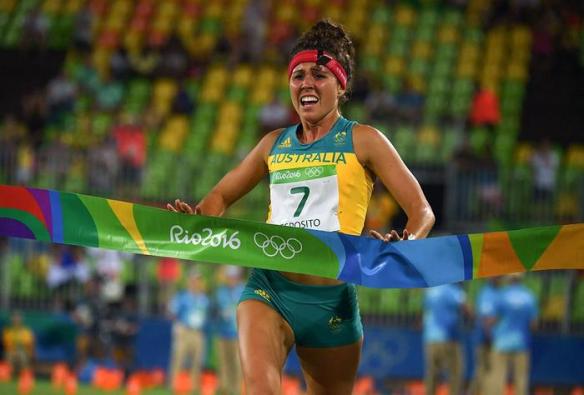
Australia's Chloe Esposito crosses the line to win the modern pentathlon at Rio 2016The surprise gold, the most emotional gold, the best gold of all. Australia’s Chloe Esposito crosses the line to win the modern pentathlon at Rio 2016. Image: Getty Images

With the three aforementioned swimmers, also add Emily Seebohm and Cameron McEvoy to the hit parade of inglorious failures. Seebohm – the double world champion at backstroke – was so abominable she finished seventh in the 100 and failed to even reach the 200 final. She’s probably more a case of a training error – not timing her taper correctly. As for McEvoy, apparently he got stage fright – something at the Australian trials he even warned the public was a possibility for any Olympic favourite. Talk about the proverbial chicken coming home to roost. If not for the upset win of Kyle Chalmers in the 100 freestyle, and Mack Horton’s narrow win the 400 freestyle, it could have been even worse.

There’s a bigger problem at play here: the mindset. Every single swimmer responded the same way at post race interviews. All tried to look for positives from their defeats, like just being in the final, or being at the Games themselves, that was success in itself. The Campbell sisters used the fact of two sisters being in an Olympic final as a means to extract something positive from their combined disaster. This is not a coincidence; they are schooled to react this way. Except, you only need watch their body language to realise it’s one big charade. It’s especially glaring if you watch those interviews with the sound muted. There’s no way anyone could align their words with the body language. Cate Campbell was clearly shell-shocked, while Larkin was constantly battling his instinct to express disappointment and his will to suppress it.

Who’s to blame? It’s the sports psychologists and so-called mentors. One of the losing swimmers attributed this to Leisel Jones: “If you’re not complete without a gold medal, you won’t be complete with one”. Note that Jones is Australia’s worst choker and biggest letdown in Australian Olympic history. Of the eight individual races she contested, she lost seven. That fact alone should disqualify her from any such mentoring role. At the very least, the swimmers should not be using her for inspiration. My vague recollection is the quote is actually from surfer Layne Beachley. That would be even worst, coming from someone in a tinpot sport of her time like women’s surfing. Regardless of the source, it’s clear the substance of that quote is embedded, because Cate Campbell paraphrased it.

Deep down, they do need a gold medal for self worth. Or, at least, for self vindication. They don’t spend 20 hours a week looking at a black line, winning world championships, breaking world records, leading the world by a whopping margin, and go to an Olympics and think “I don’t really need this”. It’s this conflict between their competitive fibre and the garbage from the sports psychologists that’s creating all the problems. They enter the pool deck and realise their dream is now in front of them. Countering that there’s voices in their head telling them it all doesn’t matter. It throws them off their concentration and race-plan, and reduces them to a physical and psychological wreck when they should be at their most confident and calm. In typical Australian fashion, their response to handling pressure is to bully the opposition. They always go out too hard rather than remain focused and be respectful of the task at hand. It’s no coincidence that the favourites all flopped and those swimming PBs came from the lower ranked swimmers. Swimmers from other nations were swimming PBs too. While you can pick out one or two of them that did fail, the difference is it was only one or two. With Australia it’s a pandemic within the team. It’s been enduring for past 20 years too.

Another problem is the timing of the selection trials. USA has theirs around 5 weeks before the Olympics whereas Australia’s is around 5 months. Ignore comments, particularly from former swimmers and commentators, that it works for us. That’s the typical Australian ego that likes to think it leads the world in everything. It doesn’t. Not when one Hungarian can win the same amount of gold medals as your entire team. After successive debacles, which includes the “successful Olympic meets” that still produced gold medals below benchmarks, it’s an unequivocal failure. It’s not even about gold medals. It’s about times, personal bests. Not enough swimmers produce them when it counts. They all can’t be suffering mental breakdowns or stage fright. It’s physical – as with Emily Seebohm. Remember, this is a 20 year embedded problem, not just the past two Olympics. Then consider the time lag means more chance of carrying an ill, injured or out of form swimmer to the Games. Conversely, late bloomers and those injured during trials miss selection. On a strategic level, Australia’s early trials also mean we lay a marker for the world to challenge, and beat.

The main concern with the American system of trials so close to a major event is the double taper. A taper is when athletes ease off after a period of hard training just prior to an event to re-energise the muscles ready to compete at peak performance. As a triathlete many moons ago and in many bodies ago, I can attest it’s a wonderful feeling to race after taper. You feel like superman and seem to have an endless supply of energy and power. Typically the taper period is about a week before an event. This will vary between sports, event and athlete, as will the training block needed just prior. For some, a few weeks won’t be enough, and if they can’t master the double taper, then it’s a decision to set for trials and hold form for the Olympics or set for the Olympics and rely on natural ability and the existing training base to qualify. Offsetting that is American swimmers don’t have to peak twice a year. Asking our swimmers to go through a hard training regime twice could be wearing down their bodies. Double-peak vs double-taper, you be the judge.

The USA’s continued domination on the world stage shows their system works. After an even world championships last year between the USA and Australia, it was a pummelling at the Olympics with the USA winning 16 gold to Australia’s 3. While you can argue they have a huge talent pool, and Michael Phelps and Katie Ledecky, you can’t deny that those athletes that qualify are consistently successful at the Games. There’s also that Hungarian. Katinka Hosszu won 3 gold medals by herself, and it would have been 4 if not for the USA’s Madeline Dirado swimming a massive PB to just win the 200 backstroke. Our stars, like even Ian Thorpe in the 200 freestyle at Sydney, will more often flop.

Even more devastating with the USA is those swimmers that haven’t tapered for trials will swim much faster at the Games once they have tapered. In contrast, ours consistently swim slower times than trials. 73% of them did, according to former head coach Brian Sutton. We went into 9 individual events with the fastest time of the year, which included 7 world championship holders and a world record holder, and left with one victory. That was Mack Horton. Madeline Groves can’t be faulted either, swimming a PB in the 200 fly when second by a whisker. Kyle Chalmers’ win was compensation – and relief – for Cameron McEvoy’s failure in the 100 freestyle. The third gold was the women’s 4×100 relay – who were favoured. So it’s 3 gold from 10 events at a 30% return. In that sense, Rio was far worse than the “disaster” of London where it was 1 from 2 at a 50% return.

There were also some strange strategic decisions made in the 4×200 freestyle relays. Emma McKeon, who rebounded with a bronze in a hot 200m freestyle field after folding in the 100m butterfly, was dropped for the women’s 4×200. Australia missed gold by just under two seconds, so would she have been two seconds faster than the fourth best swimmer? Same in men’s event, where McEvoy was dropped, seemingly to concentrate on the 100m. That backfired spectacularly with Australia just inches back in fourth from a silver and McEvoy imploding in his race anyway (thankfully Chalmers was there to clean up the mess). In hindsight, this strategy for them to focus on fewer events only increases the pressure. McEvoy surely would have enjoyed the relay swim, and grabbing a medal would have eased pressure and boosted confidence for his individual race. Let’s look to the USA again, or even Hosszu from Hungary. They have no problems with heavy programs and will even swim twice in the one evening.

The reason the the team received so much criticism was because Olympic sports receive so much of taxpayer money. This is no criticism of the funding. After all, the $332 million over four years is peanuts compared to the $1000 million we pay every single month on our national debt, and Australian success at the Games boosts national morale. The last thing we want is the return to the old days of barely any gold. It’s merely about return on investment, and the public has a right to expect a minimum standard of performing to your optimum. Of that $332m most went to swimming ($37.9m), cycling (34.1), rowing (32.4), sailing (29), hockey (28.6) and athletics (27.9). Also implemented was the “Winning Edge” program, where funds are directed to those at the top – those sports likely to win gold. Reputedly it’s a copy of Great Britain’s successful program that saw them win 29 gold in London and another 27 in Rio. Australia is at 8 after four years of a 10 year plan, so the “copy” aspect obviously still needs more work, even if Britain’s budget is much higher at 274.5 GBP (about 475m AUD). It’s worthwhile continuing with it until at least Tokyo 2020 before any review.

REVIEW OF SPORTS

Here’s a breakdown of the success of all sports at Rio with the amount in millions invested.

Swimming

$37.9m – 3 Gold, 4 Silver, 3 Bronze

Running through the events…

Men 100f – Cameron McEvoy: According to the head coach, he got “stage fright”, and finished 7th at 1 second slower than his best. Even within half a second of his best would have seen him win gold. When Kyle Chalmers came through and won, you could really sense the excitement mixed with relief on the faces of the coaches. Like most of us, they would have been watching McEvoy, exasperated at yet another impending Australian failure, only to catch a glimpse of Chalmers in the last metres surging through for the win.

Men 400f – Mack Horton: Came into Rio with the world’s fastest time of the year, and won gold, just pipping Sun Yang. Horton caused the biggest attention outside the pool with his criticism of Sun’s drugs record. The Chinese claimed the drugs were for angina and were later removed from the banned list. Interestingly, the Australian Olympic Committee encouraged Horton to speak up and hog attention in contradiction with their “One Team” philosophy. Ask Nick Kyrgios about that philosophy and he’ll say it’s only when it suits them, is politically correct or is in their own sanctimonious favour. Anything remotely controversial coming from the mouths of athletes and the speech police are out in force.

Men 100b – Mitch Larkin: Went out too hard, being just in front of world record pace, faded to fourth at .3 off his PB. Hitting is PB would have been good enough for silver only.

Men 200b – Mitch Larkin: Similar to his 100, except improved to silver, and cost himself gold by swimming .8 below his PB. He was thankful merely for the medal at this stage, expressing an “at least it’s something” attitude.

Women 50f – Cate Campbell: This was even more disappointing than the 100. With the pressure off after that flop, and for an event that requires no pacing, expectations were for her to rebound. It would have been an easy gold if she swam near her PB. She finished fifth. Her sister, Bronte, and world champion, was expected to get silver. She finished 7th. Bronte apparently had should problems leading into the Games so wasn’t fully ready.

Women 100f – Cate Campbell: The most famous meltdown of the Australian swim team and “possibly the greatest choke in Olympic history”, in her words. Fastest time by miles over anyone in the field and broke the world record only a few weeks earlier. That raised suspicions at the time she might have peaked too early. Anything near her best time and it’s a certain gold. Finished sixth. Her sister, Bronte, like with the 50, was the world champion and expected to get silver. She finished 4th.

Women 100b – Emily Seebohm: Hopelessly out of form. Her best time would have seen gold. Finished 7th.

Women 200b – Emily Seebohm: This time couldn’t even make the final. Best time would have won gold.

Women 200bf – Madeline Groves: One of the big chances based on producing the fastest time of the year. She did everything possible: swam fast, beat the Americans, beat the Chinese, beat just about anybody you’d suspect as tough competition. She lost to Spain’s Mireia Belmonte by just 3/100th of a second. She kept producing PBs so she can’t be faulted.

Women 4x100f relay: Justified their favourtism for an easy win, and in world record time. This result – on night 1 of the Games – proves the Campbell sisters arrived in form. It’s inexplicable both failed in the individual events.

Women 4x100m relay: With their best times, they would have won. Ended up second by just under 2 seconds.

In summary, 9 gold would have been the optimum return. You also counter that with the hope some swimmers improve from the trials, and you got that with the likes of Madeline Groves, who missed gold by a whisker.

Archery

$2.6m – 1 Bronze

Took a well deserved bronze in the men’s team event, and nearly caused a boilover when pushing the eventual Korean gold medalist to sudden death in the men’s singles.

Bastketball

$21.1m – 0 Medals

Women choked. Won all 5 pool games, led Serbia through the quarter final, lost by two points. Too many turnovers cost them and couldn’t cope with Serbia’s swarming defence. Warning signs were there in the pool games, where they had to make last quarter surges in their final two games to defeat Japan and Belarus. The men suffered a similar fate, also losing to Serbia, unable to cope with the pressure defence, and shooting so poor that their half time tally was only 14 points. This after beating Serbia in the pool games by 15 points, and the only loss being a close one to the USA. Then it was heartbreak in the bronze medal game, losing by 1 point to Spain. It’s the fourth loss in a bronze medal game, and one that will be rued. Not so much the bronze medal game, more the wasted opportunity in the semi final. They deserved a silver and to play for gold. While the funding seems high for the opportunity for only two medals, basketball is such a popular game that it’s worthwhile the investment. Also, had the men got that medal it would be have been one of our best and most celebrated of the Games.

Canoe/Kayak

$18m – 2 Bronze

Jessica Fox made an outstanding run in the K1 finals to secure bronze. It would have been silver if not for a faint touch on one of the gates. The Spanish winner was in a class of her own. Next Olympics C1 will be introduced for the women at the expense of the men’s K2. That will give her – and no doubt her precocious younger sister – an extra option for gold. The flat water was disappointing. The men’s K2-1000 bronze was the only medal.

Cycling

$32.5m – 1 Silver, 1 Bronze

A shocker. Even though Australia had no outright gold medal favourites, they had a plethora of top contenders and the result of zero gold is an abomination. There are some excuses, like the women’s pursuit team crashing in practice, and the ridiculously dangerous road race course saw Richie Porte crash out. Australia’s best hope, Simon Gerrens, was already out of the Games after a crash in the Tour de France. Rohan Dennis needed a bike change in the road time trial after breaking his handlebars, which cost him silver. The men’s pursuit team broke the old world record in the gold medal race only for Britain to break it by a greater margin – and win by just .8 seconds. That was superb effort. The women’s and men’s omnium events suffered from bad luck and a crash, respectively.

No excuses for our sprinters, with Anna Meares’ lone bronze the best achievement from six events. Meares entered the Games with dubiously low expectations for someone of her calibre: do better in the keirin than in 2012 (not hard since it was disaster) and to win a medal (took bronze in the keirin). Rio seemed more like farewell tour than a real, intense effort for gold. A nonchalant 10th in her pet event, the individual sprint, said it all. Matthew Glaetzer in the men’s events showed none of the speed seen in recent international events.

BMX was a wipeout with Caroline Buchanan just missing the final after a careless crash in her the final heat of her semi final. She’d not have beaten the Colombian winner, Mariana Pajon, in the final anyway. Pajon backed up after her 2012 gold medal to really demonstrate the meaning of pressure. In the men’s, both Australia’s best hopes reached the final undefeated from the semi finals, only to blow it in the final to finish 6th and 8th. Both had poor starts than usual. Quite possibly they wasted too much energy in the semi finals, allowing for fresher legs to steamroll them. The only equivocation is that BMX has a sudden death final for gold, which opens the possibility for misfortune. Earlier rounds are run over three heats, and this would be a much fairer approach to decide the medals.

Swimming’s big failures has meant cycling – particularly on the track – has escaped attention. No gold medals is outrageous for a sport that receives so much money. Authorities would have expected at least 3 gold medals, and hoped for more. With the exception of Athens 2004, cycling are perennial under-achievers. It was only one gold in London and none in Beijing. Even considering the dominance of the British track riders over those Olympics (7 from 10 in London, 6 from 10 in Rios), one gold in three Games is outrageous. Like with swimming, it’s no point popping up at world championships in other years and dominating. It’s about the Olympic Games and the sport needs an overhaul.

Diving

$8.6m – 1 Bronze

Popping up with gold two times since 2004 might have boosted funding. A minor medal or two is usually our standard, and that was the result here.

Equestrian

$10.5m – 1 Bronze

Led the eventing after dressage and cross country in both individual and team, only to lose it in the showjumping. While the individual had the precarious requirement to jump clean, the team of 3 riders could afford to drop 4 rails. That buffer was gone with the first rider. The second rider jumped clean only for the third rider – the individual leader – to drop two. That’s equestrian, and the team was really only in such a strong position after a superlative cross country. Rio will be a good base to build for Tokyo 2020 and get four more years experience into the horses.

Football

$8.1m – 0 Medals

Women lost their quarter final to Brazil in a penalty shootout after a 0-0 draw. Probably a tactical error that Michelle Heyman shot sixth, instead of on the potentially winning fifth kick. Midfielder Katrina Gorry missed that with a poor attempt, whereas Heyman, a striker, was clinical with hers. It’s an opportunity lost as the USA had already been eliminated by Sweden, leaving the gold medal race wide open. Sweden, who would have been Australia’s semi final opponent, lost 2-1 to Germany in the final.

The men had long choked when they couldn’t even qualify. They couldn’t even score a goal in their final qualifying tournament against the UAE and Jordan. Only against lowly Vietnam could they win a match. After a similar disaster four years prior in which they went entirely goalless through the final qualifying round, the question really must be asked whether it’s worth the effort to try qualify. Australia couldn’t get many of their players from overseas clubs again, and football itself goes almost unnoticed at the Games as the public and media focus on all the other sports. Most matches are played outside the host city, so it’s a very detached Olympic experience for the players too.

Football’s history at the Olympics is also a dubious one. In the amateur days, it was dominated by European communist countries. Once professional athletes were allowed in 1984, FIFA didn’t want the Olympics to rival the World Cup so European and South American nations could only field players that never played in a World Cup. That lasted until 1992 when it became an Under-23 competition. From 1996, three over-age players could be added. This compromise for legitimacy has perpetually undermined the value of the men’s competition. There’s no restrictions for the women.

If football didn’t earn so much money for Olympic organisers, it would be dumped. In fact, it should be dumped. Brazil finally winning their first gold medal in the sport is perfect timing for it to go. The money Australia spends is no issue, given it is the world’s most popular and biggest sport, and it offers the most prestigious competition in sport: the World Cup.

Golf

$4m – 0 Medals

Australia led the men for two rounds before, you guessed it, choked. In fairness, Marcus Fraser had the better of the conditions on the first day to build a lead. He was never in it after that. More important is the boycott by many of Australia’s and the world’s best golfers that undermined the credibility of the event. The women, at least, took it more seriously, and now Rio has its very first golf course. Whoopee!

Hockey

$26.7m – 0 Medals

The men, as hot favourites for gold, capitulated 4-0 to the Netherlands in the quarter finals. It’s yet another massive choke from a team of perpetual chokers. Their record is now one gold in 40 years and 11 Olympics despite consistent, and sometimes dominant, favouritism. The women were battered 4-2 by New Zealand in their quarter final to add to their woeful record in recent Games. For such a strong sport that nearly always produces a medal, Rio was a disaster. If funding is all about medals, you also must question the value of funding a sport with only two chances to win medals and only a niche appeal in Australia.

Modern Pentathlon

$0.190m – 1 Gold

Our best, and most surprising gold, of the Rio Games, if not ever for Australia. Seeing Chloe Esposito trying to control the tears as she’s running the final lap of the cross country combined and knowing she’ll win, it brings tears to your own eyes. I can’t remember a more emotional one. Up there are Debbie Flintoff-King in 1988, Cathy Freeman in 2000, Alisa Camplin in 2002, and Anna Meares and Sally Pearson in 2012 – and I’d say Esposito surpasses them. It was a remarkable win, needing to overcome a 45 second deficit in that final event to win gold. Missing only one of her 20 shots at the shooting range, she won easily and set an Olympic record. The $190k of funding received by Modern Pentathlon – the smallest amount by far for any Olympic sport – would only cover basic expenses. With Chloe’s younger brother, Max, finishing 7th in the men’s event and their father as coach, it’s primarily a family affair keeping the sport going. It’s a an old school gold medal in that sense, built on dedication, desire and sheer determination. A total contrast to the prima donna swimmers that are pampered to excess and full of excuses. Esposito surely would have carried the flag in the closing ceremony if chef de mission, Kitty Chiller, was not a former pentathlete herself.

Rowing

$31.1m – 1 Gold, 2 Silver

Kim Brennan came through in the women’s single sculls and was the second most deserved to the carry the flag at the closing ceremony (see previous paragraph). The men’s quad sculls and fours finished with silver. Both hoped for Gold. The quad sculls the most disappointing, dominating the event internationally for the past two years, only to lose when it counts. It wasn’t pleasant either, with Germany, out in lane 1 after qualifying through a repechage, rushed to an early and insurmountable lead, seemingly without the Australians realising. In the words of one of Australia’s crew, Germany “pulled a swifty”. Australia’s normally strong finish wasn’t good enough, and apparently the strong headwind didn’t help. The fours were beaten – again – by Britain. No great surprise there as the British have dominated this event for 5 Olympics now. Considering all the funding to the sport, rowing finished at least one gold too short.

Rugby Sevens

$6.6m – 1 Gold

The women won as expected. The men were outclassed as expected. This is one of the better new sports to the Games, as it’s exciting, is open to both genders, will quickly build depth, and is cheap to run. You only need a rectangular field, and all Olympic cities would have at least one of those. You wonder whether athletes from other sports might feel envious at this instant gold for Australia. They dream all their lives, and across generations, about the Olympics and here is a bunch of women scrambled together over a few years from other sports around the country and suddenly they are gold medalists at the Olympics.

Sailing

$29.3m – 1 Gold, 3 Silver

Four medals from seven events entered, so mirrored London in total medals (3 Gold, 1 Silver) and can’t be faulted. If you were picky, you might want an extra gold. In truth, it could have been four silvers if not for a masterful display by Tom Burton in the men’s Laser to finish by the required 5 places over Croatia in the Medal Race. He said his tactics to pin the Croatia before the line and force a penalty had less than a 10% chance of succeeding. Or it could have been two gold if the Nacra 17 crew finished five places, not 4, over Argentina in their Medal Race.

Shooting

$8.9m – 1 Gold

Didn’t hear a peep from it other than a surprise gold from Catherine Skinner in the women’s single trap early on (she needed a shoot-off just to reach the semi finals). Expect that to continue for future Games.

Track and Field

$29.2m – 1 Silver, 1 Bronze

Dani Samuels could have got a medal had she thrown her best. She finished fourth. Women’s middle distant events saw many Australian finalists, including 3 in the 5000m,with a consistent burst of personal best times. Not that any of them transferred into medals. The spectacular derriere of Genevieve LaCaze proved to be the biggest highlight, and I’m not even an “assman”. There was a bronze in the men’s 20km walk, and Jared Tallent took the silver in the 50km walk to match his gold from London. Track and Field is one sport that shows the value of participation means almost as much as winning medals. It’s the glamour competition of the Games, and arguably a gold there means much more than3 golds in sailing.

Tennis

$0.684m – 0 Medals

As usual, a waste of time. Samantha Stosur looked good in early rounds then folded. The men and doubles teams never on the radar. The only bright side was Monica Puig to win Puerto Rico’s first ever gold medal. Her tears made you think twice about tennis’ inclusion of the game. Then you think of all the other players that don’t care that much, that Grand Slams are still far more important, probably even for Puig, and tennis is a waste of time at the Olympics.

Triathlon

$8.5m – 0 Medals

Top 10 finishes in both events was about expected.

Water Polo

$14.3m – 0 Medals

The women choked, losing a penalty shootout after giving up a 2 goal lead to Hungary in the last quarter. The men, who were never a realistic chance for a medal, were knocked out in the group stage. Much like hockey, so much money for a sport with only two events available. In fact, it’s worst: the men only ever make up the numbers.

Other Sports

Badminton (2.2), Boxing (3.8), Gymnastics ($9.6m), Judo (3), Table Tennis (1), Taekwondo (1), Volleyball inc Beach (8.8), Wrestling (0.06) and Weightlifting (1.6) are the other sports to receive funding. All figures quoted from Australian Sports Commission, credit: ABC media.

ELSEWHERE

The Olympics are unique in that often there’s misery one day and elation the next. I watch more for general performances, and found great moments even among our depressing ones. The USA’s Simone Manuel (who said black girls can’t swim?) and Canada’s 16yo Penny Olensiak tying for first in Cate Campbell’s race (100m freestyle), and the tears from Denmark’s Pernille Blume winning the Campbell’s other failure, the 50m freestyle. It was Denmark’s first swimming gold since 1948. She would then go help the team win bronze in the 4×100 medley relay and there’d be even more tears.

The triple tie for second with Michael Phelps in the 100m fly – the first time there’s ever been a triple tie for a position in swimming. Even more amazing was Singapore’s Joseph Schooling winning the race, and beating his idol. It was Singapore’s first ever gold and meant a $1m reward for Schooling. USA’s Ryan Held, as part of the USA’s men 4×100 freestyle relay, was also in tears by sharing a podium with his hero, Phelps.

A wonderful bronze medal was New Zealand’s 19yo pole vaulter Eliza McCartney. Seeing her explode into tears after Australia’s Alana Boyd missed her final jump was amazing (sorry, Alana!). Usain Bolt was wonderful, if not overly self indulgent. It must be compensation for running for such a short time that the sprinters feel the need to spend so much time celebrating and prancing about after the race. He was trumped anyway by South Africa’s Wayde van Niekerk breaking the 400m world record, and possibly Britain’s Mo Farah doing the double double of 5000m and 10,000m in successive Games. Finally, who could forget Fiji in the Rugby Sevens, or Brazil in football. It was one of the first times in ages I was cheering for Brazil.

Not quite the highlight was Lithuania’s Ruta Meilutyte in the 100 breaststroke. She was a big highlight in London when winning as a 15yo, and I’ve been watching her career since and hoping she could repeat in Rio. She was 4 seconds off her best (as world record holder) and finished seventh. Notably she was bulkier than 4 years prior and probably lost that suppleness in her stroke and sits a bit lower in the water.

PUBLIC REACTION

Needless to say, there’s been much criticism against the criticism of Australia’s poor result. Comments like 8 gold medals are a great achievement, expectations were too high, that by population we did well, and the athletes did their best, all miss the point. First, they (read: swimmers) did not do their best. They readily admit it themselves, failing to produce anywhere near their best performances. Second, medal predictions were based on benchmarks – an athlete’s best recent time. Produce that, you win, it’s that simple. Clearly something went horribly wrong when so many failed. Third, population is irrelevant, it’s about wealth and funding, Australia funds generously. Fourth, that funding is supplied by the taxpayers. Three gold from swimming equates to a cost of $13 million each. That’s unacceptable by anyone’s measure. Cycling was even worse with 0 gold.

For the record, we are proud of our champions. We’re proud of Esposito, Brennan, Skinner and Chalmers – all of whom did step up. That doesn’t mean we can excuse the failures. The team is funded with the aspiration of a top 5 place, which is about 15 gold and 45 medals. We don’t send them for participation medals and to be gracious losers. With the taxpayer as their sugar daddy, there must be a level of accountability. Otherwise, withdraw the funding, and let’s return to the days of little Aussie battlers scratching out a handful of gold.

TELEVISION

My only complaint with Channel 7’s coverage was switching sports all over the 3 channels. It made it impossible to record anything – annoying when this was the first Games I didn’t take holidays to watch. Some structure would be nice. While the app had everything live (if you wanted to pay $20 for it), who can watch things at 4am every night. Also, you couldn’t record or watch on delay, or stream it to your TV. Oh, and Bruce McAvaney, Chile recently won the Copa America, not the Copacabana! He messed that up during the opening ceremony. He also fluffed the description of Usain Bolt’s 200m win calling it the double triple. No, it was the triple double.

I was also peeved that some nights two of the channels were consumed with tennis and golf. These became more an intrusion to the Games than an inclusion. Yes, I’d rather see sailing, shooting and judo during the Games period than sports I can see any day of the week outside the Olympics. In fact, any sport where the Olympic Games is not their most prestigious competition, it should be out. As mentioned earlier, football is one of them. For sheer stupidity, out should go synchronized swimming, and possibly rhythmic gymnastics. These are purely artist events, not sport. Besides, both are sexist, because there’s no events for men.

RIO

Despite all the troubles with organisation, the lack of local interest, dirty water, muggings and stray bullets, the Rio Olympics ultimately proved a success. That’s because of the one great constant of the Olympics itself – the fabulous sporting competition. As a host city, it won’t be remembered well, and that will have ramifications for the choice of future host cities, which will need to be large, safe and with most infrastructure in place. Tokyo 2020 will be peerless in that sense.

SUMMARY

At 8 gold medals, Australia ended up with the bare minimum as marked in the preview. Even then there was some luck to reach that. Catherine Skinner in the shooting, Tom Burton in sailing, Chloe Esposito in Modern Pentathlon, and thankfully Kyle Chambers meant Cameron McEvoy’s flop was irrelevant (other than costing a minor medal). It was good timing to add Rugby Sevens to the Olympic program too. Of course, you will always end up with surprise gold medals, and that is the beauty of the Olympics. It’s the reason I rate Barcelona 1992 so highly because Australia had struggled for so long and suddenly we had 3 golds within a few days with Kathy Watt in cycling and two in equestrian, and eventually finishing with 7. Overall medals this time was 29, which is lower than 35 of the London debacle, and the lowest since the 27 in Barcelona.

Still a problem is our poor conversion of medals to gold medals. The best performed countries always have more gold than silver and bronze. Australia went 8, 11 and 10 compared to, say, Hungary at 8, 3 and 4, or Britain’s 27, 23, and 17. It’s more evidence of our choke culture, which we can see all the way back to Sydney. They were our Silver Games, not Golden Games, when the 16 gold medals had 25 silver medals as companions. Only Athens has shown some balance since. The “Winning Edge” program needs to include that so that even a poor Games by total medals will still look good when by gold medals. Actually, this Games would have proved exactly as so if not for the massive choke.

In comparison to similar sized and wealthy nations, Netherlands and Hungary also won 8 gold, with the Dutch unlucky to finish on a sour note when Dafne Schippers had to settle for silver in the 200m on the track and the women’s hockey lost in a penalty shootout to Britain when attempting to win their third gold in a row. Britain, in fact, were phenomenal and clearly the best performed nation in my estimation. Lower down Croatia was superb with 5, and that’s despite losing to arch rivals Serbia in water polo. Brazil will be rapt with their 7, picking up gold in men’s volleyball and beach volleyball to add to football in team sports. Other gold medals were judo, sailing, pole vaulting and boxing. Commonwealth cousins New Zealand and Canada won 4 gold each.

Realistically, the AOC’s aim to finish top 5 I feel diminishes the value of each gold medal. In fact, we don’t even care about silver and bronze anymore, unless it’s a spectacular result, like almost the men’s basketball. Countries like Britain (if their funding ever dries up), France (10 gold), Italy (8), Japan (12) and Korea (8) are roughly our direct competition on the table, and we should aim to settle at 30 medals per Games, with an average of 10 gold medals and a top 10 spot. The exception are years when we know we’re in for a strong Games, because those ones (Rio) should make up for the bad ones (London). Now with this double disappointment, is it look out Tokyo 2020?

Medal table from Rio 2016 Olympics

Rio 2016 Preview & Predictions

Rio 2016 – Preview & Predictions

05 August 2016

Will Rio 2016 finally be the Olympics Australia doesn’t choke? Despite the hype generated from the swag of gold medals won since Sydney 2000, we have actually under-achieved as a nation, particularly in the pool. While we were highly critical of the 1 gold won at London 2012, in terms of predicted success, it was actually no worse than Beijing 2008.

logo01

Predictions in 2008 – notably from the American Sports Illustrated magazine – had Australia winning 12 gold medals in the pool as a minimum. If everything went right, it was 15, or even 17. While the rest of the world kept swimming personal bests in race after race, Australia kept producing flop after flop. Even worse was the jingoistic false pride from the team and the media at the minor medals won. Sorry, we, as a nation, are not proud of silver when we, as taxpayers, pump millions into a sports program and we, as sports fans, expect our athletes to perform to their abilities.

You can go back as far as Barcelona in 1992 for failures in the pool, often with the team returning half the gold medals they should have won. For all the fuss of Kieren Perkins winning the 1500m in Barcelona, he should have won the 400m too. Atlanta was similarly bereft of gold medals until two in the final days. Athens 2004, and especially Sydney 2000, are more illustrious failures. Whereas in 2012, Australia went in with only one or two gold medal favourites, and finished with one. Ironically, that was the surprise from the women’s’ 4×100 freestyle relay on the first night.

Let’s hope Rio is the salvation. Noted data analysts Gracenote are predicting, right now, 8 gold medals from the pool and 16 gold medals across all sports. A few months ago it was 18 gold medals. Our previous best was 17 in Athens. Sports Illustrated is suggesting 11 in the pool – an exaggeration this time – and 20 overall. The good news is those in the pool should be unbeatable if they produce near their personal bests. While one or two might be unlucky to be ambushed by a freak rival performance on the day, the key point is to produce the times. Too often the excuse of “it’s a racing meet” is offered for poor times, when really it should be no excuse. Swim your own race.

AUSTRALIA’S GOLD MEDAL CHANCES

Swimming

Minimum: 6
Optimum: 8
Maximum: 11

Women’s 50 freestyle, 100 freestyle, 100 backstroke, 200 backstroke and 4*100 freestyle, and men’s 100 freestyle, 100 and 200 backstroke are the key events.

Curiously, Cate Campbell broke the 100m world record only a few weeks ago. Let’s hope she hasn’t peaked. She’s miles in front of the world in that event, and favoured in the 50m, and so are the women in the 4x100f relay. Emily Seebohm and Mitch Larkin are world champions in the two backstroke events and, at the minimum, should win one of them. Cameron McEvoy in the men’s 100f is also the world champion and clearly the fastest in the world. There could be one or two surprises, like Mack Horton in the men’s 400f.

Basketball

Minimum: 0
Optimum: 0
Maximum: 1

Can the women finally win gold? Only if someone else beats the USA along the way. That’s how Australia won its world championship several years ago, and then beat Russia for gold. The men can only hope for a minor medal.

Canoe/Kayak

Minimum: 0
Optimum: 1
Maximum: 2

Jessica Fox, silver in 2012, is a double world champion. Her slalom event can be tricky – one mistake and you are gone – so difficult to bank a certain gold here. On the flat water, the men occasionally snag a gold, and won gold in the k4*1000 in London.

Cycling

Minimum: 1
Optimum: 3
Maximum: 7

Plenty of chances with not too many guarantees. Anna Meares (sprint champion in 2012) is in three events and hopefully she wins one (the keirin the most likely). Annette Edmondson is a solid chance in the omnium, as are both women and men (especially women) in the team pursuit. BMX has multiple recent world champion Caroline Buchanan, while Sam Willoughby was one in the past. Finally, either race road could spring a surprise.

Diving

Minimum: 0
Optimum: 0
Maximum: 1

Occasionally diving delivers a gold. Syncro events or women’s platform the best chances.

Equestrian

Minimum: 0
Optimum: 0
Maximum: 1

Cross country and 3-day eventing are Australia’s best chances. It’s been quiet for a few Olympics so maybe it’s time for another gold.

Football

Minimum: 0
Optimum: 0
Maximum: 1

The men didn’t qualify; the women are on the rise. A gold would be a wonderful surprise, and an extra challenge after already losing their first match in Rio. A 2-0 loss to Canada means they must beat Germany in the next match. A draw means they’ll need to rely on other results, while a loss means they are out of the Olympics on the first official day of competition. Zimbabwe is the fourth team in the group and are expected to be easy beats for all teams after already losing 6-1 to Germany.

Golf

Minimum: 0
Optimum: 0
Maximum: 1

Who cares? Ridiculous event to include. Men a chance.

Hockey

Minimum: 0
Optimum: 1
Maximum: 1

The men are a strong chance – as long as they don’t choke. Starting with the infamous failure in Montreal in 1976, for 40 years they’ve entered the Olympics as one of the favourites, if not the favourite, and returned 1 gold medal. The last two Olympics they fell apart in the semi finals after leading at half time. They could be the biggest chokers of any Australian team or individual in any sport, ever!

Rowing

Minimum: 1
Optimum: 2
Maximum: 3

Five minor medals four years ago means it’s time for gold. Kim Brennan (nee Crow) dominates women’s sculls, and the men are good chance in the fours and quad sculls.

Rugby Sevens

Minimum: 0
Optimum: 1
Maximum: 1

Women are world champions; men could surprise.

Sailing

Minimum: 0
Optimum: 1
Maximum: 3

The sport that saved our skin in London. The men’s 470s (Mathew Belcher & Will Ryan) and 49er (Nathan Outteridge & Iain Jensen) are reigning Olympic champions. Tom Burton in the Laser an outside chance. Sailing can be fickle so best not to bank too heavily here.

Shooting

Minimum: 0
Optimum: 0
Maximum: 1

Another sport that occasionally produces a gold, usually in the trap events.

Tennis

Minimum: 0
Optimum: 0
Maximum: 1

Another sport that should not be the Games. Only hopes are doubles and mixed doubles events.

Track and Field

Minimum: 0
Optimum: 0
Maximum: 2

Fabrice Lapierre in the long jump and Jared Tallent in the walking events the main chances. Tallent belatedly won gold from the 50km at London 2012 after the Russian winner was eventually disqualified for drug use.

Triathlon

Minimum: 0
Optimum: 0
Maximum: 1

Either men or women a chance.

Water Polo

Minimum: 0
Optimum: 0
Maximum: 1

Women a chance.

Total

Minimum: 8
Optimum: 17
Maximum: 39

Remember, that maximum is everything in every event for every chance going right. This obviously will not happen. In fact, I’ve already allowed for this eventuality by not assigning two gold medals to team events like rugby and hockey. It would be highly unlikely both would win. If you cut the difference between optimum and maximum (22) in half (11), then the more realistic maximum is 28.

Personally I want the swimming team to excel. Ten gold in the pool and winning the medal tally would be perfect. Especially that the swimmers that are favoured to win – Campbell, Seebohm, McEvoy and Larkin – are decent, humble people. Speaking of decent and humble, Jessica Fox in the kayak slalom would be the most exciting gold of all to win. She’s won of the few people I follow on twitter. Anna Meares deserves another gold on the velodrome, while Annette Edmondson deserves her first.

OTHER NATIONS

Of course, the Olympics is not all about other Australia. Personally, I love to look elsewhere and absorb as much as I can. Other than the obvious of Usain Bolt to win the 100m and 200m for a third time, American swimmer Katie Ledecky will be the one to watch. She won 200m, 400m, 800m and 1500m at the world titles last year, and has demolished world records, particularly in the distance events. There’s no 1500m for women in the Olympics, and the 200m will be much tougher in an Olympic year. The 400m and 800m are still there, as other relay swims. She could finished with 4 gold medals.

The athlete for which I’ll have the most interest is Lithuania’s Ruta Meilutyte in the 100m breaststroke. She won in London as a 15 year old and it would be great to see her double up. The biggest threat would be Russia’s Yuliya Efimova, who beat her at the world championships last year. Incredibly, Efimova’s status is not 100% certain, with the IOC still to confirm her eligibility to compete in Rio. Efimova is contesting the grounds for the original doping offence (that she already served) so claims she should not be part of the IOC’s directive that Russia bans all athletes ever sanctioned for drug use.

RUSSIA

The right decision has been made that individuals never caught doping are allowed to compete. To ban an entire nation is ridiculous, and speaks more of the sanctimonious and reactionary approach by WADA, and the public as a whole. WADA is more concerned with its own power than individual athletes, sets ridiculous levels for athletes to prove innocence, and uses the Court of Arbitration for Sport to enforce its decisions. Realise that the CAS adjudicates on the jurisdiction of the appealing body (WADA, in this case). It’s not a true court where guilt must be proved, meaning that case involving WADA typically goes in favour of WADA.

You saw it first hand with the Essendon scandal in the AFL. Impossible to convict under the AFL’s jurisdiction of a stronger burden of proof, WADA steps in (because the AFL is a signatory) with its jurisdiction of almost non-existent proof, and the decision is reversed. There’s also Maria Sharapova’s case of ostensibly being allowed to take an illegal drug so WADA could eventually grandstand once she tests positive.

Even despite the narcissistic influence of WADA, it simply would have been wrong to ban individuals that never doped, and especially never had their samples fiddled by the Russian government. Think if it was Australia’s track and field athletes caught in systematic doping, and it was decided all the swimmers and cyclists should be banned with them. We’d be outraged, and rightfully so!

MORE INFORMATION & LINKS

Sports Illustrated says Australia to win 20 gold medals among 50 overall. Gold medals:

Cycling – Sprint – Matthew Glaetzer
Cycling – Keirin – Anna Meares
Cycling – BMX – Caroline Buchanan
Cycling – Men Team Pursuit
Hockey – Men
Rowing – Men Quad sculls
Rowing – Women Single sculls – Kim Brennan
Rowing – Women Quad sculls
Rugby – Women
Swimming – Men 100f – Cameron McEvoy
Swimming – Men 400f – Mack Horton
Swimming – Men 100b – Mitch Larkin
Swimming – Men 200b – Mitch Larkin
Swimming – Women 50f – Cate Campbell
Swimming – Women 100f – Cate Campbell
Swimming – Women 100b – Emily Seebohm
Swimming – Women 200b – Emily Seebohm
Swimming – Women 200bf – Madeline Groves
Swimming – Women 4x100f relay
Swimming – Women 4x100m relay

Interestingly they rank Jessica Fox in kayak slalom only for bronze and have totally ignored sailing and the women’s pursuit team in cycling. The women’s 200bf is the surprise inclusion for swimming. The women’s 4x100m relay seems optimistic to beat the USA for gold. Like I said earlier, there could be surprises, and SI’s 11 gold medals match my maximum.

http://www.si.com/olympics/2016/08/01/rio-2016-olympics-medal-picks-predictions-projected-medal-count


Gracenote are giving us Fox, a sailing gold and, surprisingly, a shooting gold, while dumping Seebohm in the 200br and three cycling gold medals.

Canoe Slalom – K1 J. Fox
Canoe Sprint M K4 1000m
Cycling – Track M Team Pursuit
Hockey M Team
Rowing W Single Sculls K. Brennan
Rugby Sevens W Team
Sailing M 470 M. Belcher/Ryan
Shooting M 50m Rifle Prone W. Potent
Swimming M 100m Freestyle C. McEvoy
Swimming M 400m Freestyle M. Horton
Swimming M 100m Backstroke M. Larkin
Swimming M 200m Backstroke M. Larkin
Swimming W 50m Freestyle C. Campbell
Swimming W 100m Freestyle C. Campbell
Swimming W 100m Backstroke E. Seebohm
Swimming W 4 x 100m Freestyle Relay

http://sportsdemo1.gracenote.com/documentation/vmt#demo

The Australian Olympic Committee is predicting 13 gold medals among 37 medals overall. They’ve added two women’s cycling gold and stuck to the big chances elsewhere.

GOLD: Anna Meares (Cycling, Keirin), Annette Edmondson (Cycling, Omnuim), Women’s Team Pursuit (Cycling), Men’s hockey team, Kim Crow (Rowing, women’s single sculls), Mathew Belcher and Ryan Will (Sailing, 470), Mitch Larkin (Swimming, 100m backstroke, 200m backstroke), Cate Campbell (Swimming 50m freestyle, 100m freestyle), Emily Seebohm (Swimming 100m backstroke, 200m backstroke), women’s 4x100m freestyle relay (Swimming).

SILVER: Fabrice Lapierre (Athletic, long jump), Jared Tallent (Athletics, 50km walk), Kenith Wallace and Lachlan Tame (Canoe/Kayak, K2 1000m), Caroline Buchanan (Cycling, women’s BMX), Michael Mathews (Cycling, road race), Glenn O’Shea (Cycling, Omnium), men’s fours (rowing), men’s quadruple sculls (rowing), women’s rugby sevens team, Jason Waterhouse and Lisa Darmanin (Sailing, Nacra 17), Nathan Outteridge and Iain Jensen (Sailing, 49er), men’s 4×100 medley relay (Swimming), Cameron McEvoy (Swimming, 100m freestyle), Madison Wilson (Swimming, 100m backstroke), Casey Dellacqua (Tennis, women’s doubles), John Peers (Tennis, Men’s doubles).

BRONZE: Women’s basketball team, Anna Meares and Kaarle McCulloch (Cycling, team sprint), men’s team pursuit (Cycling), Samantha Mills and Esther Qin (Diving, 3m synchronised springboard), Tom Burton (Sailing, laser), women’s 4x100m medley relay (Swimming), men’s 4x200m freestyle relay (Swimming), Cate Campbell (Swimming, 100m freestyle), Jessica Ashwood (Swimming, 400m freestyle)

England-Who too classy for Socceroos

28 May 2016

It’s a sign of the times when the England XI contains only one recognisable name in Danny Drinkwater. That was only because I’d tuned into two of Leicester City’s late season games as they won that memorable English Premier League title. On the bench was Wayne Rooney, the only surviving member when the two teams last met – a 3-1 loss in London in 2003. That was about it. With the A-League growing and becoming more and more relevant to Australians, the English Premier League has taken a backseat in this small realm of the universe. Perhaps it’s even beyond the backseat and now dragging along the road from the back of a trailer.

Wayne Rooney scores England's second goal vs Australia, Sunderland, 2016-05-27

Wayne Rooney scores England’s second goal vs Australia, Sunderland, 2016-05-27 (image: theguardian.com)

More than 2003, this match was experimental: England in preparation for Euro 2016; Australia for World Cup qualifiers in September. While Australia were at full strength in 2003, in 2016 they were without 6 players from Asian leagues. This match was not on an official FIFA international window. England were also experimental, making 8 changes from their 2-1 win last week against Turkey. It wasn’t as bad as 2003 when the entire team were changed at half time. Even then, come the 60th minute, the game fell apart, as is often the case with these types of matches, when both teams made an endless stream of substitutions.

It was a disastrous and unlucky start for Australia, conceding just after two minutes when Marcus Rashford (who?) scored from close range from a deflected cross. Raheem Sterling (who?) also nearly got on the end of a good ball after 35 minutes. Otherwise, Australia dominated possession for much of the rest of the half, without creating many serious chances. They started just as well in the second half, only to be hit on the counter attack on 55 minutes with Wayne Rooney blasting home from just outside the box. Australia snuck one back on 75 minutes after substitute Eric Dier (who?) scored a poor own goal.

For all of Australia’s pressing, Fraser Forster (who?) only had one serious save for the match – that, late, off Robbie Kruse – as Australia remained poor with their final passes and shooting. Kruse was decidedly off for the night, while Tom Rogic returned to old habits of fluffing too many good shooting chances. Massimo Luongo seemed lost at times. Easily the best player was Aaron Mooy, who’s passing, vision and thought processes often seemed miles ahead of his team-mates’.

Overall, a decent effort and 2-1 a fair result. Australia need to do more with possession to really take the next step as a serious international team. England constantly looked dangerous on the break, as we’ve already seen with Asian teams exploiting Australia’s gameplan. Possession is useless if you do nothing with it, and by the game’s end England led that statistic anyway, 51-49.

It’s now two matches at home against Greece for Australia, the first next Saturday, and hopefully it’s solid performances from a solid test with solid results.

Summary

2016-05-27
Stadium of Light, Sunderland
England 2 – M. Rashford (3′), W. Rooney (55′)
Australia 1 –  E. Dier (75′, OG)

Full Report and Highlights

Socceroo Realm – Top 5 Moments of 2015

01 January 2016

Since the completion of the Asian Cup in January, it’s been a very quiet year for the Socceroo Realm. While the Women’s World Cup provided a tournament highlight mid-year, the U20 and U17 Men’s World Cups practically went unnoticed. The U20 for a reason: Australia didn’t even qualify. The U17s had an evolving problem.

During the dark days, during Australia’s time in Oceania, youth tournaments were a much needed solace for fans starved of international action. Otherwise, it was two serious World Cup qualifying games every four years. Nowadays, in Asia, the Socceroos are in action far, far more, to the point I barely watched 10 minutes of the U17 World Cup in Chile. I’d feel embarrassed if I was alone, that the tournament was well hyped and I simply ignored. I wasn’t alone. Even SBS couldn’t be bothered showing an evening’s highlight package. I had to check right now that Nigeria beat Mali in the final, while Serbia beat Brazil to win the U20 World Cup that was held in New Zealand.

Socceroo Realm - Australian Soccer / Football

1) Australia wins the Asian Cup

Easily the top moment of this year. It was a brilliant tournament, with a thrilling final and, obviously, a great result. More than that, it raised the profile of coach Ange Postecoglou into almost a messiah. We await for him to qualify the Socceroos for Russia 2018 and do much better than the three losses suffered at Brazil 2014.

2) The Women’s World Cup

Expanded to 24 teams and held in Canada, it proved a thrilling tournament. Not least that the Matildas did so well, with a memorable win over Brazil in the 1/8 final, thanks to a late goal by Kyah Simon. Even though they failed to inspire when losing the quarter final to Japan, the tournament itself became more exciting with pulsating knockout games and a rampant USA demolishing Japan in the final after Carli Lloyd scored a hat-trick in the first 16 minutes.

3) Jordan beating Australia in World Cup qualifying… again

Australia went into Asia for competition. We should hope it is tough, and demand it so, and not throw a tantrum and say “we should be beating these teams”. No, we should not be beating these teams. It’s football. The beauty of the game is that anything can happen. Ironically, Jordan’s win wasn’t really a case of “anything can happen”, since they won the last time when the two countries played in Amman. The fascinating aspect of this match and watching our fears materialised right before our eyes. Here’s another nugget to chew on: if we don’t miss qualifying for the occasional World Cup, then our role in Asia is failing. We are there to be mutually beneficial, which means to help improve the standard in Asia, which in turns forces Australia to improve.

4) Australia losing to Korea at the Asian Cup

A gripping match, even for a group game, that made the rematch in the final all the more exciting. Excuses did pour that Australia could have, should have, would have won. Nag, nag, nag. We Australians really must lose this arrogance of superiority, at least when it comes to football. Ultimately, losing probably helped by removing any complacency.

5) Australia beating China at the Asian Cup

With one billion Chinese watching, this quarter final was highly anticipated. Sadly for the Chinese, Australia put on a clinical display, which included a spectacular overhead goal by Tim Cahill.

Honourable Mention…

Even though the Socceroo Realm doesn’t rate “friendly” international matches, coach Ange Postecoglou rated the 2-2 draw in Germany in March as his highlight of the year: “Being champions of your region is one thing but we wanted to gain respect beyond that. It wasn’t that we got a draw, it was the manner that we got it. We played the world champions on their home soil and took the game to them. We scored two goals, could have had a couple more and didn’t take a backwards step. It gave the players a real belief that the way we play our football and our philosophy would serve us well as we build as a team, and I got a lot of satisfaction from seeing the belief flow into the players and the staff.”

It was a good result. Feelings of dread set in once Australia conceded after only 17 minutes. Big credit to the team that they didn’t fold, instead taking the lead after goals on 40 and 50 minutes, and only conceding the equaliser in the last 10 minutes.

2016

The final round robin of World Cup qualifying awaits, with Australia almost certainly through to that. It’s expanded to six teams per group, so potentially will be tougher than ever. Mid-year we have my other passion outside of the Socceroos: the Olympics! Let’s hope Australia qualify for that. Already there are problems with the qualifying tournament being held outside FIFA international dates, so the Olyroos is without many of its better players. As fans, we ask that it’s taken seriously, not like the disaster of four years ago when the team couldn’t even score a goal in the six matches of its final group phase.

Happy New Year!

Full site: socceroorealm.com

Ambushed by Jordan… again

09 October 2015

08/10 Amman: Jordan 2 – Australia 0

After three relatively easy games in this first group phase of World Cup qualifying, Australia had its big test – away to Jordan – and failed… again. Like in 2012, Australia found itself 2-0 down in Amman. Unlike 2012, there’d be no last minute Australian goal to provide a small glimmer of hope to snatch a draw. The patterns of each match were eerily similar: Australia trying to control the game via possession, Australia wasting possession, Australia wasting chances, Jordan ambushing Australia, Jordan deserved winners. To be out-smarted once is bad enough; for it to happen twice shows an inability to learn. Whether that’s arrogance, in that Australia still has the mindset about Asia that “we should just beat these teams”, there still seems some residual notion of that.

The Asian Football Confederation has revamped its qualifying path, making a much streamlined affair, and also merging Asian Cup qualifying into the process. While the first phase is notionally more difficult with more teams in the groups and only the top team guaranteed to the second group phase, there’s actually more groups this time (8), most of the weaker nations are still involved (pre-qualifying only saw 6 eliminated), and the four best second placed teams also progress. Right now, Australia are the third best of the second placed teams. They also have the luxury of three of their final four matches at home, so have a great chance to reverse the result against Jordan (as they did last time with a 4-0 win in Melbourne), and accrue enough points that finishing second in the group would most likely be enough. The only away match is to Bangladesh, while Kyrgyzstan, Tajikistan and Jordan are the home matches.

All the teams that advance from this first group phase automatically qualify for an expanded Asian Cup of 2019 while the rest play Asian Cup qualifiers as the second group phase of World Cup qualifying is on. It’s a thoroughly well thought and practical system. There were always too many qualifying matches, particularly for the Asian Cup, of which most bordered on training affairs for the bigger nations. Also, the smaller nations deserve their chance against the bigger ones in serious competition, while the bigger ones get to experience new countries and cultures like Australia has with Tajikistan and Kyrgyzstan.

The big message from this game against Jordan is that Australia needs to change its approach when playing overseas against Middle Eastern teams. They are prepared to be patient and capitalise on mistakes, whether those mistakes be carelessness or from opposing pressure. All the talk of “controlling the game” is nonsense if there’s no reward for it. Arguably Jordan controlled the game much better despite conceding possession. Th axiom remains that it’s about usage of the ball, not the amount of time with it. Home teams like Jordan for this match are the ones under pressure to win. Therefore they should be respected in that manner. Allow them a bit of the ball. Let them take some risks coming forward. Let Australia do the ambushing.

One thing that won’t help is complaining about time wasting. Until FIFA clamps down on it with 10 minute expulsion of a player from the game for calling on a doctor, it’s a legitimate part of the game. Once Jordan took the lead just after half time, Australia allowed their frustration to affect their game. Tim Cahill was lucky not to spotted for knocking over a player off the ball late in the game. Cahill might also have already been aggrieved at being, again, a late substitution onto the field. It seems that coach Ange Postecoglou might be fading him from the first team selection, just in case he doesn’t last until the next World Cup.

Both of Jordan’s goals were apparently contentious. The first one came after Nathan Burns was dispossessed in midfield and a long ball sent through that saw Matthew Spiranovic concede a penalty. TV pundits mused whether Spiranovic should have been sent of as well. No. First, it was a 50/50 hustle for the ball that saw an inadvertent clip of Hamza Aldaradreh’s trailing leg. It’s not even a yellow card. Second, no goal scoring chance was denied. Jordan actually had a better chance thanks to it being a penalty, and it was duly converted by Hassan Mahmoud.

The second goal came after yet another 50/50 hustle, this time involving Jason Davidson after 84 minutes. He and his opponent both fell in the clash, which saw the ball then passed into space for Aldaradreh to pounce, and score. If anything, Davidson might have been called for obstruction after he seemed to trip himself first and then angled his body in front of his opponent, which contributed to the push he may then have received. While commentator Andy Harper was adamant it was a foul, those in the Fox Sports studio were not. Since Harper is also one that seems to want any hint of offside called, maybe it’s just best to disqualify his inane opinion on such matters. Both goals were totally fair. Football has a mystique of infairness onto which it prides itself, so the fair thing is to accept being beaten fairly, and by a better team, and learn for next time.

Previous Results

08/09 Dushanbe: Tajikistan 0 – Australia 3
Great perseverance by Australia. It took until 57 minutes to score, before another on 73 and then one more in injury time. Biggest fear seemed whether the stadium’s lighting would be strong enough.

03/09 Perth: Australia 5 – Bangladesh 0
After two goals in the first 8 minutes, this match started reminiscent of the first 10 minutes of American Samoa v Australia. American Samoa kept it 0-0 for 10 minutes before losing 31-0. Unlike American Samoa that could not hold on, Bangladesh conceded two more by 29 minutes and then only one more for the remainder of the game.

16/06 Bishket: Kyrgyzstan 1 – Australia 2
Unlucky to concede after two minutes from a bobbled free kick. Despite upsetting the Socceroos with their fast and direct style, Kyrgyzstan restricted mostly to spraying mid and long range shots. Class told in end.

Full site: socceroorealm.com

Canada 2015 – Women’s World Cup – Review of Australia / Matildas

28 June 2015

Disappointing end to a promising campaign

After escaping the so-called “group of death”, and then beating Brazil in the round of 16 to record their first knock-out match win ever, the Matildas succumbed to World Champions Japan 1-0 in the quarter final. Even with 5 days break compared to 3 for Japan, the Matildas seemed lethargic from the start and unable to impose their game. While commentators suggested fatigue was the problem, it seemed more like a combination of Japan being too good and Australia possibly pacing the game in case of extra time. The “hot weather”, which was 26 at the start of the game and forecast to reach 31, should not have been a problem. The artificial pitch, supposedly 50 degrees in such conditions, did not hamper the players’ post match commiseration, as they lay sprawled all over it in sadness. Pacing the knockout games seemed to be a trend at the men’s World Cup in Brazil last year, and maybe it’s crept in here too. It’s a good strategy, as long as you’re not sucker-punched near the end of regulation time.

Other than the early phase of the second half, Australia were shut out of the game, and ultimately hit with a sucker punch. Their only shots were speculative from range or from the very rare Japanese mistakes. While 8 corners to zero and a 60% possession rate are suggestive of the dominance, the reality of the dominance is that Japan’s high-pressing strategy saw Australia’s attempt to play its possession game collapse. It only seemed a matter of time that Japan would capitalise on a mistake or convert a corner, and that proved exactly true when a loose pass out of defence was picked off. After the shot was blocked, the resulting corner on 87 minutes was scrambled into the net. Game over against a Japanese team that all teams have found difficult to crack. Ignoring the bad goal-keeping error in the R16 final against the Netherlands, Japan have only conceded one goal all tournament.

Australia’s best performance of the tournament came against Brazil in the R16 final. They managed to shut down the dangerous Brazil while creating good opportunities for themselves. The winning goal came on the 64th minute by the fabulous Kyah Simon, who scored both goals in the pivotal game against Nigeria that virtually sealed Australia’s place in the second round, to leave the Brazilians shattered. It was marvellous scenes for both the jubilation of the Matildas and tears of the often arrogant and conceited Brazilians.

This World Cup had been expanded to 24 nations from 16, meaning the four best third-place teams from the six groups would also progress and 3 points is quite often to progress. Australia drew 1-1 with Sweden in their final group match to hold second place, while Sweden’s three draws were enough for them to progress in third. USA, which had difficulties against Australia and Sweden, won the group with 7 points. Against the USA, Australia matched them for the first 60 minutes, entering half time at 1-1, before class told in the end and USA ran out 3-1 winners.

Quotes – Norio Sasaki, Japan’s coach

Even if we didn’t get a goal within 90 minutes, I felt we would get it inside 120 minutes. The game-plan was executed very well. We recognise the growth of Australia in this World Cup and my team will take confidence from this and we can build with future success (at the tournament). Also the solutions we came up for this match worked very well, and this also gives us confidence. We will fight hard in the semi-final being mindful of the people supporting us back in Japan.

Quotes – Alen Stajcic, Australia’s coach

Clearly the better team won, even though I thought it evened out a bit after the first 20 minutes. Japan were a lot more composed over the full 90 minutes. We didn’t set out to play any differently, but we just spent a lot of energy in the first 20 minutes chasing the game. Most of our players are young, and it is a heartbreaking moment for them, but sometimes you learn from these experiences. We don’t want to compete with the best, we want to beat the best, so now it is a case of taking further steps. There is a lot of room for growth moving forward.


The Women’s Game

Watching these tournaments since Sweden 1995, when just 12 teams participated and Australia lost all 3 games, the growth in skill has been phenomenal. The key growth area is the goal-keepers, who bordered on embarrassing even until the last World Cup in Germany. So many long shots would be scored as the goalies’ poor athleticism would preclude them from reaching shots that seemed in very simple reach of the men. Even allowing for women being less powerful in the leap and generally shorter, the attempts to save looked terrible, or the women would be left flat-footed. That’s all changed for Canada 2015 with notably far few shots from range being scored, and that’s not from the lack of trying. Australia’s Lydia Williams notably pulled off several world class saves, especially against Brazil, and she’s only 175cm tall. Defending is also tighter in general, especially the lack of one-on-ones. It’s only the African and Latin American teams, who are quite a bit off the pace, that you still see some of this calamity. Also the expansion to 24 teams did bring a few weaker teams in, notably Ivory Coast and Ecuador, both of whom conceded 10 goals in a match.

The general attraction of the women’s game – the more open play and more shots on goal – that’s still there. That should remain a part of the fabric of the game given women’s weakness (or strength!) of being naturally not quite as strong or fast as the men. So, too, should the paucity of diving, cheating and time-wasting that often blights the men’s game. Let’s hope this difference is a result of women having more integrity rather than being “less professional” than the men so that it never enters the women’s game. This overall increase in action and flow meant that the Australia/Japan QF was probably the only match that approached the banality of a stalemate in the men’s game. If the women keep improving, there’s no reason why they cannot provide a product that’s as compelling to watch as the men’s. In tennis and basketball, connoisseurs of those sports (including myself) appreciate the more technical and nuance nature of the female versions. Football, with the rules unchanged for the woman, can certainly reach this level.

Of course, the other attraction of the women’s game is the women themselves. Let’s be realistic and resist accusations of sexism, women have for generations enjoyed watching men play for reasons more than just watching a football match, so why not vice versa? Thankfully the women are not treated as sex objects, as play in the same uniforms as the men, not any stupid bodysuits to artificially “sex up” the game, like Australian basketball did or once Sepp Blatter notoriously suggested that football do. Kyah Simon has the prettiest eyes and a winning smile that’s as lethal as her boot, and is certainly my favourite of the Australian team, while any player with a long ponytail looks so elegant. Japan’s Rumi Utsugi, who was integral in converting the winning corner, is one notable, as too almost the entire starting eleven of the Netherlands. USA still has the glamorous Hope Solo, who’s been a long time favourite.

It’s good to see different teams dominate at world level. In the early days the trio of USA, Norway and China were the most dominant. While Norway and China have slid a little, the USA have reached the semi final of every single World Cup. Japan has taken over as Asia’s most dominant team, while Germany has supplanted Norway. Traditional footballing countries are now improving thanks to their domestic leagues, notably England and France, and this was the first ever World Cup for Spain, Netherlands and Switzerland. Latin America is poor (except for Brazil) and Africa is far behind. Canada is the other strong member in the Americas, while Asia saw Thailand qualify to reinforce the power of the east. New Zealand is competitive for Oceania.


Offsides

Give the female assistant referees a gig at the men’s events! Never before have I see a virtual faultless display off refereeing the offside law. Most particular the “favour the attacker” edict in that, yes, in every line-ball case, the referees favoured the attackers! Maybe only once I’ve seen an obvious offside allowed, and even then we’re still talking reasonably close. More importantly, I don’t recall seeing a wrong offside called. Those are the true bane of the sport, because they deny goals and goal chances. The spirit of the law is being refereed perfectly at this World Cup. Whatever it is, better eyesight, reinforcement of the edict, or females having a better empathy for the game, it’s been wonderful. The outfield refereeing has also been great. If there’s an area that the women have clearly surpassed the men, it’s the referees.


Equality

The big talking point in the media has been the discrepancy of pay between the men and women. While the men get $6000 per match at their World Cup, the women get $500 at theirs. Obviously market forces are involved here, with the men generating far more revenue. They also get a slice of the prize-money, which the women also do. While you could say double the match payment to $1000, there will still be calls of inequality unless it’s even. Just look at Grand Slam tennis where even at less than 5% difference in recent years, the women were still howling until it was equal. That’s even despite the fact their matches are only 60% as long as the men, they attract less crowds and the depth in their fields is much weaker. Given the match payments are a relatively small cost in the overall expense of sending a team to a World Cup, the FFA should probably just make it equal. As for prize-money split, that percentage should also be equal. Unfortunately, until the women’s game generates enough revenue to pay the massive prize-money on offer at a men’s World Cup, that means total dollars from prize-money will remain low compared to the men.

The important thing with any issue of equality is to see it progressing. It was only 20 years ago that the men were striking at their pathetic pay, which was in the realm of a few hundred dollars like the women now. Remember World Series Cricket in the 70s? That was all about pay, particularly revenue coming into the game that wasn’t being spread to the players. Cricket has just recently put their women on contract, something that the FFA has emulated. The advantage with the cricket model is that, yes, you do control your players, so your national team is never compromised. Unfortunately that’s created a problem that the women are then precluded to play overseas, where they could earn much more money than the local W-League. Football is not cricket, with fundamentally different structures at international level. Whereas cricket is a pseudo club team almost permanently on international tour, football is representative and an adjunct to domestic club competitions. For the short-term sacrifice to the improvement of the Matildas that the contract system seems to have made for this World Cup, it would better to disband the contracts, use that money to pay higher wages in the W-League, and be more accommodating to any player that does want to go overseas. After all, if it’s about equality, our female warriors should be treated equally to our male ones.

Full site: socceroorealm.com

Asia wins as Australia win the Asian Cup of 2015

01 February 2015

Match Report, Asia’s Reaction, FIFA’s Reaction and Asia’s Future

31/01 Sydney: Korea Republic 1 – Australia 2 (1-1 FT)

The Asian Cup of 2015 needed the gripping final that it got to cement itself as the greatest moment in Australian football. It’s been a marvellous tournament, with thrilling football, big crowds and seamless organisation. The fact that the entire football community could so readily engage in the competition, especially to see games live, the tournament was so friendly, and that all the teams were our fellow Asian friends, made it more enjoyable, as a whole, than recent World Cups. Winning the championship surpasses Australia’s previous best triumph on home soil of qualifying for the 2006 World Cup. That was just a one-off game, whereas the Asian Cup was a proper tournament that required sustained high achievement over six games.

The final itself, just like the group game against Korea, could have gone either way. The Koreans had the three best chances of the first half, including an open header from a free kick, while Australia could only muster one decent shot on goal, that from Tim Cahill on a tight angle. Distinct from all previous opponents, Korea did not allow Australia to play its dominant possession game, pressuring high up the pitch, almost to the point Australia’s style collapsed. Australia’s opening goal, just before half time, ironically came from a deep pass direct from Trent Sainsbury to Massimo Luongo through one of very few channels the Koreans allowed. Even then, the pass needed Luongo’s deft skill to quickly turn past his marker, and then shoot quickly from 20 metres out. The “Luongoal” came out of nowhere, surprising everyone. It was fitting that Luongo, the man of the tournament, broke open the game with a stunning strike.

Korea dominated the second half, as you’d expect for a team chasing the game. They kept Australia’s defence busy as the match’s pattern became a sense of could Australia hold on. These were the critical moments of the match that ultimately caught Australia out. Even though the defence, in their defence (!), were superb, managing to repel almost everything, facts are that over an entire half, Korea would always create a few chances regardless of Australia’s defensive integrity. It ultimately became a matter of when Korea did, or whether Australia could exploit the open space available. Weaknesses in such situations were already observed in Australia’s previous two games and such profligacy would be punished against Korea. That Korea took until 91 minutes to slip a ball through for an equaliser, only made it heartbreaking for Australia, not undeserved for Korea

Reputedly, coach Ange Postecoglou told his players that extra time would be about making the Asian Cup story even better. Australia came out stronger and scored just before the end of the first period of extra time. It was a tenacious effort by Tomi Juric, who scrambled after a ball, was then doubled teamed on the goal-line, managed to flick the ball through the legs of a defender and then cross it low for James Troisi to slam home the spillage from goalie’s interception. The second period was part 2 of Korea on the press and Australia continually fluffing chances going forward. For some reason, players, when double teamed or even triple teamed, want to flick the ball through somehow. Fine if there’s no choice; terrible when you have a teammate on both wings in the clear, as was the most galling example by Juric really late in the game. 3-1 and you kill the game. Even when cramped in space, there still seems the obsession to pass it to other players tightly marked, rather than look for the obvious route out of a free play that there must be if the opposition is crowding you. This caused constant turnovers and must be the next step of Postecoglou’s development with the team. The two goals Australia scored were closer to a freak nature than of any great breakdown of the Korean defence.

The only disappointment with the final was the television coverage of the winning moment. With a camera still focused on Mathew Spiranovic after he repelled Korea’s final attack, those at home missed the moment of the referee’s whistle ending the game and missed seeing the jubilation of all the players on the field at once. Spiranovic seemed to have an eternity of coverage, then Postecoglou, then various players. Even the commentators missed the moment.

Asia’s Reaction

The Asian Football Confederation are ecstatic with this edition, with one official labelling it the best ever, and AFC president Shaikh Salman bin Ebrahim Al Khalifa glowing in his endorsement: “The tournament itself has been tremendous. Filled with quality and excitement, it was a fantastic festival of football that the whole of Asia can be proud of. As such, allow me to congratulate Australia for hosting such a memorable AFC Asian Cup. The whole world was presented with a competition that has been remarkable in spirit and in passion, and we have Australia to thank for that.” The biggest endorsement and validation and has come from Australia itself. Not just with words, it came with action.

All the garbage you read about Australia being “racist”, especially when the subject of dealing with illegal immigration is raised, this tournament showed the entire world the inclusive and welcoming nature that is modern day Australia. It’s doubtful any other Asian nation could showcase such a vibrant and passionate feel that this nation did for almost every single game. Crowds at just over 650k are the third highest ever, only behind China 2004 (1.02m) and South East Asia 2007 (690k). Cricket’s World Cup starts shortly, and if you want an idea of a true “lemon” on the global sporting scene in terms of general worldwide interest, local interest and crowds, look to that.

FIFA’s Reaction

FIFA President Sepp Blatter was in town for the final and also remarked on the amazing staging of this Asian Cup. He surprised no one when he lamented that no World Cup had yet been held in Australia, saying it’s “an unfortunate omission in sporting history because very few countries boast such a rich sporting culture and long list of champions” and that “we can say with confidence that it would be more than deserved if Australia were to stage the World Cup at some point.” Empty words by a sly and sleazy politician leading an even more sly and sleazy organisation. The World Cup bid was a debacle and if Australia has learnt one big lesson, it’s that any future bid must be foremost about football. Because of the over-reliance on oval grounds, the proposal for 2022 benefitted Australian Rules the most. Also the time of year, with Qatar 2022 certain to be staged in the northern winter, FIFA must formalise a flexible schedule so that a bidding nation can showcase the sport at its best.

With both the Asian and African Cups on in January, European clubs can clearly cope with this time of year, especially when most have winter breaks. The World Cup is only an extra week over those two continental ones. Even then, once the knockout stage started, Australia revived its A-League schedule during the Asian Cup. Therefore it’s only 3 weeks, maybe four, that the few European leagues not on a winter break (name England’s) might need to shut down. One or two leagues might need to re-schedule a few matches depending on the teams in the late stage of a World Cup. Note that this would happen only once every 16 years (at worst) and if it can’t be managed, then the entire notion of “world” in the World Cup needs to be re-examined.

Asia’s Future

Some unsavoury, older, comments emerged during the week about West Asia’s discomfort with Australia in the Asian confederation. It’s quite understandable considering many of them see it as Australia taking a World Cup spot without the region gaining much else in return. West Asia probably couldn’t care that much that the Asian Cup was such a success because, again, there’s no direct benefit to them. The reality is that strong teams make other teams stronger and that wallowing within your own little construct will only keep you down. We see that manifest with most Arab nations left behind at international level because their leagues have stagnated. Of the 10 Middle Eastern teams in Australia, seven went home after the group stage, with two of the 3 survivors coming out of a group of four Middle Eastern teams.

The World Cup situation has a simple answer. Rather than reduce competition (ejecting Australia has almost zero chance anyway), or contemplate the farcical notion of splitting West Asia entirely from the rest, Asia should embrace more competition. When Australia joined Asia, the expectation was that Asia’s final spot would be a playoff with Oceania. That occurred in 2010 when Bahrain lost to New Zealand, only to be dropped for 2014 when FIFA decided the two inter-continental playoffs should be randomly drawn. Asia copped South America where Jordan lost to Uruguay. Now is the time Asia seize their destiny and guarantee a full fifth spot by bringing Oceania into the fold. It’s a joke of a region, containing only New Zealand and 10 tiny Pacific island nations. There’s a reason Australia were desperate for decades to leave. With the Asian Cup expanding to 24 teams for the 2019 edition, and an expanded qualifying path for the 2018 World Cup, it makes even more sense to add Oceania to the mix to make a broader confederation representing all of Asia and the Pacific.

Full site: socceroorealm.com

On the precipice of mission accomplished

28 January 2015

26/01 Sydney: Korea Republic 2 – Iraq 0
27/01 Newcastle: Australia 2 – United Arab Emirates 0

Another polished performance saw Australia bound into the final of the Asian Cup after defeating the UAE 2-0. An impressive Korea Republic awaits them. Both teams won their semi-finals comfortably and both look to be the two teams entering the latter stages of the tournament in the best form and in the freshest condition. The final will be a rematch of the group A encounter in which the Koreans inflicted the Socceroos only loss. Korea enters the final not only undefeated, they haven’t conceded a goal during the entire tournament. While Australia has scored far more, they have conceded two. One was the very first goal of the tournament by Kuwait, and the second the solitary goal against the Koreans.

Like the quarter final against China, the semi final against UAE was broken open by two quick goals. This time they came within the first 15 minutes of the game, rather than around half time. One was a headed corner by Trent Sainsbury and the other a mid-range shot by Jason Davidson after it pinged out from a goal mouth scramble. The goals effectively killed the match, both in the UAE’s capacity to recover, and also killed the atmosphere. At 2-0 up, Australia was only in a position to lose, and without further goals coming, there seemed little to keep the crowd interested. The UAE’s best chance came immediately after Australia’s first goal, with a shot that skimmed the post. Other than that, any encroachment into the penalty box was easily snuffed out, leaving them restricted to mostly longer range efforts.

The only blemish with Australia’s performance was, for a second successive match, the inability to consolidate a result from the many chances created. Even ignoring the referees denying several goal chances with wrong offside calls (the one against Tim Cahill when he was 2 metres in his own half was particularly ridiculous), the conversion rate must improve against the miserly Koreans.

Curiously, Sainsbury made news during the week by saying UAE’s star player Omar Abdulrahman’s laziness could be exploited: “Very tidy on the ball, not the hardest worker and I think we can exploit that”. That they did, because Abdulrahman let Davidson waft forward to ultimately score that second goal. Abdulrahman made a late rush and challenge, to no avail. Australia also kept him under control, with that early opportunity that skimmed the post the only really dangerous chance he created.

Saturday night is shaping up to be a pivotal night in Australian football. It will be the first major trophy for the men’s team (the Matildas won the 2010 Asian Cup) and even the wretched rainy weather experienced in NSW for much of the tournament has disappeared for mostly fine days leading into the big night and on the night proper. When Ange Postecoglou was appointed as coach barely more than a year ago, the clear mission was to produce a plan to maximise the chances of winning the Asian Cup. Right now, he’s on the precipice of mission accomplished.

Full site: socceroorealm.com

Australia through to the semis, Iran and Japan out

24 January 2015

Quarter Finals
21/01 Melbourne: Korea 2 – Uzbekistan 0 (AET)
21/01 Brisbane: Australia 2 – China
22/01 Canberra: Iran 3 – Iraq 3 (1-1 FT, 6-7 PK)
22/01 Sydney: Japan 1 – UAE 1 (4-5 PK)

So much for the “mother of all football games” of Australia facing Iran in the Asian Cup final, with a match against Japan in the semis before that. While both Australia and Iran did their jobs in the group phase (Australia lost their last match, Iran won theirs), neither Japan or Iran could survive the first knockout game. Iran was terribly unlucky, losing a man early through a dubious red card when leading and then responding twice in extra time to draw the game level, while Japan failed to convert their rare chances eked out against the resolute UAE defence. Both matches went to penalty shootouts that proved notable for none of the four goalies able to make a save. The shootouts were decided on the kickers missing the goal totally. So much for the nonsense that shootouts are about luck. They are 100% skill and the ultimate test of nerve. Shoot straight and you convert, always.

After a tough first half, the Socceroos breezed through 2-0 over China in their quarter final. It’s amazing that a couple of goals can transform a game so much. Despite ridiculous statistics like 288 passes to 70 and 72% possession during the first half, China had Australia well contained, and looked dangerous on the break. While coach Ange Postecoglou said the strategy was to maintain possession and tire the Chinese, it looked more like he was trying to bore them to death. The vast bulk of that possession was messing about in the back line. Too often, forward approaches often resulted in the ball passed back. When Tim Cahill broke the stalemate early in the second half, it didn’t come from open play, it came from the second phase of a corner, with a delightful bicycle kick. Whether by design or accident, the ball came off the outside of his shin for the perfect angled shot across the face of goal. Fifteen minutes later, Cahill made it 2-0, this time from a trademark header from open play. From there, with China really opening up, Australia looked dangerous, creating many chances, unfortunately converting none, which is a concern.

Superficially the quarter final results seemed a great outcome for Australia. UAE in the semi finals is supposedly easier than Japan, while it will be Iraq or Korea (who knocked out Uzbekistan) in the final. The quarter final results show that the perceived difficulty factor doesn’t always correlate with reality on the day. Japan would not sit back against Australia like UAE most likely will do, so they could allow more chances to be created. Then there’s always the notorious frail Australian sporting psyche that can see them beat top teams one match then succumb to weaker teams in the next. The bravado entering these games often sees respect for the opponent lost, bullying becomes the game plan, the match doesn’t progress as expected, pressure builds, and it’s calamity. With Postecoglou at the helm, let’s hope he keeps that reigned in.

The quarter finals of the Asian Cup have been an some turnaround for Middle Eastern teams. Of the 10 that qualified for Australia, 7 went home after the knockout stage, with two that did progress coming from a group of four Middle Eastern teams. The only east Asian team that failed in the group phase was DPR Korea. Even then, DPR Korea’s supreme leader has no doubt told his people that their current world champions have demolished their group and quarter final opponents, and are on the way to winning the Asian Cup to match their World Cup winning romp in Brazil last year. That western Asia now has half the semi finalists is some redemption for their poor results over the past two World Cup cycles that’s only seen one team (Iran for Brazil 2014) qualify. Even accounting for Australia’s presence in Asia taking a spot, Bahrain failed in a playoff against New Zealand for 2010 and former powerhouse Saudi Arabia failed to even reach the final Asian qualifying phase last time. Ideally it would be good to see one of the Middle Eastern teams in the Asian Cup final, as long as it’s not the UAE.

Iran’s Red Card

Any major tournament sees issues emerge. While the group phase progressed smoothly, even to the point of producing no draws and every group finishing with teams on 9, 6, 3 and 0 points, the major talking point of the quarter finals was the second yellow card against Iran’s Mehrdad Pooladi. The clash with the Iraqi goalie was never a yellow card, and it was only made worse by the fact the referee, Australia’s Ben Williams, forgot Pooladi was already on a yellow. The Iraqis then reminded the referee of the case, to which the red card was issued.

The big question: would the yellow have been issued had Williams remembered the first yellow? The thing is, it shouldn’t matter. Here you have referees – and they all do it – trying to finesse the laws of the games. It’s either a yellow card offence, or it isn’t. It seems Williams – as all referees do – consider previous behaviour before issuing a card and therefore do it for general insubordination – known as “accumulated fouling”. As we’ve seen, how can referees remember the little incidents from each player that support such a case? One such challenge is a verbal warning, second or third is a yellow. Clearly the referees can’t remember. Even worse, if there’s legitimate accumulated fouling by a player already on a yellow, only the final minor foul will be remembered for the second yellow, and therefore the red, which outrages all. How can you send someone off for barely a tickle? Well, that’s the outcome of finessing the law to include accumulated fouling.

If the incident was adjudicated in isolation, there’d be no yellow and therefore Iran keeps their man in a match they were dominating, and probably go on to win. The referee’s either confused the player, or forgotten that he issued a yellow for the earlier incident. It’s not Williams’ fault either. It’s the sport’s antiquated laws and the culture that thinks players can be moulded and taught to play the perfectly behaved game on the edge of the laws. They can’t, and humans, especially in ultra competitive sport, will always be prone to bend the laws as far as possible. In fact, such finessing of the laws by the referees only encourages it. Players on a yellow believe that only a more serious infraction than normal will earn a second yellow, so bend the rules further.

Time Wasting

The Asian Football Confederation promoted before the tournament “Don’t Delay Let’s Play Football”. Apparently they want 60 minutes of actual game time in each 90 minutes. While this tournament has been much better than others, it proved a farce in the Iran-Iraq quarterfinal once extra time started. The second period went for 23 minutes for about 5 minutes of play. Much of the last 10 minutes were taken by the Iranian goalie suffering a wrist injury and the bizarre medical practice of spraying every part of his body except his wrist with some sort of magic spray. Once the goalie was up and the ball back in play, time was instantly called. The first period also had many stoppages, and was stopped bang on 15 minutes. Again, you blame the sport’s antiquated laws and culture. If you want 60 minutes of game time, simply have 30 minute halves and stop the clock on every single stoppage, just like in American football. Once time is up, play is stopped once the ball becomes dead. Extra time period is 10 minutes, or even 5 minutes. Right now, 15 minute halves seem too much as players are clearly conserving energy even during regulation time to prepare for ET.

Full site: socceroorealm.com

Could have won, should have won, would have won – that’s football

18 January 2015

17/01 Brisbane Stadium: Australia 0 – Korea Republic 1

Australia lost 1-0 to Korea last night in match that was provided a more resilient, stronger and lethal opponent than that of Kuwait and Oman in the first two games. Australia need this test to validate the development seen in those first two games, and to help prepare it for even tougher tasks ahead. It proved exactly a test, being a cagey game until Korea scored just after 30 minutes, then opening up in the second half in a fascinating duel between two teams not wanting to concede an inch. As Australia dominated possession, passing and shots on goal, Korea held firm and created a few chances of their own on the rebound. You could argue Korea’s goalie was brilliant, or maybe Australia unlucky to convert chances. That’s football.

James Troisi created a glorious chance for himself in the first half, shooting just wide after wrong-footing the goalie. Robbie Kruse created similarly in the second half, dribbling past a defender, only for his shot to be saved. At the other end, Mat Ryan saved point blank shot from a one-on-one break that would have seen Korea 2-0 up. It was fabulous entertainment, with the players and coach echoing the belief that the team played well enough to win, are good enough to win the tournament, and will now look forward to the quarter final against China on Thursday.

Australia started the match with a reshaped forward line, with Nathan Burns, Tomi Juric and Troisi leading the line. Juric also had at least two good chances to score himself, with one a poor first touch that saw the ball escape him, and the other from close range that went over the bar. Of those three players, he’s probably the one to just lack that bit extra to excel at international level. Burns and Troisi did well. Late in the game Tim Cahill, Kruse and Matthew Leckie were brought on to try rescue the game, remembering that a draw was enough to win the group. While their presence was notable, Korea largely contained them.

In fact, Korea really did their homework against the Socceroos, often goading them with little shoves and plenty of time wasting, hoping Australia would retaliate excessively. It worked, frustrating the Australians, and possibly contributing to Matthew Spiranovic’s rough challenge late that saw him get a second yellow card for the tournament and therefore miss the next game. Aziz Behich was almost lured into rough conduct, with the potential scuffle broken up by the referee, while you could speculate Australia lost concentration on the Korean goal. Three players were lured to the ball carrier after a throw in, creating the space for the short through-ball and low cross that was guided into the net.

Ultimately the loss meant nothing, other than pride. If you had to lose a game, this is the one, especially after playing so well and showing the team is firmly on the right track. It might even knock down any of the excessive bravado that might have been building. Despite nonsense about the perils of not winning the group, there is barely anything between the quarter final options of Saudi Arabia, Uzbekistan and China, so there’s also no material consequence of the loss. Before the tournament, Uzbekistan looked the strongest team; now they may not even qualify for the next phase. We now know China is our opponent, and other than sealing their group win after just two games, they, along with Saudi Arabia, have been rubbish the past few years. Playing China also means Australia stay in Brisbane, even if the negative there is substandard pitch.

The real interest because of this loss, and if Australia beats China, is Australia likely faces Japan in the semi final and Iran in the final. Amazingly, Japan is still not assured of even qualifying for the knockout phase, needing no worse than a 1 goal loss against Jordan to guarantee it. Otherwise, with Iraq likely to wipe aside the hapless Palestine, that would leave all three teams in Group D on 6 points. With head-to-head unable to split the three, it will go to goal difference. A two goal loss to Jordan and if Iraq beats Palestine by four (maybe even 3 is enough), it’s goodbye Japan. Iran plays Group C leaders the UAE on Monday night so need a win to top the group. Otherwise, it’s Australia in the semi finals, not the final. For those still traumatised by the Iran Game of 1997, the only therapy is to plan Iran again. It will happen one day. It needs to be a big one-off game on home soil. The final of the Asian Cup is the perfect time. It is our destiny.

Full site: socceroorealm.com