Paris 2024 Review: Matildas World Cup Heroes to Olympic Flops & Top 5 Australia Gold Medals

16 August 2024

What a difference a year makes. Last year at the Women’s World Cup in Australia and New Zealand, the Matildas, Australia’s national women’s football team, became the toast of the nation during their run to the semi finals. A year later, at the Paris 2024 Olympics, they were bundled out in the first round in one of the most embarrassing displays ever witnessed by an Australian national football team. The Matildas could not even achieve the low standard of being two of the best third placed teams out of the three groups, even with Canada docked 6 points in one of the other groups. It was also their earliest elimination since Sydney 2000.

Australia knocked out of the Paris 2024 Olympics following a 2-1 loss to USA. Olympics Review & Top 5 Australia Gold Medals
Australia knocked out of the Paris 2024 Olympics following a 2-1 loss to USA – Image: Getty

After a 3-0 loss in the opening game to Germany, Australia inexplicable were 5-2 behind against Zambia, and only sneaking the win 6-5 thanks to an own goal, a shocking goalkeeping error, and a sloppy penalty conceded. Winning that game was a moment of relief, not of rejoice, yet they celebrated like it was a great success. The final game, which Australia were required to win, finished in a 2-1 loss to the USA. That was a flattering result, with the Americans dominant and Australia only grabbing a goal near the end to make it interesting.

The theme of all these losses was terrible defending. It was well known that Australia had trouble defending set pieces, so to see Germany score their first two goals from corners was galling. It’s like they learnt nothing. Coach, Tony Gustavsson, publicly stated it was an area that needed work heading into the Olympics, yet when the moment came, Germany had zero difficulties finding a free player and scoring. The USA’s first goal against Australia also came from a corner.

In hindsight, perhaps the 2023 World Cup was flattering. After a scrappy 1-0 win over Ireland, Australia lost 3-2 to Nigeria before defeating Canada 4-0. That match was probably Australia’s best performance under Gustavsson, and about the only time they beat a quality opponent (Canada were the Olympic champions from 2021 in Tokyo). Australia then beat Denmark 2-0 in the round of 16. In the quarter finals, it took a penalty shootout to beat France following a 0-0 final score, and then England and Sweden outclassed Australia 3-1 and 2-0, respectively, in the semi final and the third placed game.

The Matildas’ woes actually started way earlier than in 2023. In January of 2019, just 5 months before the World Cup in France, Alen Stajcic was sacked as coach of the Matildas by Football Federation Australia for supposedly overseeing a poor playing environment. This followed a “Matildas Wellbeing Audit”, which was always dubious, as it seemed an orchestrated affair in response to a few players complaining about a “culture of fear”. Apparently, a quarter of them responded that they felt psychological distress and many were afraid to ask for support.

Despite the supposed problems under Alen Stajcic, that era saw the Matildas at their best when they won the Tournament of Nations in 2017 held in the United States, beating USA, Japan and thrashing Brazil 6-1 along the way. They followed that in the 2018 tournament with wins over Brazil and Japan and a draw against the USA to finish second to the Americans on goal difference.

Ante Milicic replaced Stajcic for the 2019 World Cup held in June and July, where Australia were defensively abhorrent. Following 5-2 and 3-0 losses to the USA and Netherlands, respectively, in warm up games, Australia lost 2-1 to a dominant Italy in the first World Cup game. Australia then went two goals down to Brazil before winning 3-2. Poor goalkeeping by Jamaica contributed to Australia winning 4-1 in the final game. Australia were then bundled out on penalties in the round of 16 by Norway following a 1-1 draw.

Curiously, this was the not first time an uprising by the Matildas caused the removal of a coach. In 2014, a player mutiny against Hesterine de Reus saw her sacked by the FFA. Apparently, she was too tough on the players. Fast forward to the Gustavsson era, we had a coach that seemed to pamper, mollycoddle and let the players run the show rather than force his imprint on the team. Following the Olympics exit, some players labelled his era as “disorganised chaos”. That really shows he lacked sufficient control and authority within the team. A notorious trait of his was constantly being boastful about the team, which is a sign of hiding weaknesses and trying to avoid scrutiny.

Former Matildas coach Tom Sermanni responded about the post-Olympics whinging and said it’s easy to find upset or unhappy players. That seems a pattern now, with a core group of players actually running the team. When it gets too tough, a few of them initiate a revolt. Gustavsson just let them have it rather than fight it. With a bunch of spoiled brats, a team led by a con man not a coach, and a team operating on the moronic “Til it’s done” motto as though a major championship will just automatically happen, the whole campaign reeked of distraction, entitlement and laziness. The end result was no surprise in that context.

Australia’s Paris 2024 Medal Results

18 Gold, 19 Silver, 16 Bronze

It does make you wonder why even bother spending so much on team sports for only one set of medals on offer when swimming has a dozen opportunities within a week. Football is a bit different in that it’s already a mainstream sport and highly popular. Something like hockey, where Australia has performed abysmally for the past four Olympics, and it’s a sport with niche appeal, seems a waste of time.

Australia’s haul of 18 gold, 19 silver and 16 bronze medals, for a total of 53 medals, was an outstanding result, and the second highest total behind the 58 won in Sydney (16 gold, 25 silver, 17 bronze). While there are more sports and events than ever (no skateboarding or BMX in Sydney and Australia won 13 gold from 151 events in Melbourne in 1956 vs 18 from 329 in Paris), the competition is overall tougher. The early onslaught of gold in Paris was particularly stunning, while the hopes to reach 20 gold slipped away with a rush of silver towards the end.

After just 7 days, Australia had 11 gold, 6 silver and 5 bronze, so 22 medals within a week, and half of them gold. For the next 9 days it was 7 gold, 12 silver and 14 bronze. This reflects more that Australia’s most dominant sport, swimming, was held in the first week, while the canoe slalom was also scheduled early where 2 gold medals were quickly won thanks to Jessica Fox. Swimming contributed 7 gold, with the women’s road cycling time trial on the first day delivering gold and women’s BMX racing the 11th gold.

The remaining 7 gold medals came from canoe slalom (women’s kayak cross), tennis (men’s doubles), 2 in skateboarding (men’s and women’s park), sailing (men’s dinghy), track cycling (men’s team pursuit) and athletics (women’s pole vault). The last day that Australia won gold medals were the four on 7 August 2024, or the Wednesday of week 2, and then no more came over the final four days of the Games. Those four gold were the sailing, men’s skateboarding and the track cycling, with the pole vault the very final gold medal won. Note, that sailing gold would have arrived a day earlier if not for weather delays, so it was more a coincidence that Australia won four golds that day. Matt Wearn’s lead was actually so large that the final race was mostly a formality (he won it anyway). It was also the fourth straight Olympics that Australia won the men’s dinghy in sailing, with Wearn repeating his effort from Tokyo.

It must be mentioned that most of these medals, and specifically the overall haul, was not a surprise. Australia spends a lot of money on Olympic athletes and sent the third largest team behind USA and the hosts, France. The aim is to finish top 5 at every Olympics. Australia finished fourth, just squeaked out of third on the final day by Japan when they won two golds in wrestling. As the previous hosts, Japan is no doubt feeling the legacy effect of the money invested in sport for their home Games, and finished with an excellent haul of 20 gold (including 8 in wrestling), 12 silver and 13 bronze for 45 total.

Could Australia have done even better?

Australia actually missed several excellent chances for gold. Gracenote, the data company that analyses form leading into the Olympics, predicted Australia would win 54 medals – just one more than the actual. Their breakdown was 15 gold, 23 silver and 16 bronze. Most interesting of all, they predicted 10 gold in swimming, not the eventual 7. The missed predictions were the men’s 200m breaststroke, women’s medley relay and probably the women’s 100m freestyle. French superstar Leon Marchand, who won four events, easily beat Zac Stubblety-Cook into silver in the breaststroke. USA won the relay in world record time. The 10th event is not mentioned and I presume it’s the women’s 100m freestyle given the strength of Mollie O’Callaghan. Sweden’s Sarah Sjöström surprisingly won gold after initially deciding not to race it, while O’Callaghan could only finish fourth. Had she swum her personal best, should would have won. The other option could have been the men’s 400m freestyle in which Elijah Winnington was beaten into silver in a fairly close race. Sjöström would win her pet event, the 50m freestyle too.

Given the 9 swimming gold medals won at Tokyo 2020 (held in 2021) and the bravado coming into Paris to beat the USA, Australia would have hoped to win at least 9. The final total was 7 gold, 8 silver and 3 bronze. In hindsight, the women’s medley relay was an improbable chance, so would have expected the women’s 100m freestyle and one of the other two to come through. Countering that, Australia winning the 50m freestyle thanks to Cameron McEvoy was the trickiest of the predicted golds by Gracenote, and it was a gold that was highly hoped more than expected.

With two more gold medals, Australia would have won 20 gold total for the Games, finished third overall, and beaten the USA by 1 gold to win the swim meet itself. They’ve only done that once before: at the Melbourne 1956 Olympics (8 golds to 2 from 13 swimming events), where they also finished third overall with 13 gold. Curiously, France’s Leon Marchand won 4 by himself in Paris and Canada’s Summer McIntosh won 3. McIntosh actually beat 3 Americans into silver so Australia can thank her for getting so close to the USA. Interesting that Australia does not produce such superstar swimmers like Marchand and McIntosh capable of winning more than 2 gold medals, relying more on specialists and team depth. Shane Gould is the only swimmer, and any athlete, to win three individual events at a single Olympics, when she won the women’s 200m and 400m freestyle, and the 200m medley, at the 1972 Munich Olympics. She also took silver in the 800m freestyle and bronze in the 100m freestyle.

The other tricky golds won were women’s BMX racing, women’s kayak cross, men’s doubles tennis, women’s skateboarding park and women’s pole vault. All were good chances, if not strong chances; it’s just that things can go wrong. Then there are the misses: zero from rowing (always expect one or two gold; only won one bronze), track cycling (could have won one more with luck), kayak sprint (lost men’s K2 500m by 0.04 seconds) and men’s BMX freestyle (defending champion fell in all three rounds after qualifying in third). Australia were also close to winning the men’s windsurfing, men’s surfing (unlucky with waves), women’s water polo and individual eventing in equestrian, with all of them winning silver instead. Jessica Hull was unlucky to be beaten by a legend in the women’s 1500m athletics. Kenya’s Faith Kipyegon won the event for the third straight Olympics. Women’s hockey were expected to challenge for gold, and choked at the quarter final stage yet again. They’ve been a disaster since their win in 2000. Women’s rugby sevens also had a shocker, missing a medal entirely.

Balancing the gold medals that were a bit tricky versus the plethora of other chances not converted, Australia really should have won 20 gold medals at these Olympics. We’ll take 18 and still call it a wild result, even if, on examination, it was optimal.

Minor Medals

Silver and Bronze can be a monumental achievement, like men’s basketball finally winning a medal at Tokyo 2020 with bronze. For Paris 2024, it’s hard to go past the silver Jessica Hull won in the women’s 1500m on the track as the best minor medal. She was in a purple patch of form, having recently broken the 2000m world record (even if it’s a rarely contested race), and raced every round perfectly. While silver will never be as good as gold (had she won gold, our response to her run would be stratospheric!), her achievement is undeniably stellar. Australians just don’t win medals in middle distance races, and we need to go back to the 1950s and 1960s and the likes of John Landy, Herb Elliot, Brenda Jones and Ralph Doubell for middle distance medals.

Raygun

Yes, Rachel Gunn in the breaking (break dancing) was a joke and a complete embarrassment. Her appearance speaks more about the selection process and the drive to get the sport into the Olympics before it was ready. The World DanceSport Federation, who have tried to get ballroom dancing into the Games over the years, only became the official governing body of breaking in 2018. They really had little knowledge of it, and farmed out the qualifying process to regional organisations (AUSBreaking for Oceania). The judging panel was comprised of nine independent international judges as selected by WDSF. Raygun won the Oceania spot. Then she made a mockery of it in Paris. Knowing she could not beat the other b-girls on “the dynamic and the power moves”, she decided to be “artistic and creative”. Meaning, she wore a daggy tracksuit and hopped around the stage and rolled around the floor like an idiot, and lost 54-0. If you’re outclassed, fine. At least try and compete as intended by the event.

Other Countries

Applaud our neighbours, New Zealand, with 10 gold, 7 silver and 3 bronze for 20 medals total. Ellesse Andrews won two in track cycling while canoe sprint legend, Lisa Carrington, won 3 more gold medals (in the 500m races for K1, K2 and K4) to add to her 5 previous gold medals. On the silly per capita argument (wealth and investment is more relevant than raw population), NZ won the medal tally ahead of Netherlands (15, 7 and 12 for 34 total) and Australia, if you exclude tiny countries like Dominica and Saint Lucia.

USA won the overall medal tally when they won the final event of the Games: women’s basketball. They finished equal with China on gold (40 each), and won far more minor medals. On total medals, it was USA with 126, China 91, Great Britain 65 (+4 spots vs rank by gold), France 64 (+1), Australia 53 (-1), Japan 45 (-3), Italy 40 (+2), Netherlands 34 (-2), Germany 33 (+1) and Korea 32 (-2). As for the American media listing the medal table by total medals instead of gold, they have always done that (and it’s common in Canada). It’s a quirk of theirs, not a new scheme to look good after a slow start to the Games. Perhaps after the ignorant ridicule, they might follow the rest of the world in future and list by gold first.
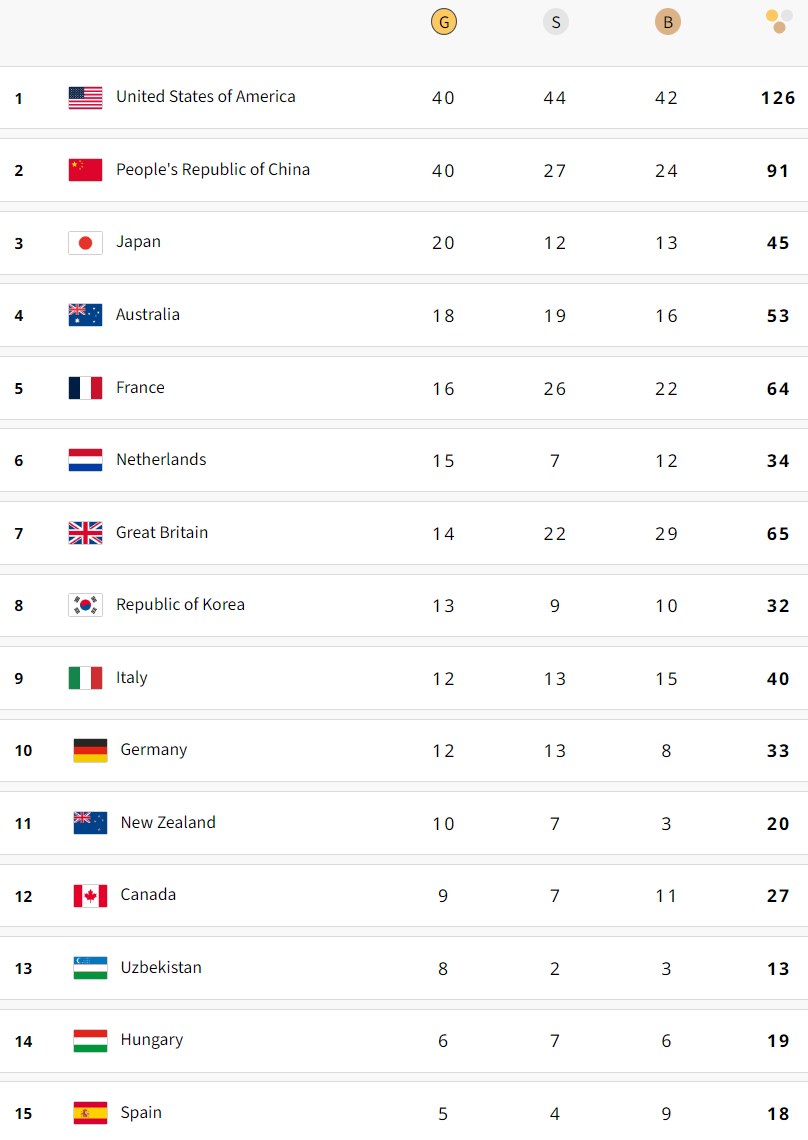
Paris 2024 Olympics - Final Medal Table. Olympics Review & Top 5 Australia Gold Medals.
Paris 2024 Olympics – Final Medal Table

Australia’s Top 5 Gold Medals

5 Kaylee McKeown (200m backstroke – women)

The double double! Kaylee not only became the only Australian to win four individual gold medals at the Olympics (even the famed Ian Thorpe could only manage three), she was the first to defend two Olympic titles. She won both backstroke events, the 100m and the 200m, at successive Games. If gold medals are everything at the Olympics, then she’s also Australia’s greatest Olympian ever.

4 Team Pursuit (track cycling – men)

Since Australia won five gold medals on the velodrome in 2004, which included the men’s team pursuit, it’s been a horror run for the track cycling team. Only one gold medal since, by Anna Meares in 2012 in the women’s sprint, and hopes were high for the team pursuit in Paris. The men broke the world record with a phenomenal time of 3:40:730 in the semi finals (I remember when breaking 4 minutes was a major achievement) and then it was a matter of beating arch rivals, Great Britain, in the gold medal race. It was neck and neck throughout with Australia holding onto the slightest of advantages. The Brits pushed it so hard that one of their riders slipped off the saddle on the final lap and it was all over.

3 Cameron McEvoy (50m freestyle – men)

A story of resilience and perseverance as it took McEvoy until his fourth Olympics to finally win gold. McEvoy choked badly at Rio 2016 as a hot favourite in the 100m and almost quit the sport following the Tokyo Games in 2021 in which he underperformed. He revitalised his training routine, taking a more scientific approach and reducing his time considerably in the pool. It worked. He won gold at the 2023 World Championships and now it was it matter of putting all together in Paris. The squeal from commentator Giaan Rooney as McEvoy touched the wall said it all. While the women won all of Australia’s other gold medals in the pool, the best one was from a man.

2 Jessica Fox (K1 canoe slalom – women)

Another story of resilience and perseverance. Since bursting onto the scene with a silver at London 2012, big things were expected from Fox at Rio 2016 and Tokyo 2020. Both times ended in disappointment after errors cost her the gold and relegating her to bronze. While she recovered in Tokyo to win the new event of the C1 slalom to finally win a gold medal, it wasn’t THE gold medal. Fox would need to wait for her fourth Olympics to win that elusive K1 gold and this time there were no mistakes. Again, the reaction said it all, with screams and tears and relief and joy! That was just from me! Fox’s emotions were at another level. Just hearing her name announced at the medal ceremony as “Olympic champion” brought more tears to her, and myself. Fox would then win the C1 event too, while her little sister, Noemie, stunned herself, Jessica, her parents, me, and Australia, by winning the kayak cross. Jessica was knocked out in an earlier round, in a race that involved Noemie, so it shows you the fickle nature of that event. The thing is, Noemie was exceptional in all the rounds, putting herself in the right position and nailing all the gates, so her victory was all hers. Her win also meant the Fox sisters became the first ever siblings to win an individual gold medal in Australian Olympic history.

1 Saya Sakakibara (BMX racing – women)
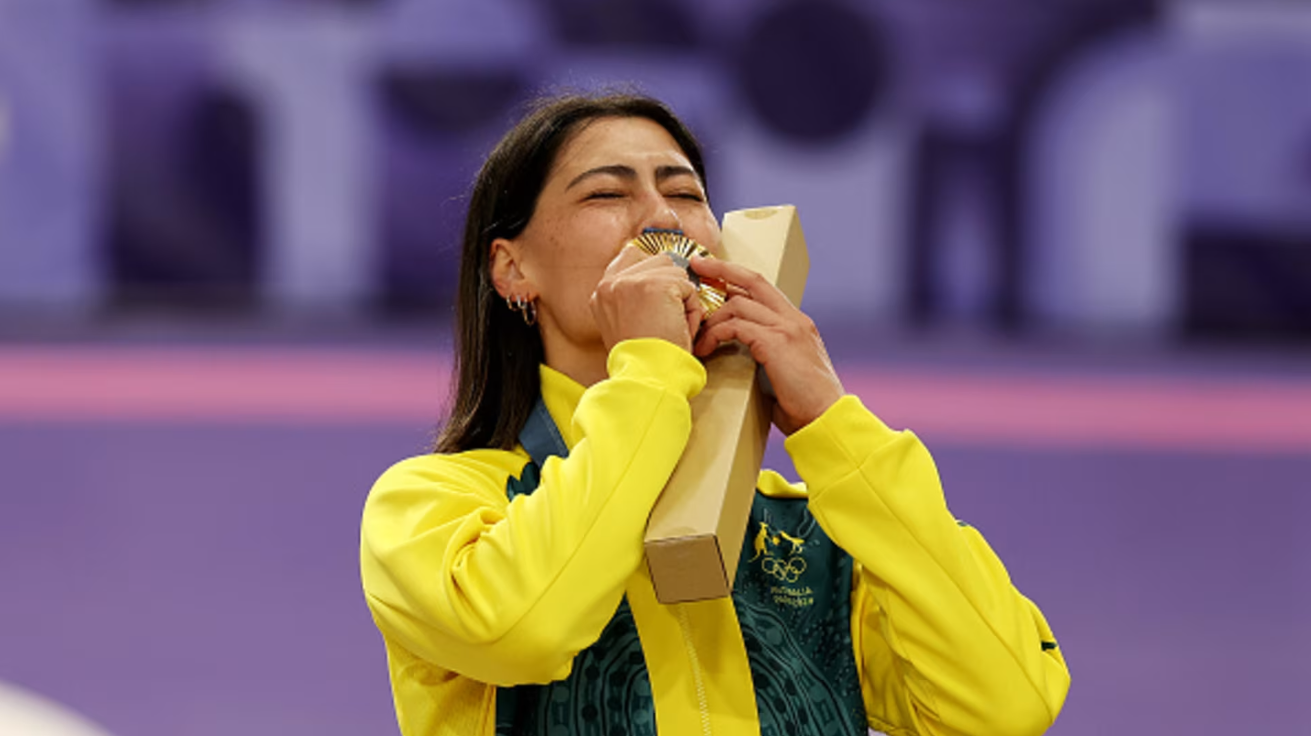
Saya Sakakibara wins the gold medal in BMX Racing at Paris 2024. Olympics Review & Top 5 Australia Gold Medals
An emotional gold medal for Saya Sakakibara in BMX Racing at Paris 2024 – Image: Getty

Australia’s history in this event is wretched, with previous hot favourites that crashed, as did Saya in the final heat of the semi finals in Tokyo. She really hoped to win a medal in Tokyo given Japan is the home country of her mother and she was riding for her brother, Kai, who crashed in a race in 2020 and suffered a severe brain injury that left him in a coma for 6 weeks. That crash was devastating for Saya, and then followed a run of injuries and several concussions that saw her contemplate quitting the sport. Come Paris, it was redemption time, and riding with Kai’s race number of 77, Saya was flawless from the very start in qualifying and in every round of racing, and won gold in emotional scenes. In her words: “All I had to do was just f…ing go and I f…ing went for it.” After the race, Saya provided one of the greatest and most honest sporting quotes about her quest for gold: “Either way, it was going to end in tears, and I wanted to make sure they are happy tears.” She’s a legend. Just prior to her race, her boyfriend, Romain Mahieu, riding for France, won bronze in the men’s event behind two other Frenchmen. He embraced her as she crossed the line and after she let out a guttural scream. Unknown to Saya, her gold was the third that Australia won that day in 77 minutes.
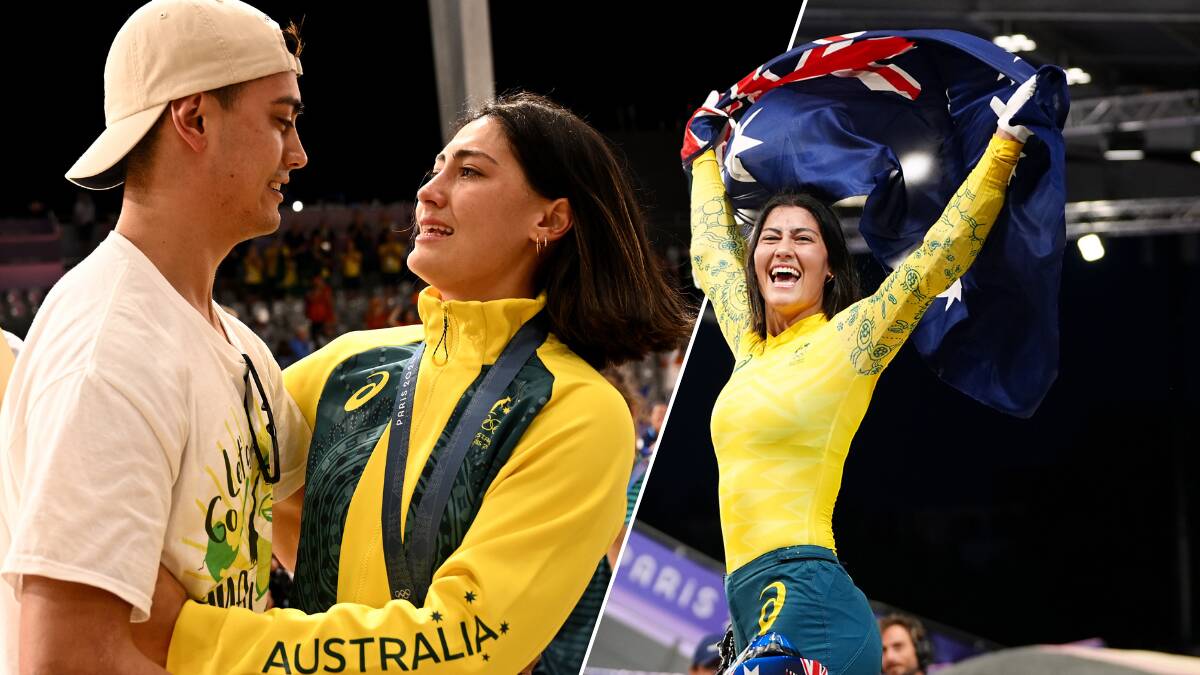
Saya Sakakibara celebrates her Olympic gold medal with brother Kai at Paris 2024. Olympics Review & Top 5 Australia Gold Medals.
Saya Sakakibara celebrates her Olympic gold medal with brother Kai at Paris 2024 – Image: AAP

The two golds that preceded Saya’s were those of McEvoy and McKeown as listed above. That personally made that day, 2 August 2024, our greatest day in Olympic history. Too often we get obsessed by total medals won instead of savouring them individually. That day we got the chance.

Paris 2024

Paris 2024 were a wonderful Olympics. The French did everything right, except perhaps not converting some minor medals to gold (16 gold, 26 silver and 22 bronze for 64 total). The opening ceremony along the Seine River was a novel idea, especially for the parade of nations, and the lighting of the cauldron was spectacular. Then the French took the opposite approach when snuffing the flame at the closing ceremony. The crowds were loud and passionate, all the venues and locations were spectacular, and there was so much available free to the general public. Little touches like the medalists taking selfies were appreciated, while Champions Park, at the foot of the Eiffel Tower, where medalists were presented to the public, will no doubt be a feature of future Olympic Games. The Winter Games already had something similar with their medal ceremonies conducted on a big public stage in the actual host city, rather than on some remote ski slope, and now the Summer Games have their own version. Paris certainly did it their way. The closing ceremony ending with a breathtaking performance of My Way by Yseult was perfect, while the rendition of the United States national anthem by H.E.R. earlier in the evening was among the best ever. Truly a superb Games – c’est magnifique! – and now my favourite Olympics ever ahead of London 2012 and Barcelona 1992. Merci, Paris!

AUSTRALIA’S MEDALS

GOLD

Athletics

Women’s Pole Vault – Nina KENNEDY

Canoe Slalom

Women’s Kayak Single – Jessica FOX
Women’s Canoe Single – Jessica FOX
Women’s Kayak Cross – Noemie FOX

Cycling BMX Racing

Women – Saya SAKAKIBARA

Cycling Road

Women’s Individual Time Trial – Grace BROWN

Cycling Track

Men’s Team Pursuit – Australia

Sailing

Men’s Dinghy – Matt WEARN

Skateboarding

Women’s Park – Arisa TREW
Men’s Park – Keegan PALMER

Swimming

Women’s 200m Freestyle – Mollie O’CALLAGHAN
Women’s 400m Freestyle – Ariarne TITMUS
Women’s 100m Backstroke – Kaylee McKEOWN
Women’s 200m Backstroke – Kaylee McKEOWN
Women’s 4 x 100m Freestyle Relay – Australia
Women’s 4 x 200m Freestyle Relay – Australia
Men’s 50m Freestyle – Cameron McEVOY

Tennis

Men’s Doubles – EBDEN/PEERS

SILVER

Athletics

Women’s 1500m – Jessica HULL
Women’s High Jump Nicola OLYSLAGERS

Canoe Sprint

Men’s Kayak Four 500m – Australia

Cycling Track

Men’s Sprint – Matthew RICHARDSON
Men’s Keirin – Matthew RICHARDSON

Diving

Women’s 3m Springboard – Maddison KEENEY

Equestrian

Eventing Individual – Christopher BURTON

Marathon Swimming

Women’s 10km – Moesha JOHNSON

Sailing

Men’s Windsurfing – Grae MORRIS

Surfing

Men – Jack ROBINSON

Swimming

Women’s 50m Freestyle – Meg HARRIS
Women’s 200m Freestyle – Ariarne TITMUS
Women’s 800m Freestyle – Ariarne TITMUS
Women’s 4 x 100m Medley Relay – Australia
Men’s 100m Freestyle – Kyle CHALMERS
Men’s 400m Freestyle – Elijah WINNINGTON
Men’s 200m Breaststroke – Zac STUBBLETY-COOK
Men’s 4 x 100m Freestyle Relay – Australia

Water Polo

Women – Australia

BRONZE

Athletics

Men’s Discus Throw – Matthew DENNY
Women’s High Jump – Eleanor PATTERSON
Women’s 20km Race Walk – Jemima MONTAG
Marathon Race Walk Relay Mixed – COWLEY R/MONTAG J

Basketball

Women – Australia

Boxing

Men’s 57kg – Charlie SENIOR
Women’s 75kg – Caitlin PARKER

Canoe Sprint

Men’s Kayak Double 500m – van der WE/GREEN

Cycling BMX Freestyle

Women’s Park – Natalya DIEHM

Cycling Track

Men’s Team Sprint – Australia
Men’s Keirin – Matthew GLAETZER

Rowing

Women’s Pair – MORRISON/McINTYRE

Shooting

Trap Women – Penny SMITH

Swimming

Women’s 200m Individual Medley – Kaylee McKEOWN
Men’s 4 x 200m Freestyle Relay – Australia
Mixed 4 x 100m Medley Relay – Australia

France 2019 – Women’s World Cup Review

Tokyo 2020 Olympic Games Review – Grading Australia’s Performance
Qatar 2022 – World Cup Review

29 December 2022

Australia’s best ever World Cup performance, a worthy winner in Argentina, a high quality and efficiently run tournament, and Lionel Messi still does not compare to Diego Maradona. That was the story of 2022 FIFA World Cup in Qatar.

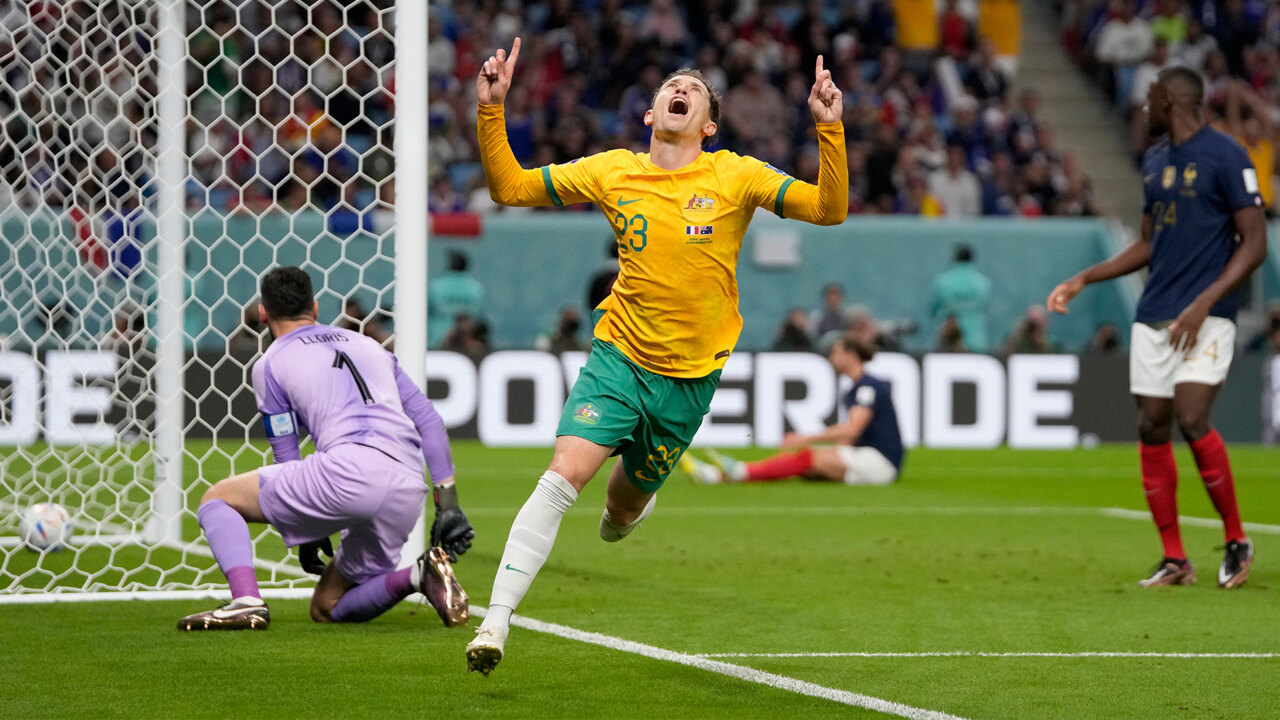
For the unheralded Socceroos, with a team of mostly domestic players and no big names, the portend of bigger things to come began early with a shock goal by Craig Goodwin on 9 minutes against the previous world champions, France. It was a quality goal too, after Mathew Leckie, on the right flank, ran onto a long pass from defender Harry Souttar, turned his defender, and crossed it beautifully for Goodwin to score. While this jolted France into action and they eventually ran out 4-1 winners – notably due to Kylian Mbappe unable to be controlled – it never stopped the aspirations of this Australian team.

Craig Goodwin scores for Australia vs France at the 2022 FIFA World Cup in Qatar - Review
Craig Goodwin scores for Australia vs France at the 2022 FIFA World Cup in Qatar

With coach Graham Arnold instilling an intense belief and a strong work ethic into the team, and fashioning a disciplined, well structured defensive unit, this was the springboard to winning their next two games, holding their opponents goalless for the first time since 1974, and qualifying for the knockout stage for only the second time ever. It was a glorious move that started from defence that saw Mitch Duke head home on 23 minutes to beat Tunisia 1-0, and then Leckie’s solo break on the hour against Denmark saw another 1-0 win and guaranteed passage to the next stage. This goal and victory proved critical, as Australia could easily have relied on a draw in expectation France would beat Tunisia in the other game. Of course, France rested many players, and lost 1-0.

Group D Table - 2022 FIFA World Cup - Qatar - Review
Group D Table – 2022 FIFA World Cup – Qatar

This qualification to the knockout stage automatically made the 2022 team Australia’s most successful World Cup team ever, and they still weren’t done. Facing eventual champions, Argentina, they had them under control for the first half and even dominated large portions of play at times, with one passage consisting of about 40 passes and almost resulting in a juicy chance on goal. Unfortunately, their discipline finally broke, when Aziz Behich gave away a silly free kick in a dangerous area near the side line, and while the free kick was initially defended, Lionel Messi was able to prod it into the net after some nice interplay on the next phase of play.

That first Argentine goal was on 35 minutes, and then 12 minutes into the second half was a moment of madness when goalkeeper Mathew Ryan, upon receiving a back-pass, tried to dribble past an Argentine player, only to be dispossessed and gift Argentina their second goal. While Ryan was clearly at fault, questions must be asked why defenders play these short, dangerous back-passes to the goalie, only for it to be usually booted upfield, when they could do it better themselves, and avoid any risk in the process. Seemingly down and out, Australia scored on 77 minutes when a Goodwin shot was deflected into the net by Enzo Fernandez.

Amazingly, Australia had two golden opportunities to equalise, when Behich made a breathtaking run into the box, only for his shot to be blocked. He really should have layed off the ball to a player waiting in the box. In the dying seconds, Garang Kuol found himself on the end of the cross, beautifully trapped the ball and spun around, and had his shot narrowly saved. It would have been fitting for this team to push the game into extra time. They deserved it. It’s not just that the results were far beyond expectations, so was their performance. They were defensively tough, scored a goal in every game, and kept two teams scoreless. Goals also came from open play, not the penalty spot as were both goals in 2018. In fact, unlike then, Australia were never involved in a Video Assistant Referee (VAR) penalty decision. The only area in which Australia disappointed was set pieces, primarily from Aaron Mooy. So many were over-hit or simply wasted.

As for coach Graham Arnold, like his style or hate it, results count. Just prior to the World Cup, when Football Australia ran a competition for fans to name their Socceroos Team of the Century, I named Arnold as coach of my team. He earned it simply from the tough qualification process he had to endure, so a competent display at the World Cup would be enough to compare favourably to his predecessors. He did far more than that.

Qatar 2022

For all the controversy about such a nation with poor human rights records hosting the World Cup, the threatened protests and moralising by many countries, including Australia, just prior to the tournament, was appalling. Qatar’s issues were known well in advance, and should have been expressed vociferously before they were announced as host. It’s certainly rich to wait all these years, on the precipice of the tournament starting, to pompously get all virtuous. It was similar with the 2008 Beijing Olympics when Tibet suddenly became an issue during the torch relay. The reality is, if such rights are so important to an individual or a team, don’t attend at all. Credit to FIFA for stamping out any chance of on-field protests by sanctimonious teams and players.

The final between Argentina and France, to finish 3-3, and then go to penalties, was as good and dramatic as you could hope, with France having two of the best chances late to steal it. Overall, Argentina were the better team, and best of the tournament, and finally got their third World Cup. No, this win does not immediately elevate Lionel Messi to legend status alongside Diego Maradona. Maradona won the World Cup almost single-handedly for Argentina in 1986, whereas Messi was merely an excellent, occasionally exceptional, player. He only really had one moment of magic for the tournament, and that was setting up the third goal in the semi final against Croatia. He’s at the second level of best ever players. Pele and Maradona sit at the top.

Qatar 2022 was a thoroughly entertaining and engaging tournament. Having four matches a day to reduce the closure period for domestic leagues, certainly added a nice, breezy flow to it. The groups developed evenly, and at pace, and we were onto the knockout phase before we knew it. In contrast, with the traditional three matches a day of previous tournaments, the group stage can seem never ending. Games themselves were good, with very few dull draws, and there were some crazy upsets, notably Saudi Arabia beating Argentina in their first group game. The refereeing was brilliant. Absolutely no concerns, and they have honed the use of VAR. Clear rules over handball certainly help, as is adding accurately all the stoppage time to prevent time wasting. Although, when it’s 8 and 10 minutes of additional time, FIFA might want to considering reducing halves from 45 minutes to 40.

It was a great tournament for Asia too. Along with Australia advancing to the knockout stage, so did Japan and Korea. The hosts, Qatar, were a disappointment when losing all three games, especially after all the investment and being Asian Cup champions. Japan were players in two of the most memorable games. Firstly, beating Germany 2-1 in their first group game, and then Spain 2-1 in their final group game. Unfortunately they fell apart during the penalty shootout in the first knockout game against Croatia, after the match finished 1-1 after extra time. Arguably the most memorable game was Korea stunning Portugal, 2-1, in their final group game. They scored the winner in the 91st minute, then waited for the result of Ghana vs Uruguay to determine if they would progress. Everyone huddled on the pitch looking at phones for several minutes was a sight to see, and then came the jubilation. Of course, let’s not forget about Morocco becoming the first team from Africa to reach the semi finals of a World Cup. A great achievement, eventually losing to France, 2-0.

In comparison to other World Cups, Qatar 2022 is on the second level. Russia 2018 remains my favourite, with USA 1994 and Brazil 2014 at the next level, and mostly let down by some weak games in the knockout stages, including the finals themselves. Germany 2006 was great simply due to Australia’s return after 32 years and then performing well. Qatar delivered a great final and semi finals, had Australia’s best every result, while being patchy elsewhere. The images broadcast were superb, especially the wire camera that could put you on the field, and the supporting graphics like for offside. Holding the tournament in winter, despite all the whinging at the time, was clearly no issue. The default commentary feed from the host was excellent, which made SBS’s continued use of the dreary Martin Tyler for certain games, like the final, extra puzzling. He waffles on inanely and is a living barometer of the state of the game. If it’s dull, he reflects it, draining all energy from the broadcast. He only pipes up when there’s a hint of action, which was at least beneficial for the times I would drift asleep.

When Qatar bid for the World Cup, their motto was “Expect Amazing”. While it didn’t quite reach such heights, we did at least get “Excellent”. They can be proud, and now we look forward to 2026, with the USA jointly hosting the World Cup with Canada and Mexico, and it will be the first World Cup to feature 48 teams. Finally, I might actually get to one.

That was Qatar 2022 – The 22nd World Championship of Football

My Socceroos Team Of The Century

Russia 2018 – World Cup Retrospective: The Final, VAR, Australia & Ange Postecoglou

France 2019 – Women’s World Cup Review

Alen Stajcic sacked for no reason sees Australia predictably fail

13 July 2019

On the surface, a loss to Norway at the round of 16 stage via a penalty shootout after 1-1 draw doesn’t seem so bad. It could even be explained as simply being unlucky. In reality, the loss capped off a disastrous few months for the Matildas, as Australia’s women’s soccer team went from genuine World Cup contenders to an inept defensive unit and struggling to beat teams they ordinarily were dealing with quite easily.

The troubles started when Alen Stajcic was sacked as coach by Football Federation Australia in January for apparently overseeing a poor playing environment following a “Matildas Wellbeing Audit”. A quarter of a players in two confidential surveys – the type that are notoriously used to inflate personal grievances into systemic problems – said they felt under stress, while the FFA cited “workplace culture” and “player welfare” issues. Director Heather Reid was quoted in the media at the time saying “if people knew the actual facts about Mr Stajcic’s behaviour ‘they would be shocked’.”

This was all a lie as FFA wanted Stajcic out for reasons unclear. While CEO David Gallop maintains Stajcic was sacked to give Australia “the best chance to perform at the World Cup”, who did they hire as his replacement? No, not Jesus, who would be just about the only person who could be doing better with the Matildas at the time. They hired Ante Milicic! This was a coach getting his first serious senior gig! So you replace a proven performer, who had won the Tournament of Nations in 2017, beating USA, Japan and thrashing Brazil 6-1 along the way, and followed that in 2018 with wins over Brazil and Japan and a draw against the USA, with a newcomer.

France 2019 - Women's World Cup Review - Sam Kerr misses penalty shootout kick for Australia vs Norway
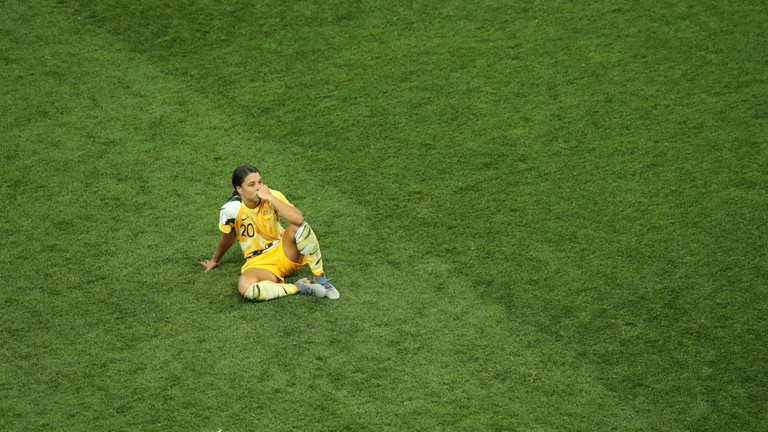
Sam Kerr despondent after missing her penalty in the shootout as Australia lose 4-1 to Norway. Image: fifa.com

It’s utterly bonkers the FFA can expect anyone to seriously believe them and, indeed, Heather Reid would later apologise and withdraw her statements “entirely and unconditionally”. She would say “I apologise unreservedly for the damage, distress and hurt that I have caused to Alen Stajcic” and “I apologise also for pain and suffering that I have caused to Mr Stajcic’s wife and two young children”, while the FFA confirmed “Stajcic’s contract was not terminated on the basis that he had breached his contract or had engaged in any misconduct”. Reid has been on indefinite leave from the FFA board due to health reasons since the crisis started, and that’s probably the reason she hasn’t been sacked yet. Gallop has announced he will leave in December – at least 12 months too late. He should have quit the moment the Matildas, and therefore he, failed.

Still we don’t know why Stajcic was really sacked. Either that survey, in this crazy “woke” era we live in, spooked the FFA into a ridiculous overreaction, or the FFA wanted him out for whatever reason and commissioned the survey hoping to get some dirt to use against Stajcic. Many high profile players were stunned at his sacking, and defended Stajcic publicly. Indeed, many didn’t even realise the survey would be used against Stajcic, and had they known, might not have been so cavalier in answering it. So if there is any legitimacy to player distress, it’s probably only a handful of younger snowflake peripheral players who think earning a spot in a national team should be easy.

No surprise it was a dreadful start for Australia in its opening game against Italy when Italy tore them apart, and were unlucky to only win 2-1. They constantly breached Australia’s high defending, while Australia lacked cohesion going forward, and wasted possession. This was a continuation of the pattern we’d already seen in preparation games against USA and Netherlands, in which Australia lost 5-2 and 3-0, with the latter result only one week before Australia’s opening World Cup match.

Australia vs Italy Highlights – France 2019 Women’s World Cup

It must be noted that team pedigree for the women does not align with the men. Even though they were current European champions, this was Netherlands’ second ever World Cup, while Italy hadn’t qualified in 20 years. France is still developing, while Spain is a step behind. Germany is the only traditional European power to excel, when winning the World Cup in 2003 and 2007. Norway has been the traditional European power (won in 1995), with Sweden just below them, as these were the first European countries that empowered women to play. In recent years, the more traditional powers have started domestic leagues for women and are beginning to exert their force. South America is still way behind with only Brazil showing glimpses of ability to challenge the best teams. China led the way in Asian initially before Japan took over (won in 2011). Now Japan are off the boil. Of course, the best female team traditionally is the USA. Australia’s mostly hovered around the second tier of teams over the years, and only hit the top tier in recent years under Alen Stajcic. Of course, he was sacked before his true test, at this World Cup in France.

Australia’s second match was against Brazil, which they won 3-2 after falling behind 2-0 – again being caught high. A goal just before half time was able to provide confidence leading into the second half. Still, it must be tempered with the fact that Brazil had lost 9 games leading into this World Cup before beating lowly Jamaica in their opening Cup game, and only lost to Australia due to a dreadful own goal by Monica.

Australia vs Brazil Highlights – France 2019 Women’s World Cup

Jamaica would be Australia’s final game in the group, and again it proved a struggle, and they had to thank some poor Jamaican defending and a goal-keeping blunder in their 4-1 win. At 2-1, Jamaica actually looked ominous until Australia snuck a goal.

Jamaica vs Australia Highlights – France 2019 Women’s World Cup

Against Norway in that round of 16 clash, Australia were caught high again when falling behind, before managing to equalise late through a fluky direct corner. Naturally the Australian media whinged about being dudded against Norway. A penalty was awarded to Australia for allegedly hand-ball in the box. Replays show the ball hit the Norwegian’s shoulder and it would have been a clear and obvious error had the penalty not been rescinded.

Norway vs Australia Highlights – France 2019 Women’s World Cup

If Australia were dudded, it was sacking coach Alen Stajcic for no reason months before the World Cup started. The defense was diabolical ever ever since, conceding multiple goals in most matches, and were lucky to beat Brazil and survive the group. Let’s not fault the players either. This debacle was all administrative, as when you sack the coach for no reason just months before the World Cup starts, you can’t expect it to go without consequences. The Matildas were put in an unmanageable position to succeed.

So the World Cup that seemingly Australia was on the precipice of achieving their best ever result, if not winning, ended in a performance and result well below ability and expectation. Sacking Stajcic was never about giving the team the best possible chance to perform, it was an exercise in vanity and ego, and likely to distract from the FFA’s own flaws. Let’s note the men’s team is at their lowest ebb in decades and the youth teams often fail to qualify for World Cups and Olympics, and now we have the women’s team go backwards. In a way, the Matildas’ failure at France 2019 is justice for the treachery of the FFA. Such selfish and despicable actions should never be rewarded.

Finally…

Overall, it was a great World Cup. USA won for the second time in a row and the fourth time overall, and showed their class throughout and handled Netherlands quite comfortably in the final for their 2-0 win. Most notable from the tournament is the Europeans have really developed and dominated, with the quarter finals featuring seven of them: Norway, England, France, Italy, Netherlands, Germany and Sweden. The standard has improved too, notably with the goal-keepers. In the early days of women’s football they were an embarrassment.

It’s a shame the American success wasn’t as unifying as it could be due to Megan Rapinoe’s unsavoury antics, notably kneeling during the anthem in 2016, the general criticism of her country, and the equal pay dispute between men and women. Curiously, that kneeling event was when Rapinoe started on the bench. She’d dare not do it on the field – restricted at the World Cup to simply not singing – and no doubt was told at the time she’d be booted off the team if there’s a repeat episode. After all, this is the USA national team. It represents the country and its people. If you don’t respect that, get out. If she was really passionate about diversity, she’d not be playing soccer anyway. One look at the American team and it looks more whiter than the Republican Party and that many come from privileged backgrounds. As for equal pay, she can start with all players in her own team and domestic competition earning the same. They do the same work, the same training, so why not? No doubt she’ll respond market forces and her value dictate her higher salary. Bingo. Same goes when trying to compare a Rapinoe to a Ronaldo, or the women’s World Cup to the men’s.

The Video Assistant Referee was highly visible in this World Cup, and while there was some minor controversy about decisions, this was more due to FIFA’s stricter guidelines on handballs and trips regarding penalties, than any wrong decisions made. Overall, it worked. Probably the area to rethink is offsides let go, and often only called once the player offside eventually touches the ball. This can causes players, notably defenders, run for the ball for no reason. Personally, the line referee needs to signal of a potential offside, especially an obvious one, so the players don’t waste their energy. If it’s not obvious, you let the game go and only check if a goal is scored, as is has become practice now. Ensuring goal-keepers don’t leave their line before a penalty kick is taken is another great use of VAR. It’s been an area of cheating for decades in the game, and it should have been long stamped out. Bravo to FIFA for actually doing good things for the game, and to the women for an excellent tournament.

Results

Group

Australia 1 – Kerr 22′
Italy 2 – Bonansea 56′, 90+5′

Australia 3 – Foord 45+1′, Logarzo 58′, Monica 66′ (OG)
Brazil 2 – Marta 27′ (PK), Cristiane 38′

Jamaica 1 – Solaun 49′
Australia 4 – Kerr 11′, 42′, 69′, 83′

Round of 16

Norway 1 – Herlovsen 31′
Australia 1 – Kellond-Knight 83′
(Norway won 4-1 on penalties)

Russia 2018 – World Cup Retrospective: The Final, VAR, Australia & Ange Postecoglou

02 September 2018

It’s been seven weeks since the final of Russia 2018, where France beat Croatia 4-2, and with that came the confirmation that the world just witnessed the best World Cup ever. In my lifetime, it certainly was. The closest competition was USA 94, which unfortunately fell down with dull semi finals and a really dull 0-0 final. Brazil 2014 was on track to be a great one until the knockout stages mostly disappointed. The rest going back to Mexico 86 were all good, while Germany 2006 will always be memorable due to Australia’s return and three dramatic matches. So Russia 2018 is it.

France wins the 2018 World Cup in Russia

France wins the 2018 World Cup in Russia. Image: fifa.com

It wasn’t so much that Russia 2018 was full of goals (at 2.64 per match), or even full of great goals. The dead rubber of France vs Denmark was the only 0-0 too. It was mostly that it was full of drama. That drama was epitomised with the final itself, where own-goals, video assistant referees, penalties, a smaller nation excelling, and touches of class, all made it a microcosm for the tournament itself. With many Russian cities quite easterly, it meant a reasonably friendly timezone, so more of a football feast for us in Australia.

The six goals in the final of Russia 2018 was the same total as all the goals in normal time of the last four World Cup finals, and one less than the seven goals of the 1958 final. Croatia, though benefitting from one of the softest draws imaginable and requiring penalty shootouts and England to choke to progress, were unlucky to be 2-1 behind to France at half time. France had only one shot on goal for the half compared to 7 for Croatia. Classy goals on 59 and 65 minutes effectively sealed it for France, before a crazy goalkeeping error on 69 minutes gifted Croatia one back. It proved insufficient as France comfortably held on to win.

FIFA Match Details

France were the best team all tournament and deserved 4-2 winners. In contrast to Croatia’s opponents along the way of Denmark, Russia and England, France had to contend with Argentina, Uruguay and Belgium – with the latter two arguably the third and second best teams in the tournament. Both likely would have breezed to the final on Croatia’s side of the draw. In fact, Belgium’s most important match was their final group game against England. Had they surrendered the game with a draw or a loss, they’d have been on the weaker side. Instead they won 1-0 – and then beat England again in the third placed game, 2-0.

Russia 2018 will also be remembered for the dominance of the European teams, and the poor performance outside of Europe and South America. All semi-finalists were European, while only Mexico and Japan could make the knockout phase, with both only scraping in. Despite two wins in their first two games, the 3-0 loss to Sweden in their final game meant Mexico required Korea to beat Germany. That happened only in the dying minutes, reversing the heartbreak Mexico had at the final whistle when it seemed that match would be a draw.

Japan only progressed through “fair play” rules after being in a deadlock with Senegal on all other tiebreak methods. From there, at least they put on a good show and seemed on course for a shock win over Belgium in their last 16 match when scoring two early second half goals, only to be run over and lose 3-2, with Belgium’s third goal coming with the last play of the game. Mexico looked good when beating Germany in the opening group game before later matches revealed Germany were a team on the slide. Only just scraping past Sweden and then losing to Korea to be sent home early. In fact, that win by Korea made it quite a successful tournament in the group phase for Asians teams. Four of the 5 won a match, with only Australia missing out.

Australia

It’s a mixed bag. Struggling through the qualifying campaign, expectations were low for Australia’s chances in Russia, with a feeling they would be on the path to humiliation. That short-term coach Bert van Marjwilk was able to mould a competitive and resilient unit was of great credit to him. Unfortunately, defence, something that has plagued Australia since they returned to the World Cup in 2006, was again weakness, with Australia 0-0 against Chile in 1974 remaining their only clean sheet. Quite simply, you won’t win many games at a World Cup while consistently conceding goals.

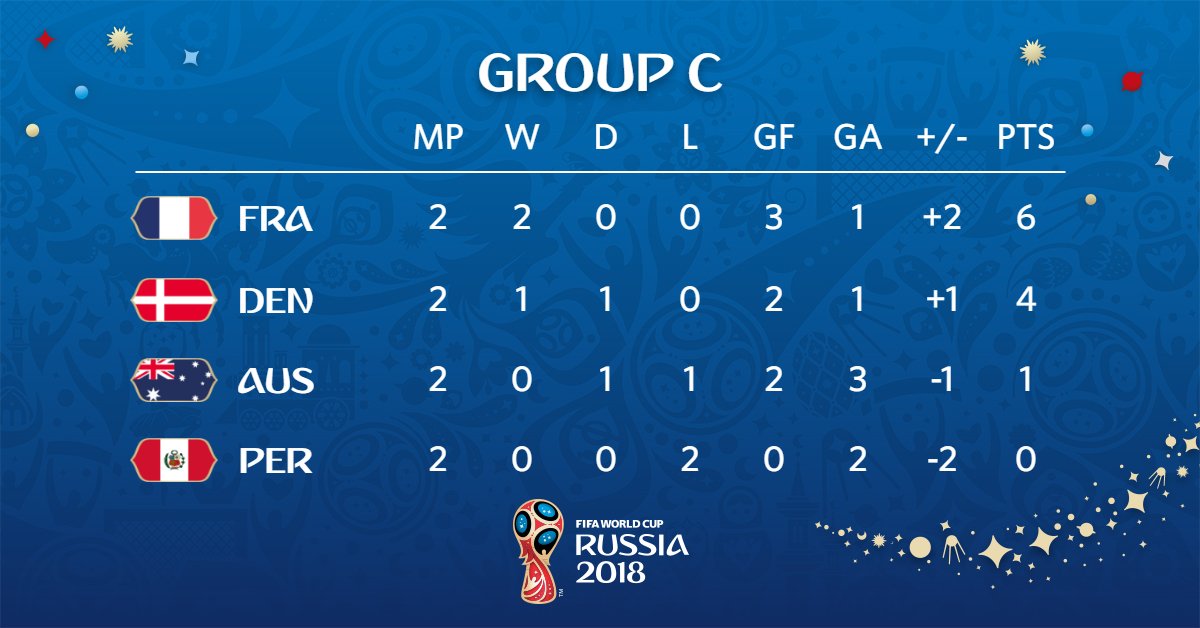
At Russia 2018, with the lack of firepower upfront, goals conceded, notably France’s second goal and Denmark’s goal, proved fatal. Both should have been prevented, and if so, a loss and a draw becomes a draw and a win, and progress to the knockout phase. By the time of the final match against Peru, there was little to play for, and for a Peruvian team unlucky in their first two matches, they were too good for Australia. So bottom of the group with 1 draw and two goals by penalty, it’s not good reading, and not the progress expected after 3 losses in 2014. One positive is, that after Belgium, Australia probably gave the eventual world champions their greatest test.

World Cup Russia 2018 – Group C final standings

World Cup Russia 2018 – Group C final standings

While debate turned to van Marwijk’s lack of use of Tim Cahill until the second half against Peru, the reality is the coach was left little time to prepare the team so stuck to a fixed plan. It was based on a settled team and improving them as a unit. With Cahill barely playing any minutes for the latter half of the season at Millwall, and already being phased out under Ange Postecoglou, it was always questionable to promote him ahead of players with solid time and form with their clubs. The second half against Denmark, when the game was there for the taking and Cahill remaining on the bench, that was probably the only questionable decision. While, in retrospect, Cahill should have got a run, too much focus there detracts from the overall good job done. As van Marwijk said, he’s not a magician. Australia’s issue all along was lack of quality players, especially gamebreakers and scorers in the final third.

Ange Postecoglou

Also questionable was former coach, Ange Postecoglou’s article on the Player’s Voice website, suggesting Australia still likes being an underdog, and his quest to change that attitude was actually a personal crusade, not a tidal wave of change he was about to ride. While that underdog sentiment still lingers (“brave” was a common word heard after the close loss to France), Postecoglou’s proposition to play aggressive, attacking football, to show the world Australia are not battlers, is very much another way to dodge accountability for poor results. As much as saying “we were underdogs” tries to justify a loss, so is saying “at least we had a go”. Neither are great mentalities, as the key measure of success at a World Cup is always results. If you look at a comparable team like Sweden, the question of whether you’d prefer their grafting style that sees consistently reach the quarter finals when they qualify or a “have a go” strategy that really only achieves praise from armchair neutrals, I know which way I’d go.

This World Cup was a counter-attacking World Cup, where the possession game was demolished, so to think Australia could bustle in and take on these crack international teams with such a strategy would have been a guaranteed mission of suicide. The “competitiveness and defensive stability” that van Marwijk brought was actually a positive because Australia lost it under Postecoglou. Being aggressive and attacking is all well and good as long as you don’t sacrifice other key aspects of the game. It’s quite galling for Postecoglou to be so critical of the playing style at this World Cup when he had abandoned the team with mission incomplete. For someone so full of the “have a go” mentality, he showed incredible weakness when crunch time came. Not just on the field either. Off the field and facing accountability, that was not something palatable for him. It seems as though Postecoglou felt he had carte blanche to do anything he pleased with the team, even if it jeopardised World Cup qualification itself. Apparently we were meant to look at the big picture. No, the big picture is the World Cup, and that’s where success and failure is defined.

TV Coverage

It’s hard not feel some sort of sympathy for Ange Postecoglou’s ethos anyway, as much of the media and fans are obsessed with “performance” over results – a phenomena normally most appreciated only in the bedroom. Chief choir boy was again, Craig Foster on SBS, who typically within 5 seconds of being asked a question he’d begin prattling on about the same old stuff, while Lucy Zelic would look gushingly on. It became unlistenable that I would mute the telecast. Zelic had her faults too, notably her obsession with correct pronunciation of foreign names while doing nothing about her appalling English diction. It’s one of the worst Australian accents on TV. If she can sort that out, she’s a winner.

This was the first SBS football telecast since the death of Les Murray and it had a sense of watching kids on work experience kids. Really amateurish at times, with the two main hosts lacking direction. Guest panelists would lift it, as did the increased use of David Zdrilic. In retrospect, SBS might have been caught short as they were meant to only show one match per day after selling off most of the rights to Optus Sport. The debacle with their streaming service meant SBS would simulcast the games anyway. It’s a shame, because Optus had the far superior presentation, with the likes of John Aloisi and Mark Schwarzer providing great insight into the actual games, while their use of default English language commentators meant we were liberated from the tiresome Martin Tyler.

Video Assistant Referee (VAR)

This tournament was full of so many penalties, which be attributed to VAR. It was great in finding penalties that would often happen happen too fast, or not 100% certain, for the referee to see. It also created confusion about when it should be used, that whether it’s for overturning a “clear and obvious error”. First thing to realise, denying a rightful penalty would be a clear and obvious error. It’s not so much blatancy of a foul, it’s the impact, and obviously not awarding a penalty is a great impact on the match.

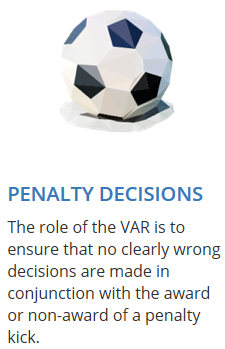
VAR guidelines on penalty decisions

VAR guidelines on penalty decisions

The final itself had a great example (along with Antoine Greizmann in France vs Australia) when Ivan Perisic was adjudged to have fouled. Whether deliberate or not is now irrelevant, and that’s been the trend for many years now, way before VAR. Bottom line is Perisic moved his hand downward to the ball, and palmed it onto his leg to knock it out of play. Intentional or not, the use of the hand clearly blocked the corner from entering the goal area. The only issue is that the referee took so long to confirm it.

Suggestions by ESPN commentators that the referee initially decided no when checking the replay, and then returned to look again, possibly prompted by VAR, is likely nonsense. He could have already confirmed a penalty and decided to double check. Remember also that with VAR about, referees are now less inclined to make tight calls, so rather than VAR there to intervene on clear and obvious errors, it’s really to intervene on clear and obvious incidents, especially relating to penalty kick decisions, and also if the referee never saw the incident in the first place.

Also the rule about “deliberate” means subjectivity is always involved. While the referees have been moving towards zero tolerance over the years, VAR almost makes it zero tolerance. With that knowledge, then “deliberate” needs to be removed from the equation, and any handball in the box that affects the offensive team’s chance of scoring should be a penalty. Note, such incidents outside the box are nearly always a foul, so just because the repercussions might be harsher on the offending team, it shouldn’t mean the enforcement of the rule is less strict. In fact, when the stakes are higher, so should be the enforcement. Remember that players are so adept these days at making anything intentional look like an accident, and while Perisic may have known nothing about the penalty, there’s every possibility he did know about it, and in the natural action of dropping his arms after jump, he deliberately made sure to contact the ball.

Own Goals

Another curiosity of this World Cup was the plethora of own goals. A new interpretation seemed in effect whereby any deflection was classed as an own goal. Previously the shooter would get the goal as long as the shot looked like it was heading towards goal, so typically meant glancing deflections were always goals and huge ones less likely so. I’ve never liked that interpretation and always believed it should be about intent. Any deliberate shot towards should be a goal regardless of deflection because the shot caused the deflection, whereas an own goal is a deflection from a non-attempt on goal, like a cross. Obviously goals directly from the defending team are always own goals.

Best Matches

QF Brazil vs Belgium 1-2
A quality display by Belgium to snuff out Brazil’s chance for immediate World Cup redemption after the semi-final 7-1 debacle against Germany in 2014.

R16 Belgium vs Japan 3-2
A stunning second half where Japan scored a double early before Belgium over-ran them, scoring the third goal only the last play of the match via a classic counter attack.

R16 France vs Argentina 4-3
France showed their potential to put Argentina away. A flattering result for Argentina, while Lionel Messi leaves another World Cup with both he and his country unfulfilled.

R16 Uruguay vs Portugal 2-1
Uruguay provided a classy display to sweep past the pretentious Portugal and Ronaldo, especially notable for two superb goals by Edinson Cavani.

QF Russia vs Croatia 2-2 (3-4)
The most dramatic match of the tournament with Croatia coming from 1-0 down to go 2-1 up in extra time, only for Russia to equalise late to sent it to penalties. A shame the Russians had to go, especially after knocking out Spain in the previous round.

Qatar 2022

With a winter World Cup confirmed, set for 21 November to 18 December, talk now is about the other big possible change: increasing teams to 48. In terms of games played, there’s only 16 more, so the real issue is whether a small country like Qatar can accommodate 48 teams plus all the supporters. Typically these sorts of suggestions that would be well embraced by national associations are implemented quickly, so it’s likely a 48 team World Cup will arrive 4 years earlier than planned. The smaller confederations benefit the most with Asia getting 8 places (currently 4.5), Africa 9 places (5), CONCACAF 6 places (3.5) and Oceania 1 place (0.5). Europe get 16 places (13) and South America 6 (4.5). There’ll be 16 groups of 3, with the top 2 progressing to the knockout stage, meaning 32 teams will play 3 matches like now. It sounds ideal, so get it done.

One foible will be that with 3 teams to a group there’s no simultaneous final match like presently. Personally, these simultaneously matches have always been an overreaction to a controversy in 1982 when Austria and Germany seemed to conspire in their final group match to ensure they both progressed instead of Algeria, who played the day before. Such a situation can be avoided by a floating schedule for the final round whereby, in the 1982 case, Austria and Germany would have played first. Facts are, these days the final round equations are obvious anyway (eg: this year France and Denmark knew a draw would be enough to progress ahead of Australia), while a small thing called the telephone and internet keep teams updated about the concurrent match anyway (note when Japan learnt Senegal went behind to Colombia they suddenly settled for their 0-1 score against Poland and simply kept possession for the last 10 minutes). Also, in a 3 group team, a conspiracy situation is less likely to arise.

FIFA World Cup Russia 2018 Logo

That was Russia 2018 – The 21st World Championship of Football

Russia 2018 – Australia vs Peru Review, What Went Wrong, Tournament Player Ratings

Russia 2018 – Australia vs Peru Review, What Went Wrong, Tournament Player Ratings

28 June 2018

This World Cup was always more about hope than expectation, and that hope was only ever a tentative one. A solid performance in the 2-1 loss to France provided a small spark of hope that Australia could beat Denmark in their next match and set a strong course for the next phase. That spark quickly extinguished when Denmark scored early, only for it to reignite when the Socceroos equalised not long after. Alas, no. Despite dominating much of the game, Australia were unable to get a winner, so were faced with the double jeopardy of beating Peru and hoping France beat Denmark.

Entering the final game against Peru in Sochi, it was almost a continuation of the Denmark game. Australia dominated early, failed to convert opportunities, and then went behind on 17 minutes. Four minutes into the second half, it was another goal for Peru, and any flickering hope we had now changed to putting us out of our misery and ending this campaign that always seemed forlorn. A late Peruvian shot hit the post to avoid a more embarrassing 3-0 loss. Not that an Australian win would have mattered, as France and Denmark only needed a draw to qualify first and second, and 0-0 was the not so unexpected final score.

Aaron Mooy sums up Australia's disappointing campaign after 2-0 loss to Peru - World Cup Russia 2018

Aaron Mooy sums up Australia’s disappointing World Cup campaign after their 2-0 loss to Peru in their final game at Russia 2018. Image: fifa.com/Getty

In fairness, Peru were the second best team of the group and should have progressed. They dominated much of the action against Denmark and France with 27 shots on goal, and shot a penalty over the bar against Denmark. They lost that game that they should have won, meaning their match against Australia was only for pride. In victory, they looked as despondent as Australia did. Not only were Peru more deserving to progress, and more lethal when required, they also out-played Australia strategically. In contrast to their two frenetic opening games, knowing Australia had to win, Peru let Australia do all the running, and picked them off the break.

Peru’s opening goal was simply a lob over the top that was passed across the box for a running Andre Carrillo to hit first time into goal. Calls of offside were dismissed as Trent Sainsbury got a foot to the ball to annul the possible offside. It was Peru’s first real chance of the game, whereas Australia and several opportunities, and continued to create them. The best being a low cross by Robbie Kruse that saw Mathew Leckie just fail to connect while under pressure by two defenders, Tom Rogic shooting meekly at the goal-keeper after skipping past four Peruvian players, and an Aziz Behich volleyed cross that failed to find an open Tim Cahill.

World Cup Russia 2018 – Group C final standings

World Cup Russia 2018 – Group C final standings

A disappointing end to a totally disappointing campaign. Even the qualifying campaign was disappointing, with the team constantly conceding goals and having trouble to score goals. It came down to an intercontinental playoff against Honduras, in which, after 0-0 in Honduras, Australia won 3-1 in Sydney, thanks to a free kick and two penalties by Mile Jedinak. In Russia, it was all too familiar. Conceding goals, and the only two goals scored were penalties to Jedinak. While the lack of a killer edge up front was clearly obvious, facts are the perennially leaky defence could never be fixed. Ignoring the less relevant fact Australia hadn’t kept a clean sheet at a World Cup since the 0-0 against Chile in 1974, the more relevant fact is through the entire World Cup cycle for Russia 2018, defence has been a problem. The glaring reality is if Australia could have denied France one of their goals and Denmark their goal, they’d have made the next round.

In hindsight, there doesn’t seem much more Australia could have done. The most glaring situation was when Tim Cahill not brought on against Denmark when they were ripe for the picking. When Andrew Nabbout was injured, it’s fair to say most people were surprised that Tomi Juric came on instead. This was at a stage when Denmark, with France as their final game, were clearly happy with the 1-1 score, and were playing tentatively. Australia was in desperate need of a big moment and Tim Cahill is our big moment player. It wasn’t until Peru that he got a run – not long after Peru went 2-0 ahead – and it was all too late by then. To his credit, in that limited amount of time, he had a shot blocked after a corner, and would have had a goal at his fourth World Cup had Behich crossed better.

It would be unfair to criticise Bert van Marwijk too harshly as he arrived with only a limited amount of time with the squad, and would have judged his playing selections by his own measure. Cahill played barely any club football in 6 months so it’s not right to compare the Cahill we’ve known all these years, or even a year ago, with the Cahill of now. Remember, Ange Postecoglou had been phasing Cahill out of his starting teams long ago, and indeed, it was Postecoglou deserting Australia with mission incomplete that compromised the team’s preparation. Van Marwijk’s first match was a 4-1 loss in Norway in late March, and fears coming to Russia were a smashing by France. That the team produced three creditable and competitive performances, and put themselves in a positions to win, is a huge tick for van Marwijk, and easily offsets the non use of Cahill against Denmark, especially since we can never know if he’d have made a difference.

PLAYER RATINGS FOR THE TOURNAMENT

GOALKEEPER

Matt Ryan 6

Not at fault for any of the goals, nor made any miraculous saves or penalty saves. So it’s a “good” rating for doing his basic job.

DEFENDERS

Trent Sainsbury 7

Did little wrong at the back, other than almost conceding a penalty against Denmark, and not being quite able to intercept the pass that led to Peru’s first goal.

Mark Milligan 7

Solid in an unnatural position as a stopper next to Sainsbury. Had some good attacking flair too. Good to see him rewarded with three match starts after only playing one match in the past 3 World Cup campaigns.

Josh Risdon 6

Showed some good pace and got into good positions; unfortunately never resulted in much.

Aziz Behich 4

Not good enough at this level.

MIDFIELDERS

Mile Jedinak 6

Reasonably solid in a defensive midfield position, and reliable with penalties. General forward passing was uninspiring, or went sideways.

Aaron Mooy 8

Best player of the campaign. Let down by very few decent corner kicks, and he plenty of them to try.

Tom Rogic 7

Always looks neat and skilful on the ball, and played the two passes versus Peru that set up Kruse’s and Behich’s crosses. Otherwise, his work often results in very little, and he can’t shoot either. The World Cup is not like playing Motherwell in Scotland. Was substituted in all 3 games.

Robbie Kruse 5

Another player that looks neat, or tries to look neat. He’s lost pace, and often when he gets into good positions his crosses are rubbish or are blocked. Was substituted in all 3 games.

Mathew Leckie 8

Really stepped up when the situation demanded it. Fast and always looked dangerous. Unfortunately never quite had the support to capitalise on his work, and missed a great shooting chance late in the game against Peru by taking an extra touch.

Daniel Arzani 7

Came on all all 3 games, always looked dangerous, and twice against Denmark nearly set up a goal. Unfortunately, no actual result for his effort so it keeps his score down.

Jackson Irvine 6

Serviceable as the second midfield substitute in all three games.

FORWARDS

Tomi Juric 5

An old fashioned target man, he was neither a great target or could create much himself. A substitute for Nabbout in the first two games; started the third before being substituted for Cahill.

Andrew Nabbout 6

Looked dangerous at times, especially with his speed. Never quite got the service. Missed the final game through injury. Was substituted for Juric in the first two.

Tim Cahill 6

Only appearance was as a substitute against Peru. Did as much as he could with his 35 minutes. Would have had a goal if Behich’s cross on 71 minutes vs Peru was better.

As much as we can pick at coaches, preparation, tactics, selections and even bad luck, ultimately, the players of this generation are not good enough. During the qualifying campaign it was noted that none of this 2018 team would get a start in 2006. Perhaps the possible exception is either Mile Jedinak or Aaron Mooy for Jason Culina. Not even Tim Cahill was in the starting eleven then, and now, at 38 years old, he is still Australia’s most dependable goal scoring option. Comparing to the other teams at Russia 2018, the differences are clear. One less touch, a bit more urgent, a bit more ruthless, a bit more tricky, even a bit more cunning. We need to be resigned to the fact that World Cup success below the top echelon of nations is about generations. All teams go through it. The likes of the Netherlands can go from almost a World Cup winner in 2010 to a non-qualifier in 2018, while Italy missed out too. It’s not about grand visions, technical direction, permanent playing styles, changing landscapes and other hocus pocus ideas. It’s about youth development and growing the game domestically to ensure the best talent is attracted to the game and a pathway is provided for them to reach their full potential. Then the final polish is made with coaching, tactics, strategy and general support. The hope now is the wait for that next generation of great players is not too far away.

FIFA Match Details

ABC News Report

Russia 2018 – Denmark vs Australia Review as VAR Succeeds Again

Russia 2018 – France vs Australia Review & VAR Controversy

Russia 2018 – World Cup Preview, Predictions & Australia’s chances

Russia 2018 – Denmark vs Australia Review as VAR Succeeds Again

23 June 2018

The 1-1 draw against Denmark in Samara on Thursday has left Australia in a precarious position. Fail to beat Peru on Tuesday night, Australia are out. If France fails to beat Denmark on Tuesday night, Australia are out. A 1-0 win over Peru will be sufficient as long as France’s win is also a low scoring match. If it’s 3-2 or higher, Australia must beat Peru by 2 goals.

World Cup Russia 2018 - Group C standings after 2 games

World Cup Russia 2018 – Group C standings after 2 games

It’s disappointing that Australia is in this predicament after they were the better team against Denmark and blew too many good opportunities to score. The match started poorly for Australia when Denmark scored after just 7 minutes. The ball wasn’t properly cleared well after a Danish throw-in, and Denmark was able to pop the ball through an unsettled Australian defence for a relatively simple running volley by Christian Eriksen. The ashen look on coach Bert van Marwijk’s face said it all. It was a sickening opening to a match Australia entered with high hopes of winning.

Thankfully it was only 20 minutes later that Australia equalised, thanks to a penalty by Mile Jedinak. It came after the intervention of the Video Assistant Referee (VAR) when the referee was notified to check the replay for a possible handball. The Australians had protested immediately when Matthew Leckie’s header towards goal was blocked and, indeed, replays showed Yussuf Poulsen had blocked the header and possibly prevented a goal. It even looked deliberate too, with Poulsen’s arm flailing in the air, so lucky to avoid a yellow card. It’s the second game in a row where Australia’s goal came from a penalty after a handball infringement and no yellow card was given.

Once into the second half, Australia began to exert its dominance as Denmark became tentative. A loss to Australia would mean Denmark would need to beat France in their final game and obviously wanted to avoid that. Sadly, Australia could not make the breakthrough, with substitute Daniel Arzani providing the best two opportunities: one a cross that slipped through the penalty box untouched, and later a shot himself from a tight angle after a burst down the wing. Another cross might have been beneficial there. Then there were other lost opportunities through the recurring problem of errant passing and poor decision making. For Denmark, a tangle between Trent Sainsbury and Andreas Cornelius could have been a possible VAR intervention for another penalty. Cornelius managed to stay on his feet, and pass to Pione Sisto for a shot just wide.

Van Marwijk fielded the same starting line-up again, and made similar substitutions, notably leaving Tim Cahill on the bench. When Australia really was needing a moment of magic, it seemed strange that Tomi Juric was used instead of Cahill. While the team has played well in both games, clearly up front isn’t potent enough. Tom Rogic can’t shoot while Robbie Kruse is too slow. Leckie has been dangerous out wide only to be let down by a lack of support for his creativity. That’s where a Cahill just pops up to nod one in. Even his presence alone benefits the team, as he’ll draw defenders and inspire more confidence. The only issue against Peru should be whether Cahill, with barely any club time in the last few months, starts the game or comes on in the second half. The chorus among fans and many commentators is at least make sure he gets a run. Instead of Kruse, it’s worthwhile to give Arzani a go from the start too. He’s trickier, and faster.

As noted, the VAR was active again, and successful again. Of course, in the bizarro world of SBS’s World Cup coverage, VAR was another misuse and wrong use. Despite Poulsen clearly blocking a goal-bound header with his arm, for Craig Foster, it wasn’t a penalty, with his primary reasoning is if it was Australia infringed, would we be happy? Yes! Just like with the Griezmann penalty against France. Rational Australians want the rules applied fairly and consistently, not on potential feelings of indignation. Then in the Brazil vs Costa Rica match, Neymar reacted to a touch, threw himself to the ground, and somehow Foster deems Neymar was impeded so it’s a penalty. Meanwhile, Griezmann was clearly impeded and he says no penalty? VAR doesn’t decide or overturn anything either. It advises the referee to check the replay, then he decides. The only issue with VAR is that perhaps it doesn’t intervene enough. No doubt it will be reviewed after the tournament, and possibly one idea is the referee asks for a review, rather than rely on VAR itself to intervene.

– Australia plays Peru on Tuesday night 26 June at midnight (00:00 27 June). France vs Denmark is at the same time.

FIFA Match Details

ABC News Report

Russia 2018 – France vs Australia Review & VAR Controversy

Russia 2018 – France vs Australia Review & VAR Controversy

18 June 2018

Australia got the job done against France in their opening game at the 2018 World Cup in Russia. Despite the 2-1 loss, the broader aim is qualifying for the knockout phase from the group, and with that, against by far the group’s strongest team, the primary aim was of damage minimisation. While a draw would obviously be better, or even to snag a win, the most realistic and critical outcome was goal difference. The 4-0 hammering to Germany in 2010 cost the Socceroos a spot in the next round, while the experimental 2014 team lost 3-1 to Chile – effectively ending their campaign when Netherlands and Spain were still to follow.

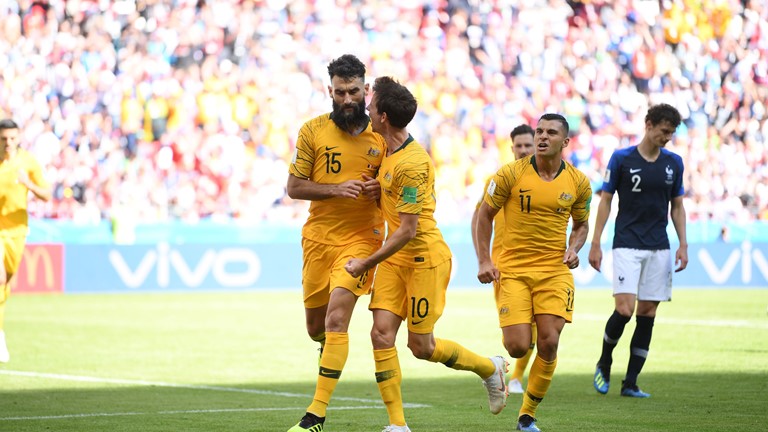
Mile Jedinak scores a penalty for Australia against France at World Cup Russia 2018

Mile Jedinak scores a penalty for Australia against France. Image: fifa.com

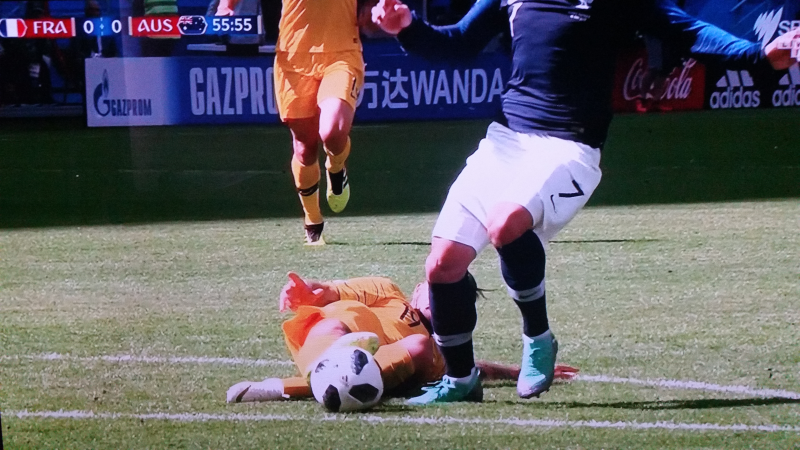
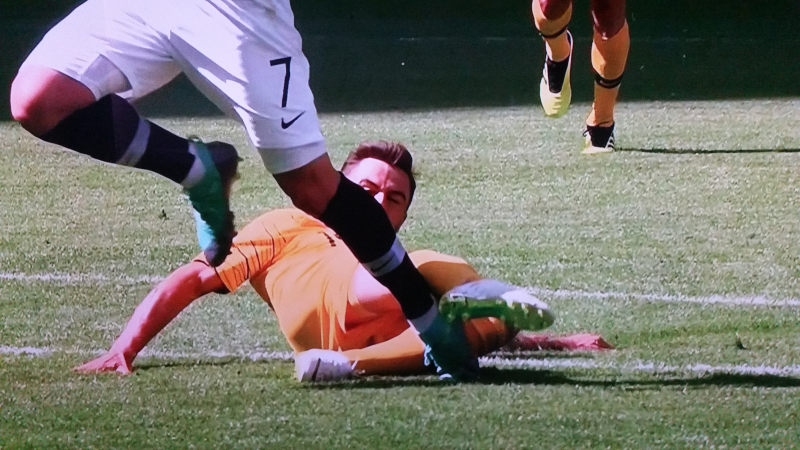
After a nervy start, Australia handled both themselves and France well. While France always looked the more dangerous side, eventually they ran out of ideas and Australia began to create the occasional opportunity themselves. Nil-nil at half time was perfect, and it was hoped the pattern could remain. Then, after 10 minutes into the second half, the chaos started. A penalty on Antoine Griezmann when tripped by Josh Risdon was followed within minutes by one for Australia when Samuel Umtiti inexplicably, and deliberately, handle the ball. Mile Jedinak converted while Umtiti inexplicably avoided a yellow card.

As the game progressed, Australia began to tire and became sloppy, losing the ball too often in midfield either by dallying too much on the ball or through errant passing. Eventually France would capitalise, and it happened in the last 10 minutes when Paul Pogba ran onto a loose pass and shot on goal. It deflected off Aziz Behich’s leg, over goal-keeper Mat Ryan, off the crossbar and over the line. Curiously it was awarded as an own goal by Behich. So disappointing to concede so late after all of that hard work was done.

All the post-match focus since has been about that penalty to France. It was the first time the Video Assistant Referee (VAR) had been used to determine a penalty situation at a World Cup, and it’s driven controversy online and in the media since. Much of this is through ignorance or a downright denial of reality. For those in Australia it’s been led by SBS’s Craig Foster. While initially he agreed with the decision (as the commentators did), he reversed his view and now claims no penalty. Claims that only “clear and obvious” errors are meant to be “overturned” is also misleading.

First, the use of VAR. For penalty decisions, the FIFA website says its “role is to ensure that no clearly wrong decisions are made”. There’s nothing about “overturning” a decision. With the VAR active, the referee, when in doubt, is more likely inclined not to unnecessarily stop the game and call a penalty, preferring to wait for notification from the VAR. In this particular case, the referee was notified of a possible missed decision, went and checked the video himself and awarded a penalty. His decision was never “overturned” as the system relating to penalty kicks is not about that anyway. It’s about preventing clearly wrong decisions, and denying a penalty based on the footage would have been clearly wrong. The system worked.

VAR guidelines on penalty decisions

As for the decision itself, the chorus of “he touched the ball” as somehow meant to annul further fouls is nonsense. Again, Foster has led this in Australia, primarily from picking out of context David Elleray’s (former English referee and head of VAR) admission Risdon got a touch on the ball. Even Australia’s players post-game, and captain Mile Jedinak in the press conference, blindly blathered away about this infamous “touch” – a touch that was barely noticeable and only deviated the ball’s direction by 5 degrees, if that. The touch is irrelevant, as Griezmann is still entitled to regather the ball. In his subsequent stride, Risdon lifted his leg and clearly tripped Griezmann. That’s always a penalty. The sequence of events:

Risdon/Griezmann penalty France vs Australia World Cup Russia 2018

Risdon attempts to tackle Griezmann, barely contacting the ball. Note this is outside the penalty box, so a foul would have been preferable then.

fra-pk13

Now inside the box and Griezmann into a new stride, Griezmann skips clear in pursuit of the ball while Risdon lifts his leg and drops it on Griezmann’s heel.

Risdon/Griezmann penalty France vs Australia World Cup Russia 2018

The force of the contact causes Griezmann to fall and Risdon’s leg to fly into the air. It’s clearly a subsequent incident, clearly a trip, and clearly a penalty.

David Elleray’s full quote:David Elleray on France Antoine Griezmann penalty vs Australia World Cup Russia 2018

It’s a shame there’s been so much focus on this one incident as it’s a mostly a distraction. Facts are France “handed” Australia a penalty back within minutes, reversing the damage and restoring the game to level scores. Australia lost because of their constant turnovers in midfield that gave France too many opportunities on the break. Australia were lucky not to be punished earlier. So look to the match in the broader picture, praise the team for playing so well and remaining so disciplined. Whinging won’t help. Even the complaints against France’s Lucas Hernandez constantly going down on any minor contact is irrelevant. As he admitted in the press conference, “Sometimes I exaggerate, but that’s all part of the spectacle… it also helps to take more time when you are winning.”, it’s all part of the game.

Mile Jedinak was right about one thing: It’s time to move on and look forward to Denmark. With Denmark beating Peru 1-0 in their opening game, that blocks the scenario of two draws being enough for Australia to qualify for the knockout phase. That would have been a real scenario as long as France beat Denmark and Peru by more than a goal, and all other games were draws. As it stands, and presuming France doesn’t implode and lose both of its remaining games, Australia cannot afford a loss to Denmark otherwise it’s all over. A draw will mean the final game is alive and goal difference will likely count (the real achievement made against France). A win will mean a draw is most likely enough against Peru. A win by two or more goals means a narrow loss to Peru would also be sufficient.

– Australia plays Denmark on Thursday night 21 June at 22:00 AET. France vs Peru follows at 01:00 on 22 June. The group’s final games are Tuesday night 26 June at midnight (00:00 27 June).

FIFA Match Details

ABC News Report

Russia 2018 – World Cup Preview, Predictions & Australia’s chances

15 June 2018

“I will do it my own way.” With those words at his initial press conference, out went the old ways of previous coach Ange Postecoglou, and in come the new ways of coach Bert van Marwijk. So much for changing the landscape, or leaving a legacy, as was Postcoglou’s mission. It was always a fool’s policy that Postecoglou set, and actively encouraged by elitists in the media, that a national team can be moulded into a permanent style. National teams are representative, meaning player options are often limited, not bought or recruited from anywhere, so strengths across the field can vary through the years.

FIFA World Cup Russia 2018 Logo

With that, it was also pleasing to hear van Marwijk say “it’s important we play in a way that fits the players, and “you cannot play in a way that players cannot do.” Australia struggled through World Cup qualifying primarily because of Postecoglou’s enforced doctrine. The possession and pressing game, and always playing out from the back, was exploited, with the leaky defence never to be fixed, and experimentation with team selection never ending.

In the four internationals van Marwijk has controlled the Socceroos since his appointment late January, things are slowly improving. A 4-1 loss in Norway was followed by a 0-0 against a quality Colombian team in London, then a 4-0 win over Czechia in St Polten, Austria. Even though Czechia appeared in holiday mode and Colombia had plenty of chances to win easily (including a penalty saved and hitting the post twice), Australia looked much better on the ball in both of those games, and finished their World Cup preparations with a 2-1 over Hungary in Budapest. That was strange game in which all goals came from mistakes: Hungary’s goal-keeper fluffed a shot from range by Daniel Arzani, Hungary equalised after Trent Sainsbury’s headed back-pass went straight into the net, while Hungary responded with an own goal of their own.

Speaking of Daniel Arzani, the 19 year old was a shock inclusion into the World Cup squad. Barely with 6 months of club football under him at Melbourne City, he’s now threatening for a starting spot in Russia. His inclusion has shown a preference towards the trickier, speedier and more skilful players in van Marwijk’s teams – evidence he sees (realistically) that the overall playing strength is not at the required level to take on these pedigreed World Cup teams head on, so he’ll rely more on individual brilliance and a counter attacking game. As he says, play to the players’ strengths, not force something unusual on them or beyond their capabilities. If he can sort out the defensive frailties further, then we could in for a surprise result or two.

Can Australia reach the knockout phase?

If you take a direct form line from Russia’s 5-0 demolition of Saudi Arabia in the opening game, it won’t be easy. Saudi Arabia, with van Marwijk at the helm, qualified ahead of Australia. Van Marwijk then quit after negotiations to renew his contract broke down, and now Australia is lucky to have secured his services for the tournament. Although, Australia handled the Saudis quite comfortably in qualifying, are arguably a more talented team, and now have a more astute and flexible coach than previously.

France is Australia’s first match, and while the French are notoriously slow to start a tournament, no risks will be taken. Remember, it doesn’t matter when you score your points to qualify for the knockout phase, as long as you score them. With France likely to beat Denmark and Peru as well, essentially it will come down to those matches. A narrow loss to France would be sufficient, and then it’s a matter of trying to gain 4 points from the other two matches, or 6 points to guarantee it.

Denmark qualified relatively easily behind Poland in a rather weak Group E, and then disposed of Ireland in the playoffs. They look the standard, solid Scandinavian team – teams Australia generally have handled well in the past. Peru was South America’s fifth best team and qualified thanks to a 2-0 playoff over New Zealand. Even with a draw (or loss) to Denmark, the fate of Australia is likely to come down to that match, and while Australia generally struggles against South American teams, as they say in the classics, if you can’t beat Peru, you don’t deserve to be in the knockout phase.

World Cup Predictions

It’s difficult to have much confidence in Australia progressing unless those defensive problems are fixed. Scoring could be a problem too if “no goal scorers” is the second favourite at $6.50 to be Australia’s top scorer. Tomi Juric is favourite at $6. Best case scenario to qualify is a 50/50 proposition. If Australia qualified for the round of 16, the likely opponent would be Argentina. Iceland, Croatia and Nigeria are the other options.

As for the World Cup winner, the draw is always the best guide, along with general form, especially through qualifying. France, Spain, Portugal and Argentina are in the top half, so some will be eliminated before the latter knockout stages. In the lower half, Germany (who won all games in qualifying) and Brazil will steer clear of each other if they win their respective groups, while Belgium is the likely spoiler, and it would be great to see a new team win. While I certainly will be hoping for the Belgians, the tournament seems set up so well for Germany to go two in a row, with Brazil their likely opponents in the final. Given the 7-1 thrashing the Germans handed Brazil in the semi finals four years ago, a repeat match-up would be quite an exciting prospect, even if both teams have won their fair share of World Cup spoils over the decades.

Australia’s Schedule (AET)

20:00 16 June France vs Australia
22:00 21 June Denmark vs Australia
00:00 27 June Australia vs Peru (Tuesday night)

Australia’s World Cup Squad

Goalkeepers: Brad Jones, Mat Ryan, Danny Vukovic

Defenders: Aziz Behich, Milos Degenek, Matt Jurman, Mark Milligan, James Meredith, Josh Risdon, Trent Sainsbury

Midfielders: Jackson Irvine, Mile Jedinak, Massimo Luongo, Aaron Mooy, Tom Rogic

Forwards: Daniel Arzani, Tim Cahill, Tomi Juric, Robbie Kruse, Mat Leckie, Jamie Maclaren, Andrew Nabbout, Dimitri Petratos

Pros and Cons of a 48-team World Cup

15 January 2017

After all the years of squabbling among the confederations for World Cup places, FIFA took the obvious answer to a surprising conclusion. While the World Cup was ripe for an increase in World Cup teams, to go from 32 teams now to 48 teams for 2026 was a drastic leap. The one caveat is the last increase was in 1998 when 32 teams participated, up from 24 in 1994. The World Cup probably should be 40 teams already, and by 2026 it will be 28 years since the last change. The format will be 16 groups of 3 teams with the top 2 progressing to the knockout phase, which adds a round of 32 to its schedule. While the number of matches overall in the tournament increases from 64 to 80, the maximum number of matches per team remains at seven.

PROS

1) More teams

This is the clear reason for expansion. Regions like Africa and Asia desperately wanted more places, and with the huge amount of money in Asia these days, it means more money for FIFA. Expect both regions to get an extra 4 spots, so Africa’s 5 becomes 9 and Asia’s 4.5 becomes 8 or 9. Oceania is certain to finally get the spot that a full member confederation deserves. They have a spot at every other FIFA tournament and the World Cup should be no exception.

2) More dreams

Teams that once had no hope to qualify now finally can dream about it. Oceania is a classic example, with the likes of Fiji, Vanuatu and Tahiti now only required to get past New Zealand, while in Asia the likes of China, Thailand, Vietnam and Uzbekistan can expect to regularly challenge for a World Cup spot. More than that, it will be nice to see these new teams at the World Cup. Look at the intrigue and excitement the likes of Iceland and Wales created in Euro 2016 when it expanded from 16 to 24 teams, or when Tahiti was Oceania’s representative at the 2013 Confederations Cup.

3) More excitement

The format means there’s one less group game and one more knockout game. While teams could often grind their way through the group phase with defensive tactics, now they need to tackly the group head on. Not so much to qualify, as 2 out of three is statistically an easier task, it’s for seeding purposes so to avoid stronger teams in the early rounds of knockout phase. There’ll also be far fewer, if any, dead matches. With 4-team groups, teams could often be qualified with one match remaining.

4) More representative of the world

Football is not a European and South American sport anymore. If they won’t cede spots to the likes of Asia and Africa to make the World Cup a fairer representation, then the number of teams must increase. Current speculation is Europe with have 16 spots (up from 13), Africa 9 (5), Asia 8.5 (4.5), South America 6 (4.5), Concacaf 6.5 (3.5), Oceania 1 (.5) and 1 for the host. The only inter-continental playoff will be Asia vs Concacaf.

CONS

1) Too many teams

Nearly a quarter of FIFA’s members will now qualify, which dilutes the basic challenge in the first place. Where’s the prestige in qualifying? Also, after two years and many qualifying games, your reward is only two games at the World Cup, not three as currently. That aspect seems an imbalance at least. In percentages terms, the number teams qualifying still quite low, particularly compared to other sports. Under a quarter of teams at football’s World Cup, compared to often 100% of Test level nations at cricket’s and all of tier 1 and most of tier 2 at rugby’s.

2) Less dreams

Sure, while the minnows are now guppies, guppies like Australia become piranhas. So much of the joy when qualifying for 2006 was that it was the first such qualification in 32 years. That mountain to conquer is already a hill in Asia, and the hill will become rubble with the extra four spots allocated. Being perennial World Cup qualifiers is not ideal for a developing nation like Australia. We need the kick up the backside occasionally, much like our youth program is now receiving after recent debacles of multiple failed qualifying campaigns at youth and Olympic level. With the move into Asia I was already prepared to accept missing one World Cup out of every 3, or even missing two in a row if the sport was in malaise. Most top European countries occasionally miss major tournaments, and if it’s ok for them to bomb out at times it should be good enough for us.

3) No 4-team group

Even with the increase of teams over the years, one time honoured staple remained: groups of 4 teams. The change to 3-team groups means each team plays only 2 matches and the odd number of teams means the final games of a group can’t be played simultaneously. This means teams can play for certain results to help others progress. While this ethical problem is quite rare in practice and still possible in a 4-team group, FIFA were always so adamant in preventing it… until now. Tied groups will also become a problem. FIFA are talking about penalty shootouts to split drawn games. That would be a disaster as weaker teams will play for draws. Goal difference and other tie-breaking mechanisms must still be used. In the worst case scenario, maybe 30 minute playoffs are introduced.

4) The squabble for spots will continue

Everyone will be happy in the short term with the extra spots. After that, watch the squabbling resume. South America are so greedy they will probably want all their countries represented. Already if you consider they will get at least 1.5 extra spots, that’s 6 out of 10 teams going. Ridiculous. As mentioned in these pages many times, spots should be based on past performances, with confederations streamlined to facilitate this. That means the Americas should be one confederation and Oceania should merge with Asia. That leaves roughly four regions of 50 teams. To each goes 8 direct spots with 1 to the host. The remaining 15 spots are allocated by previous World Cup performances over the past 3 Cups. If Asia/Oceania get 6 teams among the top 15 best performed teams, that’s six spots to them. Typically they get zero or one, so they’ll sit on 8 or 9, while Europe with usually 8 teams through will get 16 spots in total.

COMPROMISE

My personal preference is four 40 teams over 10 groups. So you still keep the 4-team group and, more importantly, make each match extra important because only 6 of the 10 second placed teams progress to the knockout phase.

Two draws keep the group interesting

12 October 2016

Why is it the only goals Australia ever concede are “soft goals”? So it was for the second World Cup qualifier in a row that Australia conceded in the first 5 minutes. The first against Saudi Arabia last week and the second against Japan last night. Naturally, they were soft! Clearly there’s still a small superiority complex Australia has over Asian teams. In truth, the Saudi goal was a brilliant dismantling of our defence with quick passing and well timed runs, and the Japanese goal was a brilliant strategic goal created by pressuring our often over-casual possession of the ball and breaking free on goal. There was nothing soft about them. Indeed! If Australia scored them, we’d be marvelling at the brilliance.

Australia's coach Ange Postecoglou not entirely happy after 1-1 draw at home vs Japan in World Cup qualifier, Melbourne, 2016-10-11

Australia’s coach Ange Postecoglou not entirely happy after a 1-1 draw at home vs Japan. Image: AAP

Both games finished in a draw, 2-2 in Riyadh and 1-1 in Melbourne. Both games also finished in a similar pattern with Australia lucky not to lose both. Australia ending up taking the lead in Riyadh on 17 minutes and felt aggrieved at conceding a goal 8 minutes later. Except, not longer later, the Saudis missed a one-on-one attempt with the ball cleared off the line after being partially saved by Matt Ryan. Likewise, Ryan was at it again in Melbourne when, on 78 minutes, brilliantly saving a low header. Both games were a fair result.

With Saudi Arabia beating the UAE 3-0 overnight, it means the group is wide open. They lead by 2 points, with Australia next on 8, Japan on 7 and UAE on 6. Iraq is on 3 while Thailand has yet to score a point. Australia is yet to play Thailand so arguably has had the tougher run so far.

Personally, the group is nicely poised. While obviously I want Australia to qualify, there’s a big part of me that wants to see the campaign stay alive as long as possible. Many Arab nations are aggrieved that all Australia has done is taken a spot from them, and that’s a fair point. Our inclusion will be a failure if we are not tested, and even occasionally fail to qualify. If Japan won last night, I’d have found that acceptable. Probably the ideal scenario is Australia goes to Japan on 31 August needing a result. They get that, forcing Japan into the playoffs, this time through Central America, and qualify anyway.

There was a bit of publicity about the poor atmosphere at last night’s game at Docklands – even with over 48,000 in attendance. It was deathly quiet at times in the first half with the Australian cheer squad barely active – especially when compared to the visiting Japanese cheer squad. While apparently the Australians weren’t fully organised, the silence was apt for the occasion. Australia had conceded early and put on a limp, clueless and ineffective display in response. Also attacking towards the Japanese end didn’t help motivate the cheer squad.

The second half, when Australia were more active and got the goal, not only did the cheer squad react more, so did the entire crown. I prefer this form of dynamic cheering rather than the incessant and repetitive and often banal chants. If these concoctions are for entertainment purposes or to add to the atmosphere, what are you really saying about the sport itself – that it’s boring? Personally it doesn’t need it, and the quiet periods only enhanced the atmosphere, as they were a reflection of the game itself.

Results

06/10 Saudi Arabia 2 (Al-Jassim Goal 5′, Al-Shamrani 79′) – Australia 2 (Sainsbury 45′, Juric 71′)
11/09 Australia 1 (Jedinak 52′ PK) – Japan 1 (Haraguchi 5′)

Reports – Saudi Arabia
Reports – Japan