Melbourne Cup 2018 – Preview and Review!

5 November 2018

With another Winx blitz over, this time her fourth Cox Plate in a row, the Melbourne Cup now grabs our attention, as it rightfully should. It is our biggest race, and the nation will be far more fixated over it than Winx’s record breaking feats.

Speaking of Winx’s feats, there’s much chatter about whether she’s the greatest horse of all time. While four Cox Plates is unprecedented, so is three Melbourne Cups as performed by Makybe Diva, and personally that is a superior achievement. The Melbourne Cup is a handicap, and winning it twice has proved super tough. Only 5 horse have done it since its inception in 1861 while there’s been 14 repeat Cox Plate winners since 1922.

Does that make Makybe Diva Australia’s best horse ever? No, she only had one stellar year, which culminated in her third Melbourne Cup. Winx has been unbeaten for more than 3 years, for a total of 29 race wins in a row, her most recent being that fourth Cox Plate. Still, that’s not enough. For me it’s Black Caviar. Never beaten in her career of 25 races, I rate her the best ever (in my lifetime) for her pure domination and higher quality of opposition. Time and time again I was in awe of her when watching her races. I rarely get that feeling from Winx, while the Diva only managed a bit of it in her final year.

On to the Cup…

rekindling-mcup2017.jpg

Rekindling wins the 2017 Melbourne Cup

I’m still trying to get a big win since my double hit in 2010 and 2011 after missing out yet again last year. Most people did, as Rekindling was somewhat a surprise winner. An international visitor, he epitomised the dilemma with them when they have their first Australian run in the Cup itself. One or two will run well; most will flop. Since the internationals started arriving in 1993, Rekindling was only the second such runner to win. The first being Vintage Crop in 1993. It remains an advantage to see them run in Australia beforehand before taking the plunge on them. It’s my golden rule that I’ll still keep until results prove otherwise. Other rules include look for form, look for class, look for ability to run the distance, look past previous Melbourne Cup runners that failed.

Another more recent rule, or guideline, is be suspicious of the Caulfield Cup form. It’s been a woeful predictor in recent years. Also, the Japanese horses are best to avoid. Other than the one-two with Delta Blues and Pop Rock on debut in 2006, they’ve stunk!

01 Best Solution $12

Won the Caulfield Cup. Didn’t get a penalty. It’s still the Caulfield Cup. None have completed the double since 2001. The one positive is German horses do quite well, even when they’re a distance doubt like him, and he’s won his last four races.

Result: 8th Missed the start, and was then hampered by The Cliffsofmoher breaking down. Would have been much closer otherwise, so a decent effort for the Caulfield Cup winner that was unknown over the distance.

02 The Cliffsofmoher $17

The name alone puts me off. Second in the Caulfield Cup so if want you use that race as a guide, the best solution is to stick with the horse that beat it.

Result: DNF Sad result breaking a shoulder, unfortunately these things happen. While it provokes the usual hysterical calls to ban horse-racing, if you want to really act on perceived torture, you’d end the pet industry in an instant. Some of the torture that goes on in that industry is unimaginably reprehensible.

03 Magic Circle $8

First time international runner, whose last two races were demolition wins in Europe. May was his last race, so against back to that dilemma of whether he’ll fire. The stable brought Mount Athos twice, who performed well, so that’s a guide they have a good formula in place.

Result: 16th The only excuse you could say was his last run was in May. Most of the other internationals had run in August before coming to Australia. Otherwise, it was the usual flop you expect from internationals.

04 Chestnut Coat $61

Japanese horse that didn’t do much in the Caulfield Cup. Sayonara.

Result: 14th As expected.

05 Muntahaa $12

International runner who won the Ebor in York. That race hasn’t been a great guide to the Melbourne Cup. A tricky one, as he won it impressively. Apparently there’s been a hiccup in the preparation too, which is always a concern.

Result: 9th Ran to form.

06 Sound Check $34

Shocking Caulfield Cup run. A positive is he has form around Best Solution and won at the distance in Germany.

Result: 18th A reality check. Flopped in Caulfield Cup, flopped in Melbourne Cup.

07 Who Shot Thebarman $34

Fourth attempt, and now a 10 year old. Sorry.

Result: 17th As expected.

08 Ace High $61

Victoria Derby winner of last year who seems out of form.

Result: 20th As expected.

09 Marmelo $14

International that ran in the Cup last year and failed. They’re trying it as a first run this time, as distinct from using the Caulfield Cup as preparation like last year. Pass.

Result: 2nd Super effort, and looked the winner until Cross Counter arrived. Well done to the team for trying a fresh approach after last year’s failure.

10 Avilius $12

Won the Bart Cummings, as Almandin did in 2016. Didn’t do it as impressively, and didn’t do much in the Cox Plate, and is a bit of a doubt at the distance. Won is last four before the Cox Plate, and as they say, winning form is good form.

Result: 22nd Only excuse is he was badly hampered by The Cliffsofmoher breaking down.

11 Yucatan $6

Dominant win in the Herbert Power and has been a favourite since. As they say, seeing is believing.

Result: 11th Horrible result. Simply didn’t run it out.

12 Auvray $101

Lacks form and class.

Result: 21st As expected.

13 Finche $23

An international that plodded into third in a weak Geelong Cup.

Result: 4th Super effort considering the average preparation race.

14 Red Cardinal $34

Ran last year and failed. Will fail again.

Result: 23rd & last Failed again.

15 Vengeur Masque $81

Not good enough.

Result: 15th As expected.

16 Ventura Storm $34

Not to the required standard and flopped last year. Won the Moonee Valley Cup in his last run if that helps.

Result: 10th OK result; didn’t run the distance.

17 Prince Of Arran $18

Qualified by winning the Lexus Stakes on Saturday. Internationals don’t do race so quickly in succession, Lexus winners don’t often do well unless they have dominant wins (think Shocking in 2009), and he was smashed by Yucatan in the Herbert Power.

Result: 3rd Led into the straight and looked the winner until the two late runners. A surprise result considering he had to run on Saturday to qualify and often this quick back-up destroys the chances of internationals. Without that run he might have gone even better.

18 Nakeeta $101

Ran fourth last year. In poorer form this year so it’s a no.

Result: 12th As expected.

19 Sir Charles Road $81

No chance.

Result: 7th Capitalised with a good result due to so many other favoured horses not firing.

20 Zacada $81

Lack of form and class.

Result: 13th As expected.

21 Runaway $41

Won the Geelong Cup. It’s not a good guide other than to verify a quality international has acclimatised, as per Americain and Dunaden in 2010 and 2011.

Result: 19th As expected.

22 Youngstar $15

Caulfield Cup flop. The only mare in the race, and their general poor record is against her too.

Result: 6th Didn’t quite run it out.

23 Cross Counter $9

Nice wins in England before arriving, and a delicious light weight. Again, it’s that dilemma of whether he’s settled.

Result: 1st In hindsight, as expected! Good form and a low weight. Distance was the only issue as he hadn’t won beyond 2800 metres. Do that, and be able to reproduce the form in Australia, you win.

24 Rostropovich $23

Didn’t do much in the Cox Plate, and other than for the major weight drop, he’d be a total write off, not a partial one.

Result: 5th Looked a possible chance to win before others overtook him. A decent result for a horse that didn’t seem to do quite enough in the Cox Plate. 

SELECTIONS

No surprises here if you note any of the “experts” giving their tips. I’m all over Yucatan like a giant meteor smashing into the planet. It’s my major bet while my smaller bet will be on Magic Circle. Interesting story is that when I was first taken to races as a youngster, a horse called Magic Tower was always so successful for me. I remember winning $6 on a 50c place bet, and that was so much money back then! So Magic Circle provides a bit of nostalgia. To complete my box trifecta and first-four I’ll add Cross Counter, Best Solution and possibly Avilius.

Remember, it’s only gambling if you lose!


THE RACE

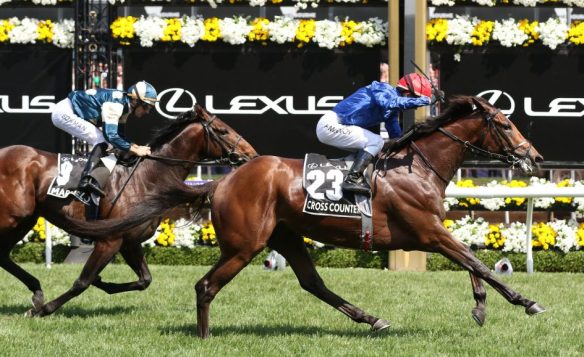
A bit of an upside-down race, with the lesser favoured of the internationals and some mild outsiders doing well. Cross Counter was my third pick, and was a spectacular winner with a late charge down the outside to overhaul Marmelo. Marmelo flopped last year, so that broke one of the guidelines to ignore previous failures. Although, as mentioned in the preview above, a different strategy was tried this year by running him fresh in the Melbourne Cup rather than using the Caulfield Cup as preparation. Facts are many horses, particularly Europeans, do perform well fresh, which, at a minimum, is 3 weeks between runs. The Caulfield Cup is 17 days prior.

Cross Counter wins the 2018 Melbourne Cup from Marmelo and Prince Of Arran - Review

Cross Counter wins the 2018 Melbourne Cup from Marmelo and Prince Of Arran

Other guidelines remained true, like the new one to ignore the Japanese. The Caulfield Cup again proved an unreliable form gauge, even though Best Solution had excuses. The distance rule is an interesting one. The big favourite, Yucatan, didn’t run it out. Many horses are untried over the distance of 3200 metres, including the winner, so it can be hit or miss. Cross Counter at least had won over 2800 metres, so that was close enough. Yucatan and Best Solution had only won over 2400, with Yucatan’s other two wins being over 2012 and 1609 metres. He really was a distance doubt so much so that he warranted some sort of skepticism. I guess that awesome Herbert Power win clouded the minds of many. Finally, horses running in the Cup without a preparation run in Australia, while Cross Counter and Marmelo excelled, Magic Circle (the other big favourite), Muntahaa and Nakeeta, failed.

A new rule is to look to European 3 year olds. They are actually 3 and a half year olds by Australian time so have that extra bit of maturity while benefitting from a lighter weight allocation that 3 year olds get. They need to be progressive and in good form too. Last year one won in Rekindling, while this year they were first and fifth.

The big trifecta I’ve been trying to land for years now was another wipeout. I had six horses going in it – Yucatan, Magic Circle, Cross Counter, Best Solution, Avilius and Muntahaa – and only Cross Counter did anything. Best Solution was next best in eighth. There’s always next year!

RESULTS

23 Cross Counter $10
9 Marmelo $12
17 Prince Of Arran $23
13 Finche $13
24 Rostropovich $18


Russia 2018 – World Cup Retrospective: The Final, VAR, Australia & Ange Postecoglou

02 September 2018

It’s been seven weeks since the final of Russia 2018, where France beat Croatia 4-2, and with that came the confirmation that the world just witnessed the best World Cup ever. In my lifetime, it certainly was. The closest competition was USA 94, which unfortunately fell down with dull semi finals and a really dull 0-0 final. Brazil 2014 was on track to be a great one until the knockout stages mostly disappointed. The rest going back to Mexico 86 were all good, while Germany 2006 will always be memorable due to Australia’s return and three dramatic matches. So Russia 2018 is it.

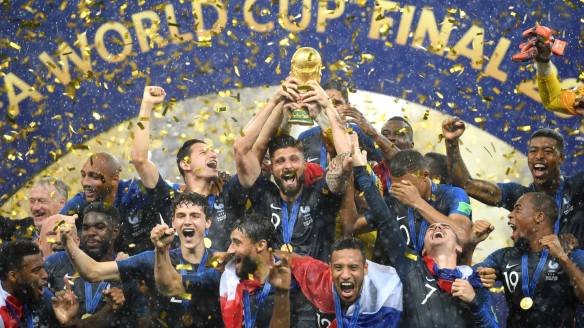
France wins the 2018 World Cup in Russia

France wins the 2018 World Cup in Russia. Image: fifa.com

It wasn’t so much that Russia 2018 was full of goals (at 2.64 per match), or even full of great goals. The dead rubber of France vs Denmark was the only 0-0 too. It was mostly that it was full of drama. That drama was epitomised with the final itself, where own-goals, video assistant referees, penalties, a smaller nation excelling, and touches of class, all made it a microcosm for the tournament itself. With many Russian cities quite easterly, it meant a reasonably friendly timezone, so more of a football feast for us in Australia.

The six goals in the final of Russia 2018 was the same total as all the goals in normal time of the last four World Cup finals, and one less than the seven goals of the 1958 final. Croatia, though benefitting from one of the softest draws imaginable and requiring penalty shootouts and England to choke to progress, were unlucky to be 2-1 behind to France at half time. France had only one shot on goal for the half compared to 7 for Croatia. Classy goals on 59 and 65 minutes effectively sealed it for France, before a crazy goalkeeping error on 69 minutes gifted Croatia one back. It proved insufficient as France comfortably held on to win.

FIFA Match Details

France were the best team all tournament and deserved 4-2 winners. In contrast to Croatia’s opponents along the way of Denmark, Russia and England, France had to contend with Argentina, Uruguay and Belgium – with the latter two arguably the third and second best teams in the tournament. Both likely would have breezed to the final on Croatia’s side of the draw. In fact, Belgium’s most important match was their final group game against England. Had they surrendered the game with a draw or a loss, they’d have been on the weaker side. Instead they won 1-0 – and then beat England again in the third placed game, 2-0.

Russia 2018 will also be remembered for the dominance of the European teams, and the poor performance outside of Europe and South America. All semi-finalists were European, while only Mexico and Japan could make the knockout phase, with both only scraping in. Despite two wins in their first two games, the 3-0 loss to Sweden in their final game meant Mexico required Korea to beat Germany. That happened only in the dying minutes, reversing the heartbreak Mexico had at the final whistle when it seemed that match would be a draw.

Japan only progressed through “fair play” rules after being in a deadlock with Senegal on all other tiebreak methods. From there, at least they put on a good show and seemed on course for a shock win over Belgium in their last 16 match when scoring two early second half goals, only to be run over and lose 3-2, with Belgium’s third goal coming with the last play of the game. Mexico looked good when beating Germany in the opening group game before later matches revealed Germany were a team on the slide. Only just scraping past Sweden and then losing to Korea to be sent home early. In fact, that win by Korea made it quite a successful tournament in the group phase for Asians teams. Four of the 5 won a match, with only Australia missing out.

Australia

It’s a mixed bag. Struggling through the qualifying campaign, expectations were low for Australia’s chances in Russia, with a feeling they would be on the path to humiliation. That short-term coach Bert van Marjwilk was able to mould a competitive and resilient unit was of great credit to him. Unfortunately, defence, something that has plagued Australia since they returned to the World Cup in 2006, was again weakness, with Australia 0-0 against Chile in 1974 remaining their only clean sheet. Quite simply, you won’t win many games at a World Cup while consistently conceding goals.

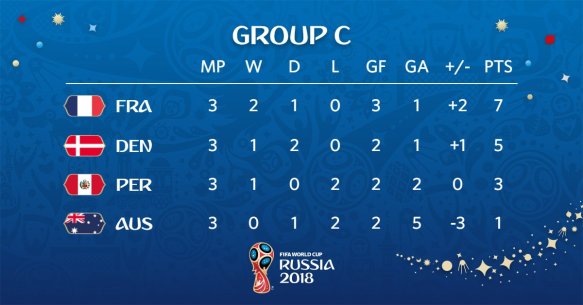
At Russia 2018, with the lack of firepower upfront, goals conceded, notably France’s second goal and Denmark’s goal, proved fatal. Both should have been prevented, and if so, a loss and a draw becomes a draw and a win, and progress to the knockout phase. By the time of the final match against Peru, there was little to play for, and for a Peruvian team unlucky in their first two matches, they were too good for Australia. So bottom of the group with 1 draw and two goals by penalty, it’s not good reading, and not the progress expected after 3 losses in 2014. One positive is, that after Belgium, Australia probably gave the eventual world champions their greatest test.

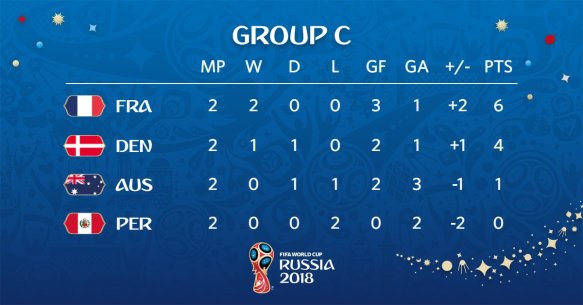
World Cup Russia 2018 – Group C final standings

World Cup Russia 2018 – Group C final standings

While debate turned to van Marwijk’s lack of use of Tim Cahill until the second half against Peru, the reality is the coach was left little time to prepare the team so stuck to a fixed plan. It was based on a settled team and improving them as a unit. With Cahill barely playing any minutes for the latter half of the season at Millwall, and already being phased out under Ange Postecoglou, it was always questionable to promote him ahead of players with solid time and form with their clubs. The second half against Denmark, when the game was there for the taking and Cahill remaining on the bench, that was probably the only questionable decision. While, in retrospect, Cahill should have got a run, too much focus there detracts from the overall good job done. As van Marwijk said, he’s not a magician. Australia’s issue all along was lack of quality players, especially gamebreakers and scorers in the final third.

Ange Postecoglou

Also questionable was former coach, Ange Postecoglou’s article on the Player’s Voice website, suggesting Australia still likes being an underdog, and his quest to change that attitude was actually a personal crusade, not a tidal wave of change he was about to ride. While that underdog sentiment still lingers (“brave” was a common word heard after the close loss to France), Postecoglou’s proposition to play aggressive, attacking football, to show the world Australia are not battlers, is very much another way to dodge accountability for poor results. As much as saying “we were underdogs” tries to justify a loss, so is saying “at least we had a go”. Neither are great mentalities, as the key measure of success at a World Cup is always results. If you look at a comparable team like Sweden, the question of whether you’d prefer their grafting style that sees consistently reach the quarter finals when they qualify or a “have a go” strategy that really only achieves praise from armchair neutrals, I know which way I’d go.

This World Cup was a counter-attacking World Cup, where the possession game was demolished, so to think Australia could bustle in and take on these crack international teams with such a strategy would have been a guaranteed mission of suicide. The “competitiveness and defensive stability” that van Marwijk brought was actually a positive because Australia lost it under Postecoglou. Being aggressive and attacking is all well and good as long as you don’t sacrifice other key aspects of the game. It’s quite galling for Postecoglou to be so critical of the playing style at this World Cup when he had abandoned the team with mission incomplete. For someone so full of the “have a go” mentality, he showed incredible weakness when crunch time came. Not just on the field either. Off the field and facing accountability, that was not something palatable for him. It seems as though Postecoglou felt he had carte blanche to do anything he pleased with the team, even if it jeopardised World Cup qualification itself. Apparently we were meant to look at the big picture. No, the big picture is the World Cup, and that’s where success and failure is defined.

TV Coverage

It’s hard not feel some sort of sympathy for Ange Postecoglou’s ethos anyway, as much of the media and fans are obsessed with “performance” over results – a phenomena normally most appreciated only in the bedroom. Chief choir boy was again, Craig Foster on SBS, who typically within 5 seconds of being asked a question he’d begin prattling on about the same old stuff, while Lucy Zelic would look gushingly on. It became unlistenable that I would mute the telecast. Zelic had her faults too, notably her obsession with correct pronunciation of foreign names while doing nothing about her appalling English diction. It’s one of the worst Australian accents on TV. If she can sort that out, she’s a winner.

This was the first SBS football telecast since the death of Les Murray and it had a sense of watching kids on work experience kids. Really amateurish at times, with the two main hosts lacking direction. Guest panelists would lift it, as did the increased use of David Zdrilic. In retrospect, SBS might have been caught short as they were meant to only show one match per day after selling off most of the rights to Optus Sport. The debacle with their streaming service meant SBS would simulcast the games anyway. It’s a shame, because Optus had the far superior presentation, with the likes of John Aloisi and Mark Schwarzer providing great insight into the actual games, while their use of default English language commentators meant we were liberated from the tiresome Martin Tyler.

Video Assistant Referee (VAR)

This tournament was full of so many penalties, which be attributed to VAR. It was great in finding penalties that would often happen happen too fast, or not 100% certain, for the referee to see. It also created confusion about when it should be used, that whether it’s for overturning a “clear and obvious error”. First thing to realise, denying a rightful penalty would be a clear and obvious error. It’s not so much blatancy of a foul, it’s the impact, and obviously not awarding a penalty is a great impact on the match.

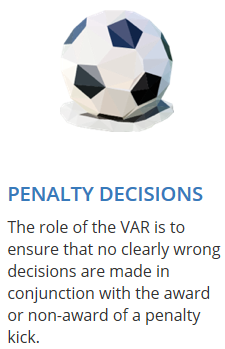
VAR guidelines on penalty decisions

VAR guidelines on penalty decisions

The final itself had a great example (along with Antoine Greizmann in France vs Australia) when Ivan Perisic was adjudged to have fouled. Whether deliberate or not is now irrelevant, and that’s been the trend for many years now, way before VAR. Bottom line is Perisic moved his hand downward to the ball, and palmed it onto his leg to knock it out of play. Intentional or not, the use of the hand clearly blocked the corner from entering the goal area. The only issue is that the referee took so long to confirm it.

Suggestions by ESPN commentators that the referee initially decided no when checking the replay, and then returned to look again, possibly prompted by VAR, is likely nonsense. He could have already confirmed a penalty and decided to double check. Remember also that with VAR about, referees are now less inclined to make tight calls, so rather than VAR there to intervene on clear and obvious errors, it’s really to intervene on clear and obvious incidents, especially relating to penalty kick decisions, and also if the referee never saw the incident in the first place.

Also the rule about “deliberate” means subjectivity is always involved. While the referees have been moving towards zero tolerance over the years, VAR almost makes it zero tolerance. With that knowledge, then “deliberate” needs to be removed from the equation, and any handball in the box that affects the offensive team’s chance of scoring should be a penalty. Note, such incidents outside the box are nearly always a foul, so just because the repercussions might be harsher on the offending team, it shouldn’t mean the enforcement of the rule is less strict. In fact, when the stakes are higher, so should be the enforcement. Remember that players are so adept these days at making anything intentional look like an accident, and while Perisic may have known nothing about the penalty, there’s every possibility he did know about it, and in the natural action of dropping his arms after jump, he deliberately made sure to contact the ball.

Own Goals

Another curiosity of this World Cup was the plethora of own goals. A new interpretation seemed in effect whereby any deflection was classed as an own goal. Previously the shooter would get the goal as long as the shot looked like it was heading towards goal, so typically meant glancing deflections were always goals and huge ones less likely so. I’ve never liked that interpretation and always believed it should be about intent. Any deliberate shot towards should be a goal regardless of deflection because the shot caused the deflection, whereas an own goal is a deflection from a non-attempt on goal, like a cross. Obviously goals directly from the defending team are always own goals.

Best Matches

QF Brazil vs Belgium 1-2
A quality display by Belgium to snuff out Brazil’s chance for immediate World Cup redemption after the semi-final 7-1 debacle against Germany in 2014.

R16 Belgium vs Japan 3-2
A stunning second half where Japan scored a double early before Belgium over-ran them, scoring the third goal only the last play of the match via a classic counter attack.

R16 France vs Argentina 4-3
France showed their potential to put Argentina away. A flattering result for Argentina, while Lionel Messi leaves another World Cup with both he and his country unfulfilled.

R16 Uruguay vs Portugal 2-1
Uruguay provided a classy display to sweep past the pretentious Portugal and Ronaldo, especially notable for two superb goals by Edinson Cavani.

QF Russia vs Croatia 2-2 (3-4)
The most dramatic match of the tournament with Croatia coming from 1-0 down to go 2-1 up in extra time, only for Russia to equalise late to sent it to penalties. A shame the Russians had to go, especially after knocking out Spain in the previous round.

Qatar 2022

With a winter World Cup confirmed, set for 21 November to 18 December, talk now is about the other big possible change: increasing teams to 48. In terms of games played, there’s only 16 more, so the real issue is whether a small country like Qatar can accommodate 48 teams plus all the supporters. Typically these sorts of suggestions that would be well embraced by national associations are implemented quickly, so it’s likely a 48 team World Cup will arrive 4 years earlier than planned. The smaller confederations benefit the most with Asia getting 8 places (currently 4.5), Africa 9 places (5), CONCACAF 6 places (3.5) and Oceania 1 place (0.5). Europe get 16 places (13) and South America 6 (4.5). There’ll be 16 groups of 3, with the top 2 progressing to the knockout stage, meaning 32 teams will play 3 matches like now. It sounds ideal, so get it done.

One foible will be that with 3 teams to a group there’s no simultaneous final match like presently. Personally, these simultaneously matches have always been an overreaction to a controversy in 1982 when Austria and Germany seemed to conspire in their final group match to ensure they both progressed instead of Algeria, who played the day before. Such a situation can be avoided by a floating schedule for the final round whereby, in the 1982 case, Austria and Germany would have played first. Facts are, these days the final round equations are obvious anyway (eg: this year France and Denmark knew a draw would be enough to progress ahead of Australia), while a small thing called the telephone and internet keep teams updated about the concurrent match anyway (note when Japan learnt Senegal went behind to Colombia they suddenly settled for their 0-1 score against Poland and simply kept possession for the last 10 minutes). Also, in a 3 group team, a conspiracy situation is less likely to arise.

FIFA World Cup Russia 2018 Logo

That was Russia 2018 – The 21st World Championship of Football

Russia 2018 – Australia vs Peru Review, What Went Wrong, Tournament Player Ratings

Russia 2018 – Australia vs Peru Review, What Went Wrong, Tournament Player Ratings

28 June 2018

This World Cup was always more about hope than expectation, and that hope was only ever a tentative one. A solid performance in the 2-1 loss to France provided a small spark of hope that Australia could beat Denmark in their next match and set a strong course for the next phase. That spark quickly extinguished when Denmark scored early, only for it to reignite when the Socceroos equalised not long after. Alas, no. Despite dominating much of the game, Australia were unable to get a winner, so were faced with the double jeopardy of beating Peru and hoping France beat Denmark.

Entering the final game against Peru in Sochi, it was almost a continuation of the Denmark game. Australia dominated early, failed to convert opportunities, and then went behind on 17 minutes. Four minutes into the second half, it was another goal for Peru, and any flickering hope we had now changed to putting us out of our misery and ending this campaign that always seemed forlorn. A late Peruvian shot hit the post to avoid a more embarrassing 3-0 loss. Not that an Australian win would have mattered, as France and Denmark only needed a draw to qualify first and second, and 0-0 was the not so unexpected final score.

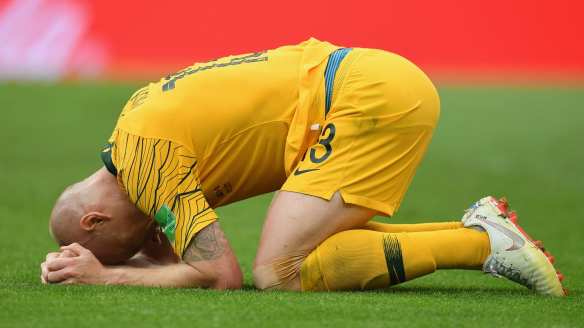
Aaron Mooy sums up Australia's disappointing campaign after 2-0 loss to Peru - World Cup Russia 2018

Aaron Mooy sums up Australia’s disappointing World Cup campaign after their 2-0 loss to Peru in their final game at Russia 2018. Image: fifa.com/Getty

In fairness, Peru were the second best team of the group and should have progressed. They dominated much of the action against Denmark and France with 27 shots on goal, and shot a penalty over the bar against Denmark. They lost that game that they should have won, meaning their match against Australia was only for pride. In victory, they looked as despondent as Australia did. Not only were Peru more deserving to progress, and more lethal when required, they also out-played Australia strategically. In contrast to their two frenetic opening games, knowing Australia had to win, Peru let Australia do all the running, and picked them off the break.

Peru’s opening goal was simply a lob over the top that was passed across the box for a running Andre Carrillo to hit first time into goal. Calls of offside were dismissed as Trent Sainsbury got a foot to the ball to annul the possible offside. It was Peru’s first real chance of the game, whereas Australia and several opportunities, and continued to create them. The best being a low cross by Robbie Kruse that saw Mathew Leckie just fail to connect while under pressure by two defenders, Tom Rogic shooting meekly at the goal-keeper after skipping past four Peruvian players, and an Aziz Behich volleyed cross that failed to find an open Tim Cahill.

World Cup Russia 2018 – Group C final standings

World Cup Russia 2018 – Group C final standings

A disappointing end to a totally disappointing campaign. Even the qualifying campaign was disappointing, with the team constantly conceding goals and having trouble to score goals. It came down to an intercontinental playoff against Honduras, in which, after 0-0 in Honduras, Australia won 3-1 in Sydney, thanks to a free kick and two penalties by Mile Jedinak. In Russia, it was all too familiar. Conceding goals, and the only two goals scored were penalties to Jedinak. While the lack of a killer edge up front was clearly obvious, facts are the perennially leaky defence could never be fixed. Ignoring the less relevant fact Australia hadn’t kept a clean sheet at a World Cup since the 0-0 against Chile in 1974, the more relevant fact is through the entire World Cup cycle for Russia 2018, defence has been a problem. The glaring reality is if Australia could have denied France one of their goals and Denmark their goal, they’d have made the next round.

In hindsight, there doesn’t seem much more Australia could have done. The most glaring situation was when Tim Cahill not brought on against Denmark when they were ripe for the picking. When Andrew Nabbout was injured, it’s fair to say most people were surprised that Tomi Juric came on instead. This was at a stage when Denmark, with France as their final game, were clearly happy with the 1-1 score, and were playing tentatively. Australia was in desperate need of a big moment and Tim Cahill is our big moment player. It wasn’t until Peru that he got a run – not long after Peru went 2-0 ahead – and it was all too late by then. To his credit, in that limited amount of time, he had a shot blocked after a corner, and would have had a goal at his fourth World Cup had Behich crossed better.

It would be unfair to criticise Bert van Marwijk too harshly as he arrived with only a limited amount of time with the squad, and would have judged his playing selections by his own measure. Cahill played barely any club football in 6 months so it’s not right to compare the Cahill we’ve known all these years, or even a year ago, with the Cahill of now. Remember, Ange Postecoglou had been phasing Cahill out of his starting teams long ago, and indeed, it was Postecoglou deserting Australia with mission incomplete that compromised the team’s preparation. Van Marwijk’s first match was a 4-1 loss in Norway in late March, and fears coming to Russia were a smashing by France. That the team produced three creditable and competitive performances, and put themselves in a positions to win, is a huge tick for van Marwijk, and easily offsets the non use of Cahill against Denmark, especially since we can never know if he’d have made a difference.

PLAYER RATINGS FOR THE TOURNAMENT

GOALKEEPER

Matt Ryan 6

Not at fault for any of the goals, nor made any miraculous saves or penalty saves. So it’s a “good” rating for doing his basic job.

DEFENDERS

Trent Sainsbury 7

Did little wrong at the back, other than almost conceding a penalty against Denmark, and not being quite able to intercept the pass that led to Peru’s first goal.

Mark Milligan 7

Solid in an unnatural position as a stopper next to Sainsbury. Had some good attacking flair too. Good to see him rewarded with three match starts after only playing one match in the past 3 World Cup campaigns.

Josh Risdon 6

Showed some good pace and got into good positions; unfortunately never resulted in much.

Aziz Behich 4

Not good enough at this level.

MIDFIELDERS

Mile Jedinak 6

Reasonably solid in a defensive midfield position, and reliable with penalties. General forward passing was uninspiring, or went sideways.

Aaron Mooy 8

Best player of the campaign. Let down by very few decent corner kicks, and he plenty of them to try.

Tom Rogic 7

Always looks neat and skilful on the ball, and played the two passes versus Peru that set up Kruse’s and Behich’s crosses. Otherwise, his work often results in very little, and he can’t shoot either. The World Cup is not like playing Motherwell in Scotland. Was substituted in all 3 games.

Robbie Kruse 5

Another player that looks neat, or tries to look neat. He’s lost pace, and often when he gets into good positions his crosses are rubbish or are blocked. Was substituted in all 3 games.

Mathew Leckie 8

Really stepped up when the situation demanded it. Fast and always looked dangerous. Unfortunately never quite had the support to capitalise on his work, and missed a great shooting chance late in the game against Peru by taking an extra touch.

Daniel Arzani 7

Came on all all 3 games, always looked dangerous, and twice against Denmark nearly set up a goal. Unfortunately, no actual result for his effort so it keeps his score down.

Jackson Irvine 6

Serviceable as the second midfield substitute in all three games.

FORWARDS

Tomi Juric 5

An old fashioned target man, he was neither a great target or could create much himself. A substitute for Nabbout in the first two games; started the third before being substituted for Cahill.

Andrew Nabbout 6

Looked dangerous at times, especially with his speed. Never quite got the service. Missed the final game through injury. Was substituted for Juric in the first two.

Tim Cahill 6

Only appearance was as a substitute against Peru. Did as much as he could with his 35 minutes. Would have had a goal if Behich’s cross on 71 minutes vs Peru was better.

As much as we can pick at coaches, preparation, tactics, selections and even bad luck, ultimately, the players of this generation are not good enough. During the qualifying campaign it was noted that none of this 2018 team would get a start in 2006. Perhaps the possible exception is either Mile Jedinak or Aaron Mooy for Jason Culina. Not even Tim Cahill was in the starting eleven then, and now, at 38 years old, he is still Australia’s most dependable goal scoring option. Comparing to the other teams at Russia 2018, the differences are clear. One less touch, a bit more urgent, a bit more ruthless, a bit more tricky, even a bit more cunning. We need to be resigned to the fact that World Cup success below the top echelon of nations is about generations. All teams go through it. The likes of the Netherlands can go from almost a World Cup winner in 2010 to a non-qualifier in 2018, while Italy missed out too. It’s not about grand visions, technical direction, permanent playing styles, changing landscapes and other hocus pocus ideas. It’s about youth development and growing the game domestically to ensure the best talent is attracted to the game and a pathway is provided for them to reach their full potential. Then the final polish is made with coaching, tactics, strategy and general support. The hope now is the wait for that next generation of great players is not too far away.

FIFA Match Details

ABC News Report

Russia 2018 – Denmark vs Australia Review as VAR Succeeds Again

Russia 2018 – France vs Australia Review & VAR Controversy

Russia 2018 – World Cup Preview, Predictions & Australia’s chances

Russia 2018 – Denmark vs Australia Review as VAR Succeeds Again

23 June 2018

The 1-1 draw against Denmark in Samara on Thursday has left Australia in a precarious position. Fail to beat Peru on Tuesday night, Australia are out. If France fails to beat Denmark on Tuesday night, Australia are out. A 1-0 win over Peru will be sufficient as long as France’s win is also a low scoring match. If it’s 3-2 or higher, Australia must beat Peru by 2 goals.

World Cup Russia 2018 - Group C standings after 2 games

World Cup Russia 2018 – Group C standings after 2 games

It’s disappointing that Australia is in this predicament after they were the better team against Denmark and blew too many good opportunities to score. The match started poorly for Australia when Denmark scored after just 7 minutes. The ball wasn’t properly cleared well after a Danish throw-in, and Denmark was able to pop the ball through an unsettled Australian defence for a relatively simple running volley by Christian Eriksen. The ashen look on coach Bert van Marwijk’s face said it all. It was a sickening opening to a match Australia entered with high hopes of winning.

Thankfully it was only 20 minutes later that Australia equalised, thanks to a penalty by Mile Jedinak. It came after the intervention of the Video Assistant Referee (VAR) when the referee was notified to check the replay for a possible handball. The Australians had protested immediately when Matthew Leckie’s header towards goal was blocked and, indeed, replays showed Yussuf Poulsen had blocked the header and possibly prevented a goal. It even looked deliberate too, with Poulsen’s arm flailing in the air, so lucky to avoid a yellow card. It’s the second game in a row where Australia’s goal came from a penalty after a handball infringement and no yellow card was given.

Once into the second half, Australia began to exert its dominance as Denmark became tentative. A loss to Australia would mean Denmark would need to beat France in their final game and obviously wanted to avoid that. Sadly, Australia could not make the breakthrough, with substitute Daniel Arzani providing the best two opportunities: one a cross that slipped through the penalty box untouched, and later a shot himself from a tight angle after a burst down the wing. Another cross might have been beneficial there. Then there were other lost opportunities through the recurring problem of errant passing and poor decision making. For Denmark, a tangle between Trent Sainsbury and Andreas Cornelius could have been a possible VAR intervention for another penalty. Cornelius managed to stay on his feet, and pass to Pione Sisto for a shot just wide.

Van Marwijk fielded the same starting line-up again, and made similar substitutions, notably leaving Tim Cahill on the bench. When Australia really was needing a moment of magic, it seemed strange that Tomi Juric was used instead of Cahill. While the team has played well in both games, clearly up front isn’t potent enough. Tom Rogic can’t shoot while Robbie Kruse is too slow. Leckie has been dangerous out wide only to be let down by a lack of support for his creativity. That’s where a Cahill just pops up to nod one in. Even his presence alone benefits the team, as he’ll draw defenders and inspire more confidence. The only issue against Peru should be whether Cahill, with barely any club time in the last few months, starts the game or comes on in the second half. The chorus among fans and many commentators is at least make sure he gets a run. Instead of Kruse, it’s worthwhile to give Arzani a go from the start too. He’s trickier, and faster.

As noted, the VAR was active again, and successful again. Of course, in the bizarro world of SBS’s World Cup coverage, VAR was another misuse and wrong use. Despite Poulsen clearly blocking a goal-bound header with his arm, for Craig Foster, it wasn’t a penalty, with his primary reasoning is if it was Australia infringed, would we be happy? Yes! Just like with the Griezmann penalty against France. Rational Australians want the rules applied fairly and consistently, not on potential feelings of indignation. Then in the Brazil vs Costa Rica match, Neymar reacted to a touch, threw himself to the ground, and somehow Foster deems Neymar was impeded so it’s a penalty. Meanwhile, Griezmann was clearly impeded and he says no penalty? VAR doesn’t decide or overturn anything either. It advises the referee to check the replay, then he decides. The only issue with VAR is that perhaps it doesn’t intervene enough. No doubt it will be reviewed after the tournament, and possibly one idea is the referee asks for a review, rather than rely on VAR itself to intervene.

– Australia plays Peru on Tuesday night 26 June at midnight (00:00 27 June). France vs Denmark is at the same time.

FIFA Match Details

ABC News Report

Russia 2018 – France vs Australia Review & VAR Controversy

Russia 2018 – France vs Australia Review & VAR Controversy

18 June 2018

Australia got the job done against France in their opening game at the 2018 World Cup in Russia. Despite the 2-1 loss, the broader aim is qualifying for the knockout phase from the group, and with that, against by far the group’s strongest team, the primary aim was of damage minimisation. While a draw would obviously be better, or even to snag a win, the most realistic and critical outcome was goal difference. The 4-0 hammering to Germany in 2010 cost the Socceroos a spot in the next round, while the experimental 2014 team lost 3-1 to Chile – effectively ending their campaign when Netherlands and Spain were still to follow.

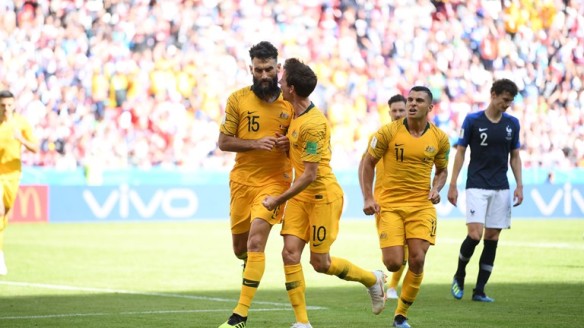
Mile Jedinak scores a penalty for Australia against France at World Cup Russia 2018

Mile Jedinak scores a penalty for Australia against France. Image: fifa.com

After a nervy start, Australia handled both themselves and France well. While France always looked the more dangerous side, eventually they ran out of ideas and Australia began to create the occasional opportunity themselves. Nil-nil at half time was perfect, and it was hoped the pattern could remain. Then, after 10 minutes into the second half, the chaos started. A penalty on Antoine Griezmann when tripped by Josh Risdon was followed within minutes by one for Australia when Samuel Umtiti inexplicably, and deliberately, handle the ball. Mile Jedinak converted while Umtiti inexplicably avoided a yellow card.

As the game progressed, Australia began to tire and became sloppy, losing the ball too often in midfield either by dallying too much on the ball or through errant passing. Eventually France would capitalise, and it happened in the last 10 minutes when Paul Pogba ran onto a loose pass and shot on goal. It deflected off Aziz Behich’s leg, over goal-keeper Mat Ryan, off the crossbar and over the line. Curiously it was awarded as an own goal by Behich. So disappointing to concede so late after all of that hard work was done.

All the post-match focus since has been about that penalty to France. It was the first time the Video Assistant Referee (VAR) had been used to determine a penalty situation at a World Cup, and it’s driven controversy online and in the media since. Much of this is through ignorance or a downright denial of reality. For those in Australia it’s been led by SBS’s Craig Foster. While initially he agreed with the decision (as the commentators did), he reversed his view and now claims no penalty. Claims that only “clear and obvious” errors are meant to be “overturned” is also misleading.

First, the use of VAR. For penalty decisions, the FIFA website says its “role is to ensure that no clearly wrong decisions are made”. There’s nothing about “overturning” a decision. With the VAR active, the referee, when in doubt, is more likely inclined not to unnecessarily stop the game and call a penalty, preferring to wait for notification from the VAR. In this particular case, the referee was notified of a possible missed decision, went and checked the video himself and awarded a penalty. His decision was never “overturned” as the system relating to penalty kicks is not about that anyway. It’s about preventing clearly wrong decisions, and denying a penalty based on the footage would have been clearly wrong. The system worked.

VAR guidelines on penalty decisions

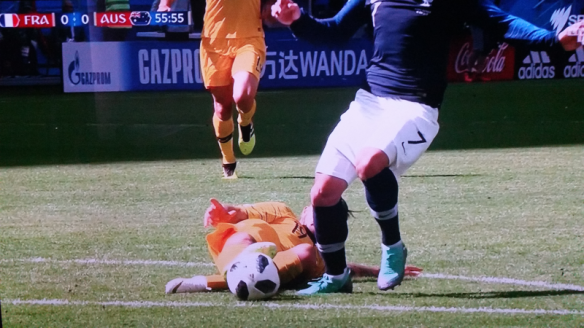
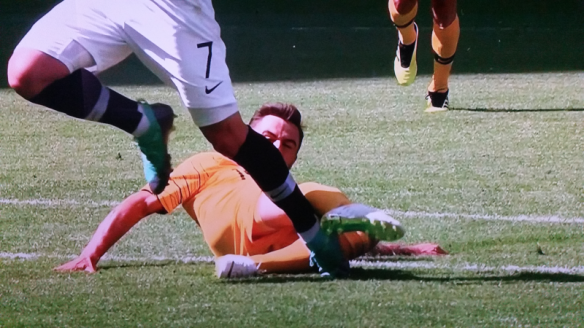
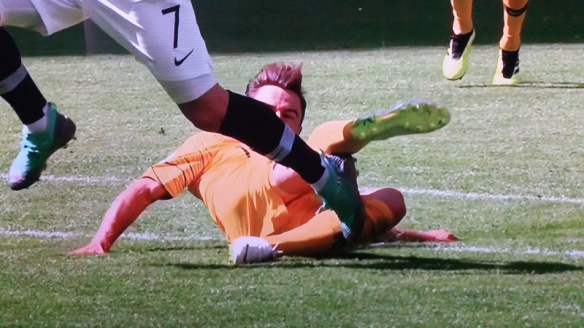
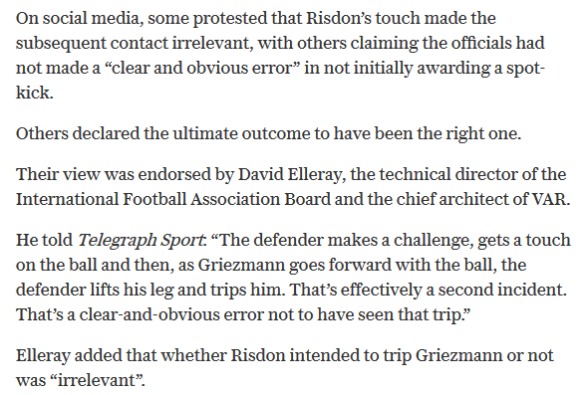
As for the decision itself, the chorus of “he touched the ball” as somehow meant to annul further fouls is nonsense. Again, Foster has led this in Australia, primarily from picking out of context David Elleray’s (former English referee and head of VAR) admission Risdon got a touch on the ball. Even Australia’s players post-game, and captain Mile Jedinak in the press conference, blindly blathered away about this infamous “touch” – a touch that was barely noticeable and only deviated the ball’s direction by 5 degrees, if that. The touch is irrelevant, as Griezmann is still entitled to regather the ball. In his subsequent stride, Risdon lifted his leg and clearly tripped Griezmann. That’s always a penalty. The sequence of events:

Risdon/Griezmann penalty France vs Australia World Cup Russia 2018

Risdon attempts to tackle Griezmann, barely contacting the ball. Note this is outside the penalty box, so a foul would have been preferable then.

fra-pk13

Now inside the box and Griezmann into a new stride, Griezmann skips clear in pursuit of the ball while Risdon lifts his leg and drops it on Griezmann’s heel.

Risdon/Griezmann penalty France vs Australia World Cup Russia 2018

The force of the contact causes Griezmann to fall and Risdon’s leg to fly into the air. It’s clearly a subsequent incident, clearly a trip, and clearly a penalty.

David Elleray’s full quote:David Elleray on France Antoine Griezmann penalty vs Australia World Cup Russia 2018

It’s a shame there’s been so much focus on this one incident as it’s a mostly a distraction. Facts are France “handed” Australia a penalty back within minutes, reversing the damage and restoring the game to level scores. Australia lost because of their constant turnovers in midfield that gave France too many opportunities on the break. Australia were lucky not to be punished earlier. So look to the match in the broader picture, praise the team for playing so well and remaining so disciplined. Whinging won’t help. Even the complaints against France’s Lucas Hernandez constantly going down on any minor contact is irrelevant. As he admitted in the press conference, “Sometimes I exaggerate, but that’s all part of the spectacle… it also helps to take more time when you are winning.”, it’s all part of the game.

Mile Jedinak was right about one thing: It’s time to move on and look forward to Denmark. With Denmark beating Peru 1-0 in their opening game, that blocks the scenario of two draws being enough for Australia to qualify for the knockout phase. That would have been a real scenario as long as France beat Denmark and Peru by more than a goal, and all other games were draws. As it stands, and presuming France doesn’t implode and lose both of its remaining games, Australia cannot afford a loss to Denmark otherwise it’s all over. A draw will mean the final game is alive and goal difference will likely count (the real achievement made against France). A win will mean a draw is most likely enough against Peru. A win by two or more goals means a narrow loss to Peru would also be sufficient.

– Australia plays Denmark on Thursday night 21 June at 22:00 AET. France vs Peru follows at 01:00 on 22 June. The group’s final games are Tuesday night 26 June at midnight (00:00 27 June).

FIFA Match Details

ABC News Report

Socceroo Realm – Top 5 Moments of 2017

7 January 2018

1) The end of an era for the Socceroo Realm

It’s been a year of transition for the Socceroo Realm. The personal webspace that’s been home for it for almost 20 years is now a thing of the past. While the site is still alive on the alphalink domain (select “Archive” from the main menu here to reach it), moving house in November and changing internet providers means I’ve lost access to it. Eventually, presuming the host ISP gets its act together, it will disappear totally. So it’s only this site, hosted by WordPress, that is being updated.

The old Socceroo Realm website

The old Socceroo Realm website as it stands now

2) Australia through to play Honduras as Ange Postecoglou shoots through

The other big event of 2017 was World Cup qualification for Russia 2018. Australia struggled through the group phase, and while they did well to score 19 points and only lose 1 game for the entire phase, it wasn’t enough to secure a top two spot and therefore direct qualification. So it was off to the playoffs where they overcame a stubborn Syria and a meek Honduras. Although, to coach Ange Postecoglou’s credit, the team played some of their best football for the entire campaign. Speaking of Ange…

3) Australia to play France, Peru & Denmark at Russia 2018; Ange Postecoglou quits

Ange Postecoglou shoots through. Yes, qualifies for the World Cup. Yes, quits the team. It’s possibly never happened anywhere else in the world before. A combination of preciousness to occasional media criticism, a long held grudge against Football Federation Australia and another job lined up, seemed behind the decision. Indeed, Postecoglou has signed with Yokohama F Marinos in the J-League, which was the rumoured outcome all along.

4) The Iran Game 20 Years On – Recounting the Memories

On more a personal note, and the reason for the Socceroo Realm in the first place, the infamous Iran Game of 1997 had its 20th anniversary. Strangely not too much fanfare about it compared to the last milestone of the 15th anniversary. No doubt because all the players of the time have retired, and there’s only so much it can gnaw at our soul anymore – especially since Australia had just qualified for its fourth World Cup in succession. Maybe I need to watch the match again to rekindled the distress and torture of that infamous night? The post linked above is actually a slightly modified version of the one written 5 years ago. With the old website no longer active, more of these “Blasts from the Past” will be feature in future.

5) Pros and Cons of a 48-team World Cup

In the world if FIFA, rarely something happens without controversy, and this time it’s the decision to expand the World Cup to 48 teams for 2026. You know what? Despite being a bit indifferent about it in the post above, now I believe it’s the right thing to do. It will happen sooner or later so may as well be sooner.

Honourable Mentions…

Australia featured in the Confederations Cup this year and performed well enough, and in what was once a staple in the Socceroo Realm, a “What Went Wrong” post returned, albeit for not qualifying for Russia 2018 directly. While I’ve written nothing all year about the women’s team, the Matildas, they are on fire. Winning the four-team Tournament of Nations in the USA in July and August by beating the hosts 1-0, Japan 4-2 and Brazil 6-1, and then beating Brazil in Australia in two internationals in September. On the back of this success, Australia plans to bid for the Women’s World Cup of 2023. Let’s hope it’s not a repeat of the last time Australia made such a bid – for the 2007 edition. With Australia the only bidder, FIFA extended the deadline and asked China to bid, and duly awarded it to them.

Melbourne Cup 2017 – Preview and Review!

6 November 2017

With Winx such the dominant headline maker throughout the spring, the Melbourne Cup has suddenly crept up on us. There hasn’t been much thought about it – until now with the final jostling for positions in the race. On first inspection of the field, it was a case of “who” for about half the field. After a few preview shows and reading the newspaper,  suddenly the horses are like old friends and excitement is mounting.

Almandin out-lasts Heartbreak City to win the 2016 Melbourne Cup

Almandin out-lasts Heartbreak City to win the 2016 Melbourne Cup

Time for my annual selections, and hopefully they’re much better since I started posting them on this blog. Ironically they’ve been poor, even despite a few outsiders winning like Green Moon in 2012 and Prince of Penzance in 2015. My last two big wins were 2010 and 2011 with Americain and Dunaden. When I say big, I mean BIG!

Also, the Melbourne Cup is evolving. The international horses have firmly taken hold, whereas before 2010, they’d be regarded as scratchings. Even then, 2010 and 2011 were both French horses, while Protectionist in 2014 was German, so it’s fair enough to be skeptical of British horses. Even the Irish ones are in a significant drought, with Media Puzzle in 2002 the last winner. Also it’s worthwhile to be skeptical of international horses that haven’t had a preparation run in Australia. Since Vintage Crop in 1993, almost 100 first-timers have run and failed, mostly abysmally. Fifteen placings by 12 individual horses is the closest they’ve come.

Speaking of skepticism, the Caulfield Cup continues its poor guide to the Cup. Whereas once it was a pivotal guide, now it’s almost useless. The last Melbourne Cup winner to even run in it was Delta Blues in 2006, who finished third. It’s become almost a b-grade race full of horses that can’t get into the Melbourne Cup (due to proliferation of international runners), while horses targeting the Melbourne Cup don’t want to risk a penalty for winning the Caulfield Cup. Consequently organisers are removing that condition, and will raise prize money to make it a stronger stand-alone race of its own. It’s only possible value these days is noting the preparation run of any international horses.

The Field & Current Odds

1) Hartnell $26

Third last year when in much better form so easy to ignore. He’s a class horse, and they’re trying a new approach to run him fresher in the Cup, so a win wouldn’t surprise.

Result: Didn’t quite run it out last year, and in weaker form this year, was beaten a long way out. 20th

2) Almandin $9

Last year’s winner and returned to the spring with a solid win, then a poor run. Also up 5.5kg on his original handicap weight last year (4.5kg up on race weight). Repeat winners are rare so will risk it.

Result: The weight and history told. 12th

3) Humidor $10

Second to Winx in the Cox Plate and the class local horse. Running the 3200 metres is a query and he’s very temperamental and prone to over-racing. That’s enough to ignore him.

Result: Failed at distance as expected. 19th

4) Tiberian $26

The son of a “teaser”. These are horses that get mares “into the mood” before the stallion arrives to do his job. Studs give the teasers a few shots at the end of the season to keep them interested, and occasionally something is produced than can run. It would be remarkable if that could be a Melbourne Cup winner. Tiberian has solid form so I might have something “small” on him. Otherwise, as an international that hasn’t run here, better to ignore.

Result: Started a long run 1400 metres from home, cruised up heading into the straight and only battled to the line. Disappointing. 7th

5) Marmelo $8

An international than ran home well in the Caulfield Cup. That proves he’s settled in, and with his obvious class and Hugh Bowman, Australia’s best jockey on board, is one of the ones to beat.

Result: A nice run just off the lead and then could only battle to the line. Another disappointment. 9th

6) Red Cardinal $18

Last start flopped; before that great. Had he a preparation run here, he’d be favourite. Do you want to risk it? He could be the one that finally breaks the fist-timer international hoodoo. Has last year’s winning jockey Kerrin McEvoy on board. He should cope with the widest barrier of 24, having done so (if I recall accurately) in 2000 with Brew. The widest is not too bad as it gives you a choice to drop back. If you’re a few horses in, then those out wide can dictate your settling position.

Result: Got into a good position and then, like Tiberian and Marmelo, battle to the line. 11th

7) Johannes Vermeer $10

I always liked this until a few others overtook him. I might still return. Third in the Caulfield Cup if that matters and solid in previous runs, with his only doubt being untested over the distance. These days, a distance doubt is a big doubt.

Result: Sprinted clear and looked the winner to be pipped 50 metres out. The jockey said the horse was going so fast he was surprised anything else could go better. 2nd

8) Bondi Beach $61

Previous Melboune Cup runs 16th and 13th. Says it all.

Result: Failed twice before, failed again. 22nd

9) Max Dynamite $15

Second two years ago and arguably should have won. Was then injured and has only run 4 times, in low grade races, since. He’s a leap of faith.

Result: Couldn’t sprint with the other two. A fabulous effort nonetheless for such a horse light on runs and up in age. 3rd

10) Ventura Storm $34

Disappointing in the Caulfield Cup. Pass.

Result: Disappointing in the Melbourne Cup. Couldn’t run the distance and out-classed. 21st

11) Who Shot Thebarman

Scratched

12) Wicklow Brave $61

Failed last year and in poorer form.

Result: Got some money this time by sneaking into the top 10. Again it proves one of the golden Melbourne Cup rules of failed before means fail again. 10th

13) Big Duke $19

Probably out-classed.

Result: Over-achieved. Class did tell ultimately. 4th

14) US Army Ranger $61

International runner in poor recent form and no preparation run. No.

Result: Never a factor as expected. 18th

15) Boom Time $31

Caulfield Cup winner at $31. Says a lot about the horse and the race.

Result: Failed to run the trip and out-classed. 15th

16) Gallante $101

Previous Cup failure and out-classed.

Result: The first one beaten. 23rd

17) Libran $41

Seems out-classed. A place hope at absolute best.

Result: Ran well enough to grab some prize money. 8th

18) Nakeeta $34

A Scottish horse, so would be a great irony if it could win for Britain before an English horse does. Won “Britain’s Melbourne Cup” – the Ebor in York – which only rarely is a good guide to the Melbourne, and that’s when the winner wins impressively. Not this year. Nakeeta only snuck in. Because the Ebor is a handicap, it’s often regarded as a poor race and good horses generally ignore it.

Result: Ran on late after being left behind in the sprint. A good result overall. 5th

19) Single Gaze $41

A mare that stuck on well for second in the Caulfield Cup. Wary of both mares and the Caulfield Cup, so will pass.

Result: The jockey said the horse was flattened, was shuffled back four pairs than preferred, and never recovered. That’s always the fear with mares. 17th

20) Wall Of Fire $12

With unsuccessful attempts at both of his 3200 races, only a doubt at the distance here. An international that finished second in his preparation run in the Herbert Power, and drops 5kg for the Melbourne Cup. It’s the pattern Protectionist’s year in 2014, except he was German and Wall Of Fire is English. If it’s a slower pace, I can imagine Wall Of Fire sprinting clear, otherwise his run will end 200 metres out, or sooner.

Result: Even though he clearly didn’t run the trip, a bit better was expected. 16th

21) Thomas Hobson $20

An international without a preparation run and seems a plodder with recent runs up 4355 metres. These types typically get out-sprinted.

Result: From the same stable as Max Dynamite and Wicklow Brave, so the trainer definitely knows his stuff, and collectively the three horses won over $700,000 in prize money. Otherwise, he was always a plodder and got left behind in the sprint. Another 800 metres and he might just catch them. 6th

22) Rekindling $14

Another international without a preparation run, and he’s a 3yo too. They often struggle with the big field and hustle and bustle of a Melbourne Cup. In fact, many internationals do, which is why a preparation run is so important.

Rekindling (pink cap) wins the 2017 Melbourne Cup ahead of stablemate Johannes Vermeer.

Rekindling (pink cap) wins the 2017 Melbourne Cup ahead of stablemate Johannes Vermeer.

Result: Obviously coped with the big field and the weight difference to the older horses told in the end. In retrospect, with his good form in Europe and the lower weight, was obviously up there as one of the leading internationals. The problem is you don’t know. No preparation run and a 3yo, historically it means failure. 1st

23) Amelie’s Star $21

A mare that ran poorly in the Caulfied Cup. Yes, despite the heroics of Makybe Diva between 2003 and 2005, mares have a poor record in the Cup.

Result: Failed at distance and out-classed. 14th

24) Cismontane $51

Or “kiss my arse” as always hearing the name evokes. Yes, kiss my arse for its chances too. A Gai Waterhouse horse, and she’ll tell you it will win in a canter. Will most likely lead until being swamped heading into the straight.

Result: Despite being out-classsed, stuck on well enough. 13th

Summary

I’m locked into Marmelo. Although, if it fails, I’ll swear off the Caulfield Cup as any sort of a guide. Then it’s a toss up between Red Cardinal and Wall Of Fire. The former arguably has the best credentials and is an international without a preparation run, while the latter is only just behind on credentials and has a distance doubt. Red Cardinal will be at juicier odds so that most likely will sway me. In fourth I’ll stick with Johannes Vermeer. For an outsider, I’ll go Libran.

Remember, it’s only gambling if you lose!


Result

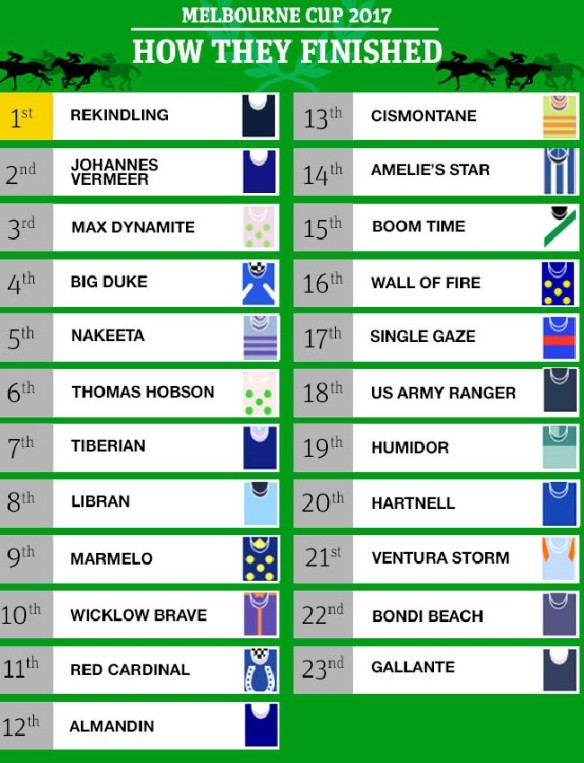
So an international horse without a preparation run in Australia wins the Melbourne Cup. It’s only the second time since the first time in 1993. Overall, it was a sterile, bland Cup. Rekindling wasn’t heavily favoured even by those “in the know”, while conspicuously quiet post race. If the second and third placed horses, Johannes Vermeer or Max Dynamite, had won, things might have been different. Without trainer Joseph O’Brien beating his father Aidan O’Brien to winning the Cup, there wasn’t even an interesting story from this year’s race. The only Cup more underwhelming than this one was 2012 with Green Moon.

Melbourne Cup 2017 Race Results

Melbourne Cup 2017 Race Results. Image: news.com.au

Despite a first-up international winning, the lesson still is to largely ignore such horses. While Max Dynamite followed his second from 2 years ago, the rest mostly failed, with the next best Nakeeta in fifth. Favoured horses such as Red Cardinal and Wall Of Fire finished 11th and 16th respectively. Each year, while one or two will race well, it’s a lottery to know the exact one. The second lesson is distance. At least half the field failed to run it out. Third lesson is class. Other than Big Duke in fourth, the outsiders ran as expected. Then there’s the Caulfield Cup. While Johannes Vermeer finished third in it, again it failed to produce the winner… nor the third placed horse, nor fourth, nor fifth… all the way up to eighth. Marmelo was the next best in ninth.

Johannes Vermeer will be one to watch next year. Near winners do have a good record the following year as they are often a bit stronger and tougher and haven’t suffered a weight penalty. Unlike the winner, in this case Almandin, which is typically penalised around 4 kgs for the following year The question for Johannes Vermeer is whether a precocious lightweight will emerge. That’s why he was beaten this year.

mc17-03a

Often the more interesting fillies are the two-legged variety. Image: news.com.au

Personally it was a wipeout. Johannes Vermeer needed to win for me as I never bet place. With the likes of Marmelo, Red Cardinal, Tiberian and Wall Of Fire all failing, all my multiples went up in flames. Oh well, there’s always next year… and the year after… and the year after!


Australia vs Iraq & UAE – Back on Course

2 April 2017

Credit where it’s due. Australia procured four precious points, as was the minimum requirement, away to Iraq and at home the United Arab Emirates this week. While the 1-1 draw in neutral Tehran against Iraq could have gone either way, the Socceroos ground UAE into submission for the win 2-0 in Sydney. It was a good response after the stunningly exciting 2-2 draw in Thailand to end 2016, where the Thais ran Australia ragged, playing inspired football in tribute to the recent death of their king, and arguably they should have won. Curiously, Australia remains the only unbeaten in the group, yet still sits in third.

The results have provided some sort of relief to a side struggling for wins, not to mention adding much more excitement to the qualifying process itself. For an ambitious team and coach, it’s been a timely boost, especially after switching to a 3-4-3 system. Remember, coach Ange Postecoglou doesn’t only want to qualify for Russia 2018, he wants to perform well there. While the 3-4-3 worked well against the UAE, often it operated as 1-2-4-3 formation. Calling it 3-4-3 is probably more a statement on the team’s psychology – to reinvigorate and inspire a more attacking and confident mentality, rather that coast as usual like the previous two coaches, Holger Osieck and Pim Verbeek, would do.

The only quibble with the results is all three goals came from corners. Several of the few well worked opportunities Australia managed to create were let down by poor final balls and finishing. Aaron Mooy missed the easiest against Iraq, while the Iraqis should have received a penalty for an Australian handball. They scored anyway a few minutes later to cancel the damage from the referee’s error. Then it was a matter of holding the Iraqis out with some desperate defense and goal-keeping.

It shows how pivotal these moments become where one moment you could be 2-0 up and it’s a cruise to victory and then suddenly it’s all equal and you’re trying to protect that crucial one point. That extends to the group process itself. After two wins from the first two games, commentators like Mark Bosnich were talking about wrapping it up quickly. Four draws later finds itself desperate for the win to simply stay in touch. Australia in third place has 13 points, behind Saudi Arabia and Japan on 16. In fact, with Saudi Arabia and Japan both winning their matches, Australia only managed to hold their position after these two games.

The real crucial game is the one against Saudi Arabia in June. A win by two goals there and Australia jumps to second. A one goal win keeps them third. Their final game is home to Thailand, so they would expect to bank 3 points there to go to 19 points. The other game is away to Japan, so no a guarantee of any points. The good news is after Australia, the Saudis are away to the UAE and home to Japan. If Australia draws with the Saudis, they will need 4 points from their final two matches and hope the Saudis lose both. A loss means Australia would need two wins and the Saudis two losses. So that game in June against Saudi Arabia is the closest thing to a high pressure, crucial World Cup qualifier we’ve had since the intercontinental playoffs during the Oceania era.

Results

2016-11-15 Thailand 2 (Dangda 20′, 57′ PK) – Australia 2 (Jedinak 9′ PK, 65′ PK)
2017-03-23 Iraq 1 (Ahmed Yaseen 76′) – Australia 1 (Leckie 39′)
2017-03-28 Australia 2 (Irvine 7′, Leckie 78′) – UAE 0

Match Report – Thailand
Match Report – Iraq
Match Report – UAE

The Scenario

Current Points and Goal Difference

JPN 16 9+
KSA 16 8+
AUS 13 5+

13 Jun 2017: AUS beat KSA 2-0, IRQ lose to JPN 0-2

JPN 19 11+
AUS 16 7+
KSA 16 6+

31 Aug 2017: JPN beat AUS 1-0; UAE draw with KSA

JPN 20 12+
KSA 17 6+
AUS 16 6+

05 Sep 2017: AUS beat THA 3-0; KSA lose to JPN 0-1

JPN 23 13+
AUS 19 9+
KSA 17 5+

Two losses and a draw are assigned to KSA for their final 3 games. Given their form, it’s quite possible they win somewhere. If it’s at the UAE, that bumps them to 19 points with goal difference probably keeping them third. If they win or draw at home to Japan, then they overtake Australia. Note, Japan will most likely be qualified by the final so could send an experimental team to Saudi Arabia.

If Australia finishes third, all is not lost. The beauty of being in a large confederation like Asia is you do get second chances, and sometimes even a third chance. This would involve a playoff with the third team from Group A (likely Uzbekistan) and then a playoff with a CONCACAF team. Wouldn’t that be exciting!

Melbourne Cup 2016 – The Verdict

31 October 2016

Preview (scroll down for the Review)

For anyone that’s read my Melbourne Cup preview for the past few years, they’d probably think “this guy is clueless”. In a sense that’s true, because for the few years this blog has been running the predictions have been poor. While last year can be forgiven considering a 100/1 shot won, which would have been missed by anyone using rational thought, and Admire Rakti was beset by a heart problem during the 2014 race that Protectionist won, Sea Moon was a poor pick in 2013 when comparing its form against the eventual winner Fiorente, and 2012 (Green Moon) was wipeout. Before that it was hit with Dunaden (2011) and Americain (2010).

About last year’s Cup, it was a slowly run race, which not only helped Prince Of Penzance win, it hurt the chances so many others, including Fame Game from Japan, the favourite. For some trainers and even one horse, 2016 is a year of redemption.

To repeat my usual guidelines:
1) Look for horses with form at, or near, the distance of 3200m
2) Look for horses in recent form
3) Look for horses with enough class
4) Look for horses that have, or are likely to, run well  in Australia
5) Ignore horses that have failed in the Cup before

Eight horses are back from the 2015 Cup, which is an unusually high number. Theoretically, if you follow rule 5, a third of the field is disqualified.

There’s also another rule, or trend, developing: The Caulfield Cup is a rubbish form reference. No Melbourne Cup winner has come through it since Delta Blue’s third in 2006, and the last Caulfield Cup winner to win the Melbourne Cup was Ethereal in 2001. Before that was Let’s Elope in 1991. Incidentally, both were mares with a light weight. It’s become so poor because many horses either skip the race, leaving it for lower grade horses or those using it as a hit out. Only four from this year’s race will even contest the Melbourne Cup.

Melbourne Cup field of 2016

Melbourne Cup field of 2016

I’ll award each horse Yes, Maybe or No for their chance to win. (I) denotes an international visitor, (R) denotes a return runner.

01 Big Orange $14 (IR)

The best credentialled international visitor, and  fifth last year. The connections rued the slow pace last year, which is ironic considering Big Orange made the pace. They admit the error of going too slow, which saw them out-sprinted at the end. There won’t be the same mistake this year. Big Orange is a grinder so he needs a fast pace and keep sticking on. I imagine the race pattern could be similar to 2006 when Delta Blues ran ahead off a strong pace and was unable to be caught. Yes

02 Our Ivanhowe $51 (R)

Form not good enough. No.

03 Curren Mirotic $34 (I)

The only Japanese horse this year. No 9yo has ever won it (9yo by Australian measure, 8.5 in actuality) and so inconsistent with his form. At his best can win. Came a narrow second in super fast over the 3200m of Tenno Sho three starts back. Then returned an 11th and 9th in his next two starts. Will most likely lead as the unofficial pacemaker for Big Orange. (Reluctantly) Maybe.

04 Bondi Beach $9 (IR)

Ran poorly last year, so that should disqualify him. He’s been set specifically, and is a year more mature after racing last year as a 3yo. Would not be so short if not for the trainer, jockey and owner, Aiden O’Brian, Ryan Moore and Lloyd Williams, respectively. Also add a few points for the iconic Australian name itself. He’s been specifically set for the race and while many experts rate him a good chance, for me it’s a reluctant Maybe.

05 Exospheric $20 (I)

In the hands of the Freedman’s now, he’s only a recent arrival so I still class as an international in terms of analysing for this race. While he was OK in the Caulfield Cup, that race’s form history is now poor and, of course, the winner was far more impressive. No.

06 Hartnell $5 (R)

The favourite, and the best horse in terms of class and form in the race. His issue is the distance, especially that he flopped in last year’s Cup. While, like stated prior, that was an odd race being run so slowly, he’s improved vastly since then anyway. Has the look of the 2013 winner, Fiorente, who also came through the WFA races and finished second in the Cox Plate. In the 2000m Turnbull Stakes prior to that, Hartnell destroyed the eventual Caulfied Cup winner. Yes.

07 Who Shot Thebarman $34 (R)

Third two years ago was his shot at it. Class never there, and form not as good either. No.

08 Wicklow Brave $15 (I)

Trainer Willie Mullins has a knack of travelling horses here and getting them to perform. Also has Frankie Dettori on board. Arguably the pair should have won last year with Max Dynamite. Won the Irish St Leger at his last start over Order Of St George. One of the top hopes. Yes.

09 Almoonqith $21 (R)

Ran 18th last year and doubt he’s ever had the last class, and this year form not as good. No.

10 Gallante $51

Sydney Cup winner so will run the distance. Class is the issue, and recent form average. No.

11 Grand Marshal $41 (R)

Another Sydney stayer. Winning the Moonee Valley Cup last start shows his form is solid. Class the problem. No.

12 Jameka $8.50

Devastating winner of the Caulfield Cup. Like the last two horses that did the Caulfield-Melbourne Cup double, is a mare with a light weight. It’s these reasons that I rate her among the top chances. Note she’s the only Australian bred horse in the field too. Named after Serena Jameka Williams, apparently because they share similarly big bums. Yes.

13 Heartbreak City $17 (I)

Last start won the Ebor Handicap, the closest Britain has to our Melbourne Cup. It’s a race not of the same standard, it hasn’t been a great form reference, and horse was well weighted. Won its previous two starts too, albeit hurdle races. Has it acclimatised too? You won’t know until the day. No.

14 Sir John Hawkwood $81

Won the Metropolitan in Sydney, which has as much relevance to the Melbourne Cup as the Bathurst 1000. Last start 10th in the Caulfield Cup. No.

15 Excess Knowledge $71 (R)

Ran OK last year to finish 7th. Form poor this year. No.

16 Beautiful Romance $81 (I)

Always skeptical of international mares (none have performed well that I can recall), and form barely average. No.

17 Almandin $11

Last two runs have been wins in local staying races. Question the class of those fields, and therefore the horse. The lightweight is responsible for his shortish odds. (Reluctant) No.

18 Assign $61

Similar form around Almandin, except was beaten convincingly by Almandin, hence the far juicier odds. No.

19 Grey Lion $51 (I)

Second in the Geelong Cup. It depends whether that’s a form reference this year. Other than the occasional hits – 2002 (Media Puzzle), 2010 (Americain) and 2011 (Dunaden) – it’s a hindrance more than a help. If you like the Geelong Cup, there’s two other horses drawing a bigger spotlight anyway. An international that will remain in Australia. (Only because it’s a grey) Maybe.

20 Oceanographer $8 (I)

Superb winner on Saturday to qualify for the Melbourne Cup after a close third in the Geelong Cup. That wasn’t the plan for this international visitor, so the big issue is whether he can run three big races in 13 days. Maybe.

21 Secret Number $31 (I)

The form looks superb with the last 5 starts being 1, 2, 1, 2 and 1. The problem is that it’s over 3 years! He’s only run one other race this year, with the previous race being the second place on the Queens Cup at last year’s Spring Carnival in Melbourne. Very tricky to place. Need to go on trust the stable can produce him on the day and, if so, especially down in the weights, a strong chance. Yes.

22 Pentathlon $126

Class and form queries. The price says it all. No

23 Qewy $26 (I)

The Geelong Cup winner, so if you fancy Oceanographer, you must fancy this. Maybe.

24 Rose Of Virgina $101

Never heard of it until I saw the Melbourne Cup field. It’s really a $201 chance. There must be sympathy money on it. No.

Summary

Five horses marked Yes: Big Orange, Hartnell, Wicklow Brave, Jameka and Secret Number.

Five horses marked Maybe: Curren Mirotic, Bondi Beach, Grey Lion, Oceanographer and Qewy.

Hartnell is the clear favourite with the public at $5, with Oceanographer ($8) and Jameka ($8.50) next. Oceanographer is exaggerated because of that big win on Saturday. For value (and that possible distance doubt), I’ll prefer Jameka over Hartnell, and hope it’s a return to form for the Caulfield Cup as a form reference. Otherwise, I’m writing it off forever! Again for value and also Big Orange already had a go last year, I’ll prefer Wicklow Brave over Big Orange for my second bet. I’ll also take small pot shots at Secret Number and Grey Lion.

The five “Yes” horses will go into my 5-horse boxed trifecta, while I’ll exclude Secret Number for my boxed First 4.

Remember, it’s only gambling if you lose!


Review

Final Results

01 Almandin
02 Heartbreak City
03 Hartnell
04 Qewy
05 Who Shot Thebarman
06 Almoonqith
07 Beautiful Romance
08 Exopheric
09 Pentathlon
10 Big Orange
11 Grand Marshal
12 Oceanographer
13 Bondi Beach
14 Grey Lion
15 Jameka
16 Excess Knowledge
17 Our Ivanhowe
18 Sir John Hawkwood
19 Assign
20 Gallante
21 Wicklow Brave
22 Curren Mirotic
23 Secret Number
24 Rose Of Virginia

I ended up changing from Jameka to Hartnell. The odds improved and the doubts about Jameka grew larger. It didn’t matter ultimately, as Hartnell finished a well defeated third. It was a good race for him, with the 4kg difference in weights proving the decisive factor between him and the winner, Almandin. The race was exciting itself with Almandin and Heartbreak City duelling to the finish line.

To continue my poor run of predictions, I had both Almandin and Heartbreak City a “No”. The class was always the issue, which means it’s the second year in a row a low weight overcame a class deficiency. In some ways, it’s a return to the Melbourne Cup of old, where horses would try and beat the handicapper to get into the Cup with a light weight and peak on the day. Does that mean we should begin to revise our guidelines for picking winners? Maybe. If a horse has won decisively at its last start, then that’s form you can trust.

Some rules were reinforced, particularly previous runners. All ran to their past performance, if not worse. While Hartnell in third, Almoonqith in fourth and Who Shot Thebarman in fifth were good, Big Orange was poor in 10th and let’s not mention Bondi Beach, Grand Marshal, Excess Knowledge and Our Ivanhowe. Hartnell is probably the exception anyway in that he clearly improved in form since the last Cup. He was a super horse in comparison and was unlucky that two sneaks produced on the day.

Horses that haven’t run in Australia before, again, it’s wise to ignore them. While they’ve come close like Heartbreak City today and Red Cadeaux in 2011, they mostly fail: Bondi Beach, Beautiful Romance, Secret Number, Wicklow Brave and Curren Mirotic. Even if one wins one day, that will be a rare exception you cop. After all, these rules are more guidelines, and horses aren’t machines.

The Geelong Cup, again, was a poor reference. While Qewy was good in fourth, Grey Lion and Oceanographer failed. The latter also only had 3 days to recover from Saturday’s win, which is alien to European horses. Much like the situation with Almandin’s and Heartbreak City’s recent wins, winners in Geelong need to dominate it, or be highly credentialled horses.

Distance: Most of them don’t run it out. Arguably even Hartnell you could say didn’t quite stay. The likes of Jameka, especially, if you have doubts, leave them out.

Class: Reinforced again with the likes of Who Shot Thebarman, Pentathlon and Grand Marshal. While they can run 3200, they can’t run it fast enough. Also be wary of plodders, or horses without a sprint. For all Big Orange’s ability to run a solid 3200, it’s pointless if several horses sprint past him in the straight. Curiously, Big Orange’s jockey blamed the pace. Last year it was blamed for being too slow when finishing fifth. This year it seemed fast enough and they only managed tenth. Excuses. Maybe he’s not good enough.

The Caulfield Cup: Yep, time to write it off as any sort of form reference.

The Japanese: It might be time to write them off too. Since the 1-2 in 2006, they’ve been a disaster.

Other than Hartnell in third, my picks were a wipeout. Wicklow Brave ran wide all the way, with Frankie Dettori saying the horse felt “flat”. More likely Frankie “flattened” him. To think he and Heartbreak City were in the widest barriers together, yet the latter ended up beautifully just off the fence midfield, while the latter was running 10 wide out of the straight the first time. A debacle of a ride. My outsider of Secret Number proved that: a secret, and just a number. Took the lead around the home bend and folded. It really is the last time I get seduced by an international horse without a run in Australia first.

I’m not the only stooge either. Only one of Channel 7’s “experts” on the day picked Almandin to win. Bruce McAvaney picked Almandin on the Sunday preview show. Several of the panel on ABC’s Offsiders had Almandin second or third, with the combined tally being Hartnell, Jameka and Almandin. On Sky Racing only Glenn Munsie from TAB had Almandin to win, while Ron Dufficy had it third. The other three panelists ignored it. Racing.com was similar with only one of the six experts selecting it to win, with one for third. Across those four media outlets, only a handful slotted Heartbreak City for a place, while Hartnell was the overwhelming top pick for most. It means the horses are far more reliable than the experts.

A good Melbourne Cup overall. You like to see a good race, a relatively popular winner and a nice story. We got a bit of all of that. Almandin was around fifth most popular in the betting and paying $11.80, the race was close to the end, and who can knock Lloyd Williams winning his fifth Cup? He has put so much money into the industry for approximately 40 years, that he deserves it. Nice to see he was trackside too for a change. He must have known something, the wily old bugger.

Rio 2016 Review – The Great Australian Choke

22 August 2016

“I don’t need a gold medal for self worth.”

“It’s not about winning, it’s about trying to win.”

“It’s a racing meet; times don’t mean much.”

With quotes like these, respectively from Cate Campbell, Bronte Campbell and Mitch Larkin, is it any wonder Australia suffered yet another disaster in the pool? It was so predictable that you could almost write the script. Big egos, a nonchalant attitude, and absurd excuses. The latter quote is one in perpetual use, as far back as double world champion Samantha Riley using it to explain her two failures at the Atlanta Olympics of 1996. The folly of it and all the other excuses is exposed when you understand that swimmers live and breath by times. They are obsessed by them, and personal bests. The opposite is actually true for them: results don’t matter, times do. All training is geared around achieving a PB, with the key focus being to deliver it in an Olympic final. We even saw Australian swimmers ecstatic at doing a PBs in an Olympic final. Unfortunately, they were the ones finishing fifth. For the favourites, it was implosion after implosion.
Australia's Chloe Esposito crosses the line to win the modern pentathlon at Rio 2016The surprise gold, the most emotional gold, the best gold of all. Australia’s Chloe Esposito crosses the line to win the modern pentathlon at Rio 2016. Image: Getty Images

With the three aforementioned swimmers, also add Emily Seebohm and Cameron McEvoy to the hit parade of inglorious failures. Seebohm – the double world champion at backstroke – was so abominable she finished seventh in the 100 and failed to even reach the 200 final. She’s probably more a case of a training error – not timing her taper correctly. As for McEvoy, apparently he got stage fright – something at the Australian trials he even warned the public was a possibility for any Olympic favourite. Talk about the proverbial chicken coming home to roost. If not for the upset win of Kyle Chalmers in the 100 freestyle, and Mack Horton’s narrow win the 400 freestyle, it could have been even worse.

There’s a bigger problem at play here: the mindset. Every single swimmer responded the same way at post race interviews. All tried to look for positives from their defeats, like just being in the final, or being at the Games themselves, that was success in itself. The Campbell sisters used the fact of two sisters being in an Olympic final as a means to extract something positive from their combined disaster. This is not a coincidence; they are schooled to react this way. Except, you only need watch their body language to realise it’s one big charade. It’s especially glaring if you watch those interviews with the sound muted. There’s no way anyone could align their words with the body language. Cate Campbell was clearly shell-shocked, while Larkin was constantly battling his instinct to express disappointment and his will to suppress it.

Who’s to blame? It’s the sports psychologists and so-called mentors. One of the losing swimmers attributed this to Leisel Jones: “If you’re not complete without a gold medal, you won’t be complete with one”. Note that Jones is Australia’s worst choker and biggest letdown in Australian Olympic history. Of the eight individual races she contested, she lost seven. That fact alone should disqualify her from any such mentoring role. At the very least, the swimmers should not be using her for inspiration. My vague recollection is the quote is actually from surfer Layne Beachley. That would be even worst, coming from someone in a tinpot sport of her time like women’s surfing. Regardless of the source, it’s clear the substance of that quote is embedded, because Cate Campbell paraphrased it.

Deep down, they do need a gold medal for self worth. Or, at least, for self vindication. They don’t spend 20 hours a week looking at a black line, winning world championships, breaking world records, leading the world by a whopping margin, and go to an Olympics and think “I don’t really need this”. It’s this conflict between their competitive fibre and the garbage from the sports psychologists that’s creating all the problems. They enter the pool deck and realise their dream is now in front of them. Countering that there’s voices in their head telling them it all doesn’t matter. It throws them off their concentration and race-plan, and reduces them to a physical and psychological wreck when they should be at their most confident and calm. In typical Australian fashion, their response to handling pressure is to bully the opposition. They always go out too hard rather than remain focused and be respectful of the task at hand. It’s no coincidence that the favourites all flopped and those swimming PBs came from the lower ranked swimmers. Swimmers from other nations were swimming PBs too. While you can pick out one or two of them that did fail, the difference is it was only one or two. With Australia it’s a pandemic within the team. It’s been enduring for past 20 years too.

Another problem is the timing of the selection trials. USA has theirs around 5 weeks before the Olympics whereas Australia’s is around 5 months. Ignore comments, particularly from former swimmers and commentators, that it works for us. That’s the typical Australian ego that likes to think it leads the world in everything. It doesn’t. Not when one Hungarian can win the same amount of gold medals as your entire team. After successive debacles, which includes the “successful Olympic meets” that still produced gold medals below benchmarks, it’s an unequivocal failure. It’s not even about gold medals. It’s about times, personal bests. Not enough swimmers produce them when it counts. They all can’t be suffering mental breakdowns or stage fright. It’s physical – as with Emily Seebohm. Remember, this is a 20 year embedded problem, not just the past two Olympics. Then consider the time lag means more chance of carrying an ill, injured or out of form swimmer to the Games. Conversely, late bloomers and those injured during trials miss selection. On a strategic level, Australia’s early trials also mean we lay a marker for the world to challenge, and beat.

The main concern with the American system of trials so close to a major event is the double taper. A taper is when athletes ease off after a period of hard training just prior to an event to re-energise the muscles ready to compete at peak performance. As a triathlete many moons ago and in many bodies ago, I can attest it’s a wonderful feeling to race after taper. You feel like superman and seem to have an endless supply of energy and power. Typically the taper period is about a week before an event. This will vary between sports, event and athlete, as will the training block needed just prior. For some, a few weeks won’t be enough, and if they can’t master the double taper, then it’s a decision to set for trials and hold form for the Olympics or set for the Olympics and rely on natural ability and the existing training base to qualify. Offsetting that is American swimmers don’t have to peak twice a year. Asking our swimmers to go through a hard training regime twice could be wearing down their bodies. Double-peak vs double-taper, you be the judge.

The USA’s continued domination on the world stage shows their system works. After an even world championships last year between the USA and Australia, it was a pummelling at the Olympics with the USA winning 16 gold to Australia’s 3. While you can argue they have a huge talent pool, and Michael Phelps and Katie Ledecky, you can’t deny that those athletes that qualify are consistently successful at the Games. There’s also that Hungarian. Katinka Hosszu won 3 gold medals by herself, and it would have been 4 if not for the USA’s Madeline Dirado swimming a massive PB to just win the 200 backstroke. Our stars, like even Ian Thorpe in the 200 freestyle at Sydney, will more often flop.

Even more devastating with the USA is those swimmers that haven’t tapered for trials will swim much faster at the Games once they have tapered. In contrast, ours consistently swim slower times than trials. 73% of them did, according to former head coach Brian Sutton. We went into 9 individual events with the fastest time of the year, which included 7 world championship holders and a world record holder, and left with one victory. That was Mack Horton. Madeline Groves can’t be faulted either, swimming a PB in the 200 fly when second by a whisker. Kyle Chalmers’ win was compensation – and relief – for Cameron McEvoy’s failure in the 100 freestyle. The third gold was the women’s 4×100 relay – who were favoured. So it’s 3 gold from 10 events at a 30% return. In that sense, Rio was far worse than the “disaster” of London where it was 1 from 2 at a 50% return.

There were also some strange strategic decisions made in the 4×200 freestyle relays. Emma McKeon, who rebounded with a bronze in a hot 200m freestyle field after folding in the 100m butterfly, was dropped for the women’s 4×200. Australia missed gold by just under two seconds, so would she have been two seconds faster than the fourth best swimmer? Same in men’s event, where McEvoy was dropped, seemingly to concentrate on the 100m. That backfired spectacularly with Australia just inches back in fourth from a silver and McEvoy imploding in his race anyway (thankfully Chalmers was there to clean up the mess). In hindsight, this strategy for them to focus on fewer events only increases the pressure. McEvoy surely would have enjoyed the relay swim, and grabbing a medal would have eased pressure and boosted confidence for his individual race. Let’s look to the USA again, or even Hosszu from Hungary. They have no problems with heavy programs and will even swim twice in the one evening.

The reason the the team received so much criticism was because Olympic sports receive so much of taxpayer money. This is no criticism of the funding. After all, the $332 million over four years is peanuts compared to the $1000 million we pay every single month on our national debt, and Australian success at the Games boosts national morale. The last thing we want is the return to the old days of barely any gold. It’s merely about return on investment, and the public has a right to expect a minimum standard of performing to your optimum. Of that $332m most went to swimming ($37.9m), cycling (34.1), rowing (32.4), sailing (29), hockey (28.6) and athletics (27.9). Also implemented was the “Winning Edge” program, where funds are directed to those at the top – those sports likely to win gold. Reputedly it’s a copy of Great Britain’s successful program that saw them win 29 gold in London and another 27 in Rio. Australia is at 8 after four years of a 10 year plan, so the “copy” aspect obviously still needs more work, even if Britain’s budget is much higher at 274.5 GBP (about 475m AUD). It’s worthwhile continuing with it until at least Tokyo 2020 before any review.

REVIEW OF SPORTS

Here’s a breakdown of the success of all sports at Rio with the amount in millions invested.

Swimming

$37.9m – 3 Gold, 4 Silver, 3 Bronze

Running through the events…

Men 100f – Cameron McEvoy: According to the head coach, he got “stage fright”, and finished 7th at 1 second slower than his best. Even within half a second of his best would have seen him win gold. When Kyle Chalmers came through and won, you could really sense the excitement mixed with relief on the faces of the coaches. Like most of us, they would have been watching McEvoy, exasperated at yet another impending Australian failure, only to catch a glimpse of Chalmers in the last metres surging through for the win.

Men 400f – Mack Horton: Came into Rio with the world’s fastest time of the year, and won gold, just pipping Sun Yang. Horton caused the biggest attention outside the pool with his criticism of Sun’s drugs record. The Chinese claimed the drugs were for angina and were later removed from the banned list. Interestingly, the Australian Olympic Committee encouraged Horton to speak up and hog attention in contradiction with their “One Team” philosophy. Ask Nick Kyrgios about that philosophy and he’ll say it’s only when it suits them, is politically correct or is in their own sanctimonious favour. Anything remotely controversial coming from the mouths of athletes and the speech police are out in force.

Men 100b – Mitch Larkin: Went out too hard, being just in front of world record pace, faded to fourth at .3 off his PB. Hitting is PB would have been good enough for silver only.

Men 200b – Mitch Larkin: Similar to his 100, except improved to silver, and cost himself gold by swimming .8 below his PB. He was thankful merely for the medal at this stage, expressing an “at least it’s something” attitude.

Women 50f – Cate Campbell: This was even more disappointing than the 100. With the pressure off after that flop, and for an event that requires no pacing, expectations were for her to rebound. It would have been an easy gold if she swam near her PB. She finished fifth. Her sister, Bronte, and world champion, was expected to get silver. She finished 7th. Bronte apparently had should problems leading into the Games so wasn’t fully ready.

Women 100f – Cate Campbell: The most famous meltdown of the Australian swim team and “possibly the greatest choke in Olympic history”, in her words. Fastest time by miles over anyone in the field and broke the world record only a few weeks earlier. That raised suspicions at the time she might have peaked too early. Anything near her best time and it’s a certain gold. Finished sixth. Her sister, Bronte, like with the 50, was the world champion and expected to get silver. She finished 4th.

Women 100b – Emily Seebohm: Hopelessly out of form. Her best time would have seen gold. Finished 7th.

Women 200b – Emily Seebohm: This time couldn’t even make the final. Best time would have won gold.

Women 200bf – Madeline Groves: One of the big chances based on producing the fastest time of the year. She did everything possible: swam fast, beat the Americans, beat the Chinese, beat just about anybody you’d suspect as tough competition. She lost to Spain’s Mireia Belmonte by just 3/100th of a second. She kept producing PBs so she can’t be faulted.

Women 4x100f relay: Justified their favourtism for an easy win, and in world record time. This result – on night 1 of the Games – proves the Campbell sisters arrived in form. It’s inexplicable both failed in the individual events.

Women 4x100m relay: With their best times, they would have won. Ended up second by just under 2 seconds.

In summary, 9 gold would have been the optimum return. You also counter that with the hope some swimmers improve from the trials, and you got that with the likes of Madeline Groves, who missed gold by a whisker.

Archery

$2.6m – 1 Bronze

Took a well deserved bronze in the men’s team event, and nearly caused a boilover when pushing the eventual Korean gold medalist to sudden death in the men’s singles.

Bastketball

$21.1m – 0 Medals

Women choked. Won all 5 pool games, led Serbia through the quarter final, lost by two points. Too many turnovers cost them and couldn’t cope with Serbia’s swarming defence. Warning signs were there in the pool games, where they had to make last quarter surges in their final two games to defeat Japan and Belarus. The men suffered a similar fate, also losing to Serbia, unable to cope with the pressure defence, and shooting so poor that their half time tally was only 14 points. This after beating Serbia in the pool games by 15 points, and the only loss being a close one to the USA. Then it was heartbreak in the bronze medal game, losing by 1 point to Spain. It’s the fourth loss in a bronze medal game, and one that will be rued. Not so much the bronze medal game, more the wasted opportunity in the semi final. They deserved a silver and to play for gold. While the funding seems high for the opportunity for only two medals, basketball is such a popular game that it’s worthwhile the investment. Also, had the men got that medal it would be have been one of our best and most celebrated of the Games.

Canoe/Kayak

$18m – 2 Bronze

Jessica Fox made an outstanding run in the K1 finals to secure bronze. It would have been silver if not for a faint touch on one of the gates. The Spanish winner was in a class of her own. Next Olympics C1 will be introduced for the women at the expense of the men’s K2. That will give her – and no doubt her precocious younger sister – an extra option for gold. The flat water was disappointing. The men’s K2-1000 bronze was the only medal.

Cycling

$32.5m – 1 Silver, 1 Bronze

A shocker. Even though Australia had no outright gold medal favourites, they had a plethora of top contenders and the result of zero gold is an abomination. There are some excuses, like the women’s pursuit team crashing in practice, and the ridiculously dangerous road race course saw Richie Porte crash out. Australia’s best hope, Simon Gerrens, was already out of the Games after a crash in the Tour de France. Rohan Dennis needed a bike change in the road time trial after breaking his handlebars, which cost him silver. The men’s pursuit team broke the old world record in the gold medal race only for Britain to break it by a greater margin – and win by just .8 seconds. That was superb effort. The women’s and men’s omnium events suffered from bad luck and a crash, respectively.

No excuses for our sprinters, with Anna Meares’ lone bronze the best achievement from six events. Meares entered the Games with dubiously low expectations for someone of her calibre: do better in the keirin than in 2012 (not hard since it was disaster) and to win a medal (took bronze in the keirin). Rio seemed more like farewell tour than a real, intense effort for gold. A nonchalant 10th in her pet event, the individual sprint, said it all. Matthew Glaetzer in the men’s events showed none of the speed seen in recent international events.

BMX was a wipeout with Caroline Buchanan just missing the final after a careless crash in her the final heat of her semi final. She’d not have beaten the Colombian winner, Mariana Pajon, in the final anyway. Pajon backed up after her 2012 gold medal to really demonstrate the meaning of pressure. In the men’s, both Australia’s best hopes reached the final undefeated from the semi finals, only to blow it in the final to finish 6th and 8th. Both had poor starts than usual. Quite possibly they wasted too much energy in the semi finals, allowing for fresher legs to steamroll them. The only equivocation is that BMX has a sudden death final for gold, which opens the possibility for misfortune. Earlier rounds are run over three heats, and this would be a much fairer approach to decide the medals.

Swimming’s big failures has meant cycling – particularly on the track – has escaped attention. No gold medals is outrageous for a sport that receives so much money. Authorities would have expected at least 3 gold medals, and hoped for more. With the exception of Athens 2004, cycling are perennial under-achievers. It was only one gold in London and none in Beijing. Even considering the dominance of the British track riders over those Olympics (7 from 10 in London, 6 from 10 in Rios), one gold in three Games is outrageous. Like with swimming, it’s no point popping up at world championships in other years and dominating. It’s about the Olympic Games and the sport needs an overhaul.

Diving

$8.6m – 1 Bronze

Popping up with gold two times since 2004 might have boosted funding. A minor medal or two is usually our standard, and that was the result here.

Equestrian

$10.5m – 1 Bronze

Led the eventing after dressage and cross country in both individual and team, only to lose it in the showjumping. While the individual had the precarious requirement to jump clean, the team of 3 riders could afford to drop 4 rails. That buffer was gone with the first rider. The second rider jumped clean only for the third rider – the individual leader – to drop two. That’s equestrian, and the team was really only in such a strong position after a superlative cross country. Rio will be a good base to build for Tokyo 2020 and get four more years experience into the horses.

Football

$8.1m – 0 Medals

Women lost their quarter final to Brazil in a penalty shootout after a 0-0 draw. Probably a tactical error that Michelle Heyman shot sixth, instead of on the potentially winning fifth kick. Midfielder Katrina Gorry missed that with a poor attempt, whereas Heyman, a striker, was clinical with hers. It’s an opportunity lost as the USA had already been eliminated by Sweden, leaving the gold medal race wide open. Sweden, who would have been Australia’s semi final opponent, lost 2-1 to Germany in the final.

The men had long choked when they couldn’t even qualify. They couldn’t even score a goal in their final qualifying tournament against the UAE and Jordan. Only against lowly Vietnam could they win a match. After a similar disaster four years prior in which they went entirely goalless through the final qualifying round, the question really must be asked whether it’s worth the effort to try qualify. Australia couldn’t get many of their players from overseas clubs again, and football itself goes almost unnoticed at the Games as the public and media focus on all the other sports. Most matches are played outside the host city, so it’s a very detached Olympic experience for the players too.

Football’s history at the Olympics is also a dubious one. In the amateur days, it was dominated by European communist countries. Once professional athletes were allowed in 1984, FIFA didn’t want the Olympics to rival the World Cup so European and South American nations could only field players that never played in a World Cup. That lasted until 1992 when it became an Under-23 competition. From 1996, three over-age players could be added. This compromise for legitimacy has perpetually undermined the value of the men’s competition. There’s no restrictions for the women.

If football didn’t earn so much money for Olympic organisers, it would be dumped. In fact, it should be dumped. Brazil finally winning their first gold medal in the sport is perfect timing for it to go. The money Australia spends is no issue, given it is the world’s most popular and biggest sport, and it offers the most prestigious competition in sport: the World Cup.

Golf

$4m – 0 Medals

Australia led the men for two rounds before, you guessed it, choked. In fairness, Marcus Fraser had the better of the conditions on the first day to build a lead. He was never in it after that. More important is the boycott by many of Australia’s and the world’s best golfers that undermined the credibility of the event. The women, at least, took it more seriously, and now Rio has its very first golf course. Whoopee!

Hockey

$26.7m – 0 Medals

The men, as hot favourites for gold, capitulated 4-0 to the Netherlands in the quarter finals. It’s yet another massive choke from a team of perpetual chokers. Their record is now one gold in 40 years and 11 Olympics despite consistent, and sometimes dominant, favouritism. The women were battered 4-2 by New Zealand in their quarter final to add to their woeful record in recent Games. For such a strong sport that nearly always produces a medal, Rio was a disaster. If funding is all about medals, you also must question the value of funding a sport with only two chances to win medals and only a niche appeal in Australia.

Modern Pentathlon

$0.190m – 1 Gold

Our best, and most surprising gold, of the Rio Games, if not ever for Australia. Seeing Chloe Esposito trying to control the tears as she’s running the final lap of the cross country combined and knowing she’ll win, it brings tears to your own eyes. I can’t remember a more emotional one. Up there are Debbie Flintoff-King in 1988, Cathy Freeman in 2000, Alisa Camplin in 2002, and Anna Meares and Sally Pearson in 2012 – and I’d say Esposito surpasses them. It was a remarkable win, needing to overcome a 45 second deficit in that final event to win gold. Missing only one of her 20 shots at the shooting range, she won easily and set an Olympic record. The $190k of funding received by Modern Pentathlon – the smallest amount by far for any Olympic sport – would only cover basic expenses. With Chloe’s younger brother, Max, finishing 7th in the men’s event and their father as coach, it’s primarily a family affair keeping the sport going. It’s a an old school gold medal in that sense, built on dedication, desire and sheer determination. A total contrast to the prima donna swimmers that are pampered to excess and full of excuses. Esposito surely would have carried the flag in the closing ceremony if chef de mission, Kitty Chiller, was not a former pentathlete herself.

Rowing

$31.1m – 1 Gold, 2 Silver

Kim Brennan came through in the women’s single sculls and was the second most deserved to the carry the flag at the closing ceremony (see previous paragraph). The men’s quad sculls and fours finished with silver. Both hoped for Gold. The quad sculls the most disappointing, dominating the event internationally for the past two years, only to lose when it counts. It wasn’t pleasant either, with Germany, out in lane 1 after qualifying through a repechage, rushed to an early and insurmountable lead, seemingly without the Australians realising. In the words of one of Australia’s crew, Germany “pulled a swifty”. Australia’s normally strong finish wasn’t good enough, and apparently the strong headwind didn’t help. The fours were beaten – again – by Britain. No great surprise there as the British have dominated this event for 5 Olympics now. Considering all the funding to the sport, rowing finished at least one gold too short.

Rugby Sevens

$6.6m – 1 Gold

The women won as expected. The men were outclassed as expected. This is one of the better new sports to the Games, as it’s exciting, is open to both genders, will quickly build depth, and is cheap to run. You only need a rectangular field, and all Olympic cities would have at least one of those. You wonder whether athletes from other sports might feel envious at this instant gold for Australia. They dream all their lives, and across generations, about the Olympics and here is a bunch of women scrambled together over a few years from other sports around the country and suddenly they are gold medalists at the Olympics.

Sailing

$29.3m – 1 Gold, 3 Silver

Four medals from seven events entered, so mirrored London in total medals (3 Gold, 1 Silver) and can’t be faulted. If you were picky, you might want an extra gold. In truth, it could have been four silvers if not for a masterful display by Tom Burton in the men’s Laser to finish by the required 5 places over Croatia in the Medal Race. He said his tactics to pin the Croatia before the line and force a penalty had less than a 10% chance of succeeding. Or it could have been two gold if the Nacra 17 crew finished five places, not 4, over Argentina in their Medal Race.

Shooting

$8.9m – 1 Gold

Didn’t hear a peep from it other than a surprise gold from Catherine Skinner in the women’s single trap early on (she needed a shoot-off just to reach the semi finals). Expect that to continue for future Games.

Track and Field

$29.2m – 1 Silver, 1 Bronze

Dani Samuels could have got a medal had she thrown her best. She finished fourth. Women’s middle distant events saw many Australian finalists, including 3 in the 5000m,with a consistent burst of personal best times. Not that any of them transferred into medals. The spectacular derriere of Genevieve LaCaze proved to be the biggest highlight, and I’m not even an “assman”. There was a bronze in the men’s 20km walk, and Jared Tallent took the silver in the 50km walk to match his gold from London. Track and Field is one sport that shows the value of participation means almost as much as winning medals. It’s the glamour competition of the Games, and arguably a gold there means much more than3 golds in sailing.

Tennis

$0.684m – 0 Medals

As usual, a waste of time. Samantha Stosur looked good in early rounds then folded. The men and doubles teams never on the radar. The only bright side was Monica Puig to win Puerto Rico’s first ever gold medal. Her tears made you think twice about tennis’ inclusion of the game. Then you think of all the other players that don’t care that much, that Grand Slams are still far more important, probably even for Puig, and tennis is a waste of time at the Olympics.

Triathlon

$8.5m – 0 Medals

Top 10 finishes in both events was about expected.

Water Polo

$14.3m – 0 Medals

The women choked, losing a penalty shootout after giving up a 2 goal lead to Hungary in the last quarter. The men, who were never a realistic chance for a medal, were knocked out in the group stage. Much like hockey, so much money for a sport with only two events available. In fact, it’s worst: the men only ever make up the numbers.

Other Sports

Badminton (2.2), Boxing (3.8), Gymnastics ($9.6m), Judo (3), Table Tennis (1), Taekwondo (1), Volleyball inc Beach (8.8), Wrestling (0.06) and Weightlifting (1.6) are the other sports to receive funding. All figures quoted from Australian Sports Commission, credit: ABC media.

ELSEWHERE

The Olympics are unique in that often there’s misery one day and elation the next. I watch more for general performances, and found great moments even among our depressing ones. The USA’s Simone Manuel (who said black girls can’t swim?) and Canada’s 16yo Penny Olensiak tying for first in Cate Campbell’s race (100m freestyle), and the tears from Denmark’s Pernille Blume winning the Campbell’s other failure, the 50m freestyle. It was Denmark’s first swimming gold since 1948. She would then go help the team win bronze in the 4×100 medley relay and there’d be even more tears.

The triple tie for second with Michael Phelps in the 100m fly – the first time there’s ever been a triple tie for a position in swimming. Even more amazing was Singapore’s Joseph Schooling winning the race, and beating his idol. It was Singapore’s first ever gold and meant a $1m reward for Schooling. USA’s Ryan Held, as part of the USA’s men 4×100 freestyle relay, was also in tears by sharing a podium with his hero, Phelps.

A wonderful bronze medal was New Zealand’s 19yo pole vaulter Eliza McCartney. Seeing her explode into tears after Australia’s Alana Boyd missed her final jump was amazing (sorry, Alana!). Usain Bolt was wonderful, if not overly self indulgent. It must be compensation for running for such a short time that the sprinters feel the need to spend so much time celebrating and prancing about after the race. He was trumped anyway by South Africa’s Wayde van Niekerk breaking the 400m world record, and possibly Britain’s Mo Farah doing the double double of 5000m and 10,000m in successive Games. Finally, who could forget Fiji in the Rugby Sevens, or Brazil in football. It was one of the first times in ages I was cheering for Brazil.

Not quite the highlight was Lithuania’s Ruta Meilutyte in the 100 breaststroke. She was a big highlight in London when winning as a 15yo, and I’ve been watching her career since and hoping she could repeat in Rio. She was 4 seconds off her best (as world record holder) and finished seventh. Notably she was bulkier than 4 years prior and probably lost that suppleness in her stroke and sits a bit lower in the water.

PUBLIC REACTION

Needless to say, there’s been much criticism against the criticism of Australia’s poor result. Comments like 8 gold medals are a great achievement, expectations were too high, that by population we did well, and the athletes did their best, all miss the point. First, they (read: swimmers) did not do their best. They readily admit it themselves, failing to produce anywhere near their best performances. Second, medal predictions were based on benchmarks – an athlete’s best recent time. Produce that, you win, it’s that simple. Clearly something went horribly wrong when so many failed. Third, population is irrelevant, it’s about wealth and funding, Australia funds generously. Fourth, that funding is supplied by the taxpayers. Three gold from swimming equates to a cost of $13 million each. That’s unacceptable by anyone’s measure. Cycling was even worse with 0 gold.

For the record, we are proud of our champions. We’re proud of Esposito, Brennan, Skinner and Chalmers – all of whom did step up. That doesn’t mean we can excuse the failures. The team is funded with the aspiration of a top 5 place, which is about 15 gold and 45 medals. We don’t send them for participation medals and to be gracious losers. With the taxpayer as their sugar daddy, there must be a level of accountability. Otherwise, withdraw the funding, and let’s return to the days of little Aussie battlers scratching out a handful of gold.

TELEVISION

My only complaint with Channel 7’s coverage was switching sports all over the 3 channels. It made it impossible to record anything – annoying when this was the first Games I didn’t take holidays to watch. Some structure would be nice. While the app had everything live (if you wanted to pay $20 for it), who can watch things at 4am every night. Also, you couldn’t record or watch on delay, or stream it to your TV. Oh, and Bruce McAvaney, Chile recently won the Copa America, not the Copacabana! He messed that up during the opening ceremony. He also fluffed the description of Usain Bolt’s 200m win calling it the double triple. No, it was the triple double.

I was also peeved that some nights two of the channels were consumed with tennis and golf. These became more an intrusion to the Games than an inclusion. Yes, I’d rather see sailing, shooting and judo during the Games period than sports I can see any day of the week outside the Olympics. In fact, any sport where the Olympic Games is not their most prestigious competition, it should be out. As mentioned earlier, football is one of them. For sheer stupidity, out should go synchronized swimming, and possibly rhythmic gymnastics. These are purely artist events, not sport. Besides, both are sexist, because there’s no events for men.

RIO

Despite all the troubles with organisation, the lack of local interest, dirty water, muggings and stray bullets, the Rio Olympics ultimately proved a success. That’s because of the one great constant of the Olympics itself – the fabulous sporting competition. As a host city, it won’t be remembered well, and that will have ramifications for the choice of future host cities, which will need to be large, safe and with most infrastructure in place. Tokyo 2020 will be peerless in that sense.

SUMMARY

At 8 gold medals, Australia ended up with the bare minimum as marked in the preview. Even then there was some luck to reach that. Catherine Skinner in the shooting, Tom Burton in sailing, Chloe Esposito in Modern Pentathlon, and thankfully Kyle Chambers meant Cameron McEvoy’s flop was irrelevant (other than costing a minor medal). It was good timing to add Rugby Sevens to the Olympic program too. Of course, you will always end up with surprise gold medals, and that is the beauty of the Olympics. It’s the reason I rate Barcelona 1992 so highly because Australia had struggled for so long and suddenly we had 3 golds within a few days with Kathy Watt in cycling and two in equestrian, and eventually finishing with 7. Overall medals this time was 29, which is lower than 35 of the London debacle, and the lowest since the 27 in Barcelona.

Still a problem is our poor conversion of medals to gold medals. The best performed countries always have more gold than silver and bronze. Australia went 8, 11 and 10 compared to, say, Hungary at 8, 3 and 4, or Britain’s 27, 23, and 17. It’s more evidence of our choke culture, which we can see all the way back to Sydney. They were our Silver Games, not Golden Games, when the 16 gold medals had 25 silver medals as companions. Only Athens has shown some balance since. The “Winning Edge” program needs to include that so that even a poor Games by total medals will still look good when by gold medals. Actually, this Games would have proved exactly as so if not for the massive choke.

In comparison to similar sized and wealthy nations, Netherlands and Hungary also won 8 gold, with the Dutch unlucky to finish on a sour note when Dafne Schippers had to settle for silver in the 200m on the track and the women’s hockey lost in a penalty shootout to Britain when attempting to win their third gold in a row. Britain, in fact, were phenomenal and clearly the best performed nation in my estimation. Lower down Croatia was superb with 5, and that’s despite losing to arch rivals Serbia in water polo. Brazil will be rapt with their 7, picking up gold in men’s volleyball and beach volleyball to add to football in team sports. Other gold medals were judo, sailing, pole vaulting and boxing. Commonwealth cousins New Zealand and Canada won 4 gold each.

Realistically, the AOC’s aim to finish top 5 I feel diminishes the value of each gold medal. In fact, we don’t even care about silver and bronze anymore, unless it’s a spectacular result, like almost the men’s basketball. Countries like Britain (if their funding ever dries up), France (10 gold), Italy (8), Japan (12) and Korea (8) are roughly our direct competition on the table, and we should aim to settle at 30 medals per Games, with an average of 10 gold medals and a top 10 spot. The exception are years when we know we’re in for a strong Games, because those ones (Rio) should make up for the bad ones (London). Now with this double disappointment, is it look out Tokyo 2020?

Medal table from Rio 2016 Olympics

Rio 2016 Preview & Predictions